Suttles, “Musqueam Reference Grammar”, Part 7
Naika wawa masi kopa Paisley pi Mokwst Alex, for reminding me of a great book by a great anthropological linguist!
Typically I’ll rake through a dictionary of a Pacific NW Indigenous language, and report to you here on the patterns of Chinook Jargon to be found there.

Above the obligatory fence is what’s been mistakenly thought to be Chinuk Wawa
(image credit: Sydney of Oysterville)
Wayne Suttles’ “Musqueam Reference Grammar“, however, isn’t a dictionary, and I don’t know of one that’s available to me for this particular variety of what some folks have called a single, wide-ranging “Halkomelem” Salish language.
So instead, I’ll snoop through the aforementioned grammar, and…
I’m going to give you a reaction video. 🤩
Just kidding, what I’m gonna do is write my reactions to everything Wayne said about Chinuk Wawa. He had more experience than any living linguist with the Jargon, for a good stretch of years. (Then he taught Henry Zenk, and wow, look what we’ve learned!)
• Page 311, a word I was talking about the other day with our Sunday Chinook Jargon conversation group:
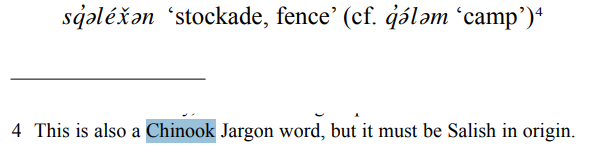
s[-]q̓əl[-]éx̣ən ‘stockade, fence’ (cf. [the Musqueam word] qə́l[-]əm ‘camp’)4
4 This is also a Chinook Jargon word, but it must be Salish in origin.
To be exact here, in CJ we never seem to find this word with the Salish noun-marking prefix s- on it. Wayne’s analysis matches my own etymology of CJ’s q’əlax̣ ~ q’əláx̣ən ‘fence’ as coming from a SW WA Salish root q’əl ‘camp’ plus the suffix -áx̣(ən) ‘side’. As a Jargon word, this one is found really far and wide, all the way north up into Haida territories at the very minimum.
