1851, OR: earliest doggerel poem is a masterpiece of Chinuk Wawa
Previously…: a California criticism of Oregonians’ love of Chinook Jargon.
And now the reply in print: one of the very first known Chinuk Wawa doggerel poems! And it’s political 😁😂
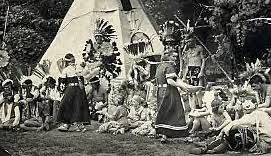
Song of Hiawatha pageant (image credit: Elgin Postcards)
Coming a decade before that genre became common, this poem was so early that it was written before any bestselling “Chinook Jargon dictionaries” started to standardize the spellings of the language.
And, an extreme rarity — this is entirely in Central-Dialect Jargon!* (Aside from the odd word of Spanish, masterfully deployed to mess with the Californians.)
* Central Dialect (Fort Vancouver style), because it’s from before the Southern or Northern Dialects came into being in the mid-to-late 1850s.
And yet it rhymes!! By Settlers’ English-language-oriented standards anyway. (As I understand the available data, Pacific NW Indigenous languages had nothing quite like that going on.)
It maintains a poetic meter, the popular “Song of Hiawatha“-style trochaic tetrameter…but 4 years before that poem was published.
A masterpiece, in Chinook doggerel world.
I’ll supply a suggested English translation. I was surprised how few difficulties came up in creating it for you.
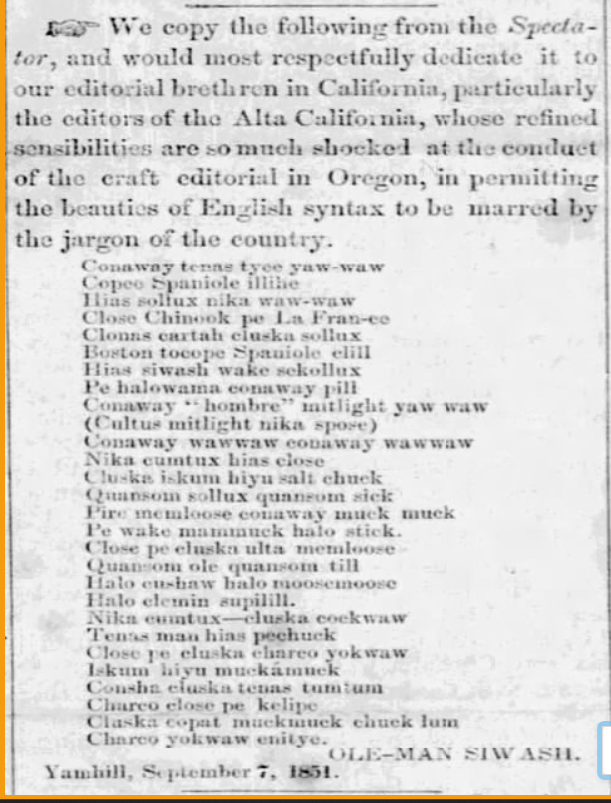
☞ We copy the following from the Specta-
tor, and would most respectfully dedicate it to
our editorial brethren in California, particularly
the editors of the Alta California, whose refined
sensibilities are so much shocked at the conduct
of the craft editorial in Oregon, in permitting
the beauties of English syntax to be marred by
the jargon of the country.Conaway tenas tyee yaw-waw
kʰánawi tənəs-táyí wáwa
‘All the little chiefs are talking’Copee Spaniole illihe
kʰapa spáyol-ílihey*
‘In Mexico’ (poking fun at California)Hias sollux nika waw-waw
hayas-sáliks nayka wáwa
‘Very grumpy I say that’Close Chinook pe La Fran-ce
ɬúsh chinúk pi làfranséy*
‘Chinook and French are good things.’Clonas cartah cluska sollux (looks like the typical Grand Ronde-area pronunciation ɬə́skə)
t’ɬúnas-qʰáta ɬaska sáliks
‘Gosh knows why they’re mad’Boston tocope Spaniole clill
bástən tk’úp(,) spáyol ɬíʔil
‘Americans are White, Mexicans are dark,’ (racialized taunt?)Hias siwash wake sekollux
háyás(h) sáwásh wík sik’áluks
‘The big Natives wear no pants’Pe halowama conaway pill
pi x̣lúyma kʰánawi píl
‘And the rest: all red’Conaway “hombre” mitlight yaw waw
kʰánawi ómbre* míɬayt yáwá
‘Every hombre that’s there’(Cultus mitlight nika spose)
(kʰə́ltəs míɬayt(,) nayka spos*) (is the writer using the Settler-style spos as a verb ‘to suppose’?)
‘(Just sitting around, I suppose*)’ (calling them lazy)Conaway wawwaw conaway wawwaw
kʰánawi wáwa(,) kʰánawi wáwa
‘All (just) talking, all (just) talking’Nika cumtux hias close
nayka kə́mtəks hayas-ɬúsh
‘I understand it’d be better’Cluska iskum hiyu salt chuck
ɬaska ískam háyú sáltsəqw
‘For them to take a good dose of saltwater’Quansom sollux quansom sick
kwánsəm sáliks(,) kwánsəm sík
‘Always fighting, always sick’Pire memloose conaway muck muck
páya míməlus kʰánawi mə́kʰmək
‘Fire killed* all the food’Pe wake mammuck halo stick.
pi wík mámuk hílu stík.
‘But didn’t use up the wood.’Close pe cluska ulta memloose
ɬúsh pi ɬaska álta míməlus
‘It’s good that they’re dying now’Quansom ole quansom till
kwánsəm úl(,) kwánsəm tʰíl
‘Always old, always tired’Halo cushaw halo moosemoose
hílu kúshu(,) hílu músmus
‘No pigs, no cows’Halo clemin supilill.
hílu t’ɬímin saplíl*.
‘No flour.’Nika cumtux — cluska cockwaw
nayka kə́mtəks — ɬaska kákwa
‘I understand — they’re like’Tenas man hias pechuck
tənəs-mán hayas-pchə́x̣*
‘Boys, really “green” ‘ (US slang for ‘inexperienced; unskilled; clueless’)Close pe cluska charco yokwaw
ɬúsh pi ɬaska cháku yákwá
‘Let* them come here’Iskum hiyu muckamuck
ískam háyú mə́kʰmək
‘To get lots of food’Consha cluska tenas tumtum
qʰə́nchey* ɬaska tə́nəs* tə́mtəm
‘When their little* hearts*’Charco close pe kelipe
cháku ɬúsh pi k’ílapay
‘Get better and come back’Cluska copat muckmuck chuck lum
ɬaska kʰəpít mə́kʰmək chə́qw-lám
‘They’ll stop drinking watery booze’Charco yokwaw enitye.
cháku yákwá ínatay.
‘(And) come over to here.’OLE-MAN SIWASH.
úl-mán sáwásh.
‘NATIVE ELDER.’Yamhill, September 7, 1851.
— from the less-than-1-year-old Portland (Oregon Territory) Weekly Oregonian of September 20, 1851, page 2, column 4

An unbelievably “cool” find. I like this poem very much indeed. I now want to copy and memorize the whole thing. It would also make great reading and teaching material for maybe a 90-minute class on Chinook Jargon.
LikeLiked by 1 person
Agreed!
LikeLike