Lempfrit’s legendary, long-lost legacy (Part 27A, Confiteor, with copying mistakes and an early “silent AND”)
Yes, more good stuff for us to learn from. Here we have some very Catholic stuff.
Page 1 of the 27th pair of pages (mis-numbered as “26” on the original page) from this precious document again brings us plenty of stuff worth knowing about Chinook Jargon — this time moving from lists of words into texts.
(Here’s a link to the other posts in this mini-series.)
“[SIC]” shows that someone mis-wrote a word. It wasn’t necessarily Lempfrit, since he was copying from someone else’s manuscript, Modeste Demers’ now-lost original to be exact.
For today’s installment, Alphonse Pinart’s “Anonymous 1849” copy (read it for free online) lacks any pages that correspond to what we’re seeing from Lempfrit.
Where you see [le]tters in square brackets, they’re not visible on the page copy that I’m working from, but we infer that they really are there!
By the way, the notation ___ means that the preceding entry is repeated in that position, along with some additional word(s).
See if you recognize words in these unusual spellings! I think we have a couple more small discoveries today, again showing the value of examining every Chinuk Wawa document — even those that appear to be straight copies of each other!
Beginning with today’s textual materials, we have the rewarding experience of seeing how a French-speaker (in the pre-Anthropology era, no less) conceptualized the word-to-word flow of spoken Jargon. Lempfrit’s “glosses” of each Chinook Jargon word might be pretty different from how you think of each word’s meaning!
The Chinuk Wawa below is what I’ve now come to call the Central Dialect. That’s the oldest variety of the language, the early-creolized Jargon associated with Fort Astoria and Fort Vancouver. The document we’re looking at here was created before the Northern or Southern dialects (associated with British Columbia and with Oregon’s Grand Ronde Reservation, respectively) even existed.
Today’s reading begins with the “Confiteor” prayer, said at communion. As usual, I advise you not to talk Chinuk Wawa like the following! It’s not normal Jargon. The wording of this prayer is creative, but not excellent. (All the more odd to find, since this prayer is copied from the version of the knowledgeable Fathers Blanchet and Demers!)
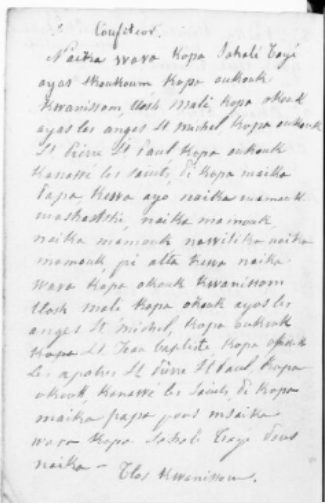
Confiteor.
(“I Confess” in Latin)
Naika wawa kopa Sahalé Tayé
[modern Grand Ronde spellings:] nayka wáwa kʰapa sáxali-táyí(,)
[meanings of words:] I say to sky-chief ,
[accurate English translation of this:] ‘I say to God,’ayas skoukoum kopa oukouk
hayas-skúkum kʰapa úkuk
very-powerful(,) to that
‘who is very powerful, (and) to that’Kwanissom tlosh mali kopa okouk
kwánsəm ɬúsh malí*(,) kʰapa úkuk
always good Mary, to that
‘always good Mary, (and) to that’ayas les anges St Michel kopa oukouk
háyásh lesásh sá* mishél*(,) kʰapa úkuk
great angel saint Michael, to that
‘great angel Saint Michael, (and) to those’St Pierre St Paul kopa oukouk
sá* piyél* sá* pól*(,) kʰapa úkuk
saint Peter saint Paul, to that
‘Saints Peter (and) Saint Paul, (and) to that’Kanawé les saint, pi kopa maika
kʰánawi lesá*, pi kʰapa maika(,)
all angel, and to you,
‘angels all of them, and to you,’Papa kewa ayo naika mamouk
pápa(,) qíwa háyú nayka mámuk
father, because much I do
‘father, because I’ve done many’mashastshi, naika mamouk,
másháchi, nayka mámuk [Ø],
bad.thing, I do it,
‘bad things; I did them;’naika mamouk nawitika naika
nayka mámuk [Ø](,) nawítka nayka
I do it, truly I
‘I did them, it’s true I’mamouk pi alta kewa [SIC] naika —— {Lempfrit mis-copied “kakwa” (‘because of this’) —-
mámuk [Ø](,) pi álta qíwa nayka
do it, and now because I
‘did them, and now therefore* I’wava kopa okouk kwanissom
wáwa kʰapa úkuk kwánsəm
say to that always
‘say to that always’tlosh Mali kopa okouk ayas les
ɬúsh malí*(,) kʰapa úkuk háyásh lesásh*
good Mary, to that many angel
‘good Mary, (and) to that great angel’anges St Michel, kopa oukouk
sá* mishél, kʰapa úkuk [SIC]
Saint Michael, to that(,)
‘Saint Michael, (and) to that one,’kopa St Jean baptiste kopa okouk —– {there’s an extra kopa here by Lempfrit’s mistake}
kʰapa sá* shá* batíst*(,) kʰapa úkuk
to Saint John baptist, to that
‘to Saint John the Baptist, (and) to those’Les apotres St Pierre St Paul, kopa
lesapót* sá* piyél* sá* pól*, kʰapa
apostle Saint Pierre Saint Paul, to
‘apostles Saint Peter (and) Saint Paul, (and) to’okouk, konawé les Saints, pi kopa
úkuk kʰánawi lesá*, pi kʰapa
that all saint, and to
‘those saints all of them, and to’maika papa pous msaika
mayka(,) pápa(,) pus msayka
you, father, so.that you.folks
‘you, father, so that (all of) you’wava kopa Sahale Tayé pous
wáwa kʰapa sáx̣ali-táyí pus
talk to sky-chief for
‘talk to God for’naika — Tlos kwanissom. —- {Lempfrit failed to copy the last word, kakwa = ‘like that’}
nayka — ɬúsh kwánsəm.
me — good always.
‘me — may it always (be so).’
One note of interest: All the way back to the Demers-Blanchet original, we find the same “leaving out” of pi (‘and’) that you see above. This suggests that the same “silent AND”, which I’ve long pointed out in the Northern Dialect, goes back quite early in Chinook Jargon’s development!
We can compare the above with the current Catholic Church version in English:
I confess to almighty God
and to you, my brothers [and sisters],
that I have greatly sinned,
in my thoughts and in my words,
in what I have done and in what I have failed to do,
through my fault, through my fault,
through my most grievous fault;
therefore I ask blessed Mary ever-Virgin,
all the Angels and Saints,
and you, my brothers [and sisters],
to pray for me to the Lord our God.
