Why are ‘grandmothers’ Salish? Some musings
‘Grandmother’ in Chinook Jargon (chích), and its relatives in both Lower Chinookan and Lower Chehalis, may all come from Salish — even though Chinookan is considered unrelated to Salish.
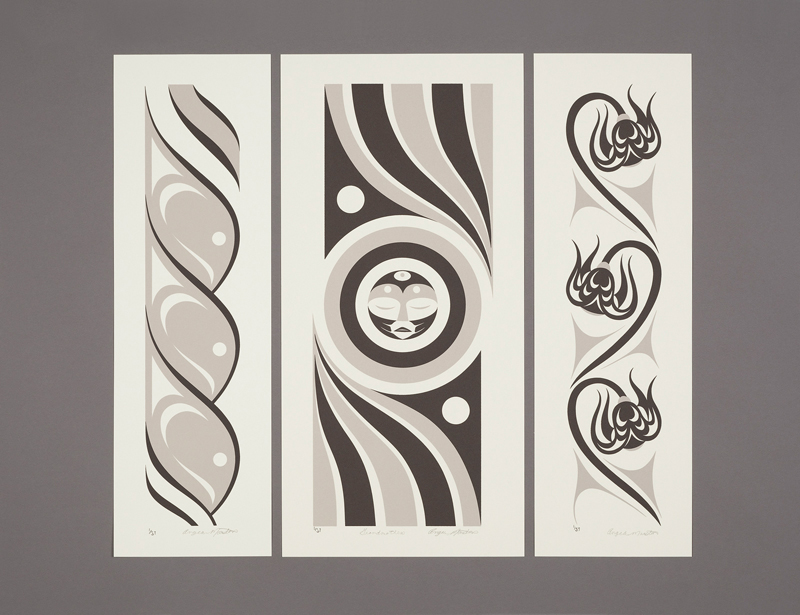
“Grandmother” (Salish weave), by Angela Marston (image credit: Salish Weave)
As I’ve shown dozens of times, there’s a strong pattern of ancient intimate contact between Salish and Chinookan languages at the birthplace of Chinuk Wawa.
It’s virtually always detectible as a one-way direction of word loaning, from Lower Chehalis (Salish) into Lower Chinookan. (You’ll find extremely few Chinookan-sourced words in any of the SW Washington Salish languages, by contrast.)
This is one of the two main reasons why we find so many Salish-looking words in Chinook Jargon: Lower Chinookan took in many, many Salish words long ago due to the speakers long living side-by-side with Lower Chehalis speakers, who were their relatives. That’s the explanation for words like Chinuk Wawa’s t’ɬəmínxwət ‘a lie’, for instance…really!
The other reason for lots of the Salish words in Jargon is that plenty of them came straight from Lower Chehalis speakers in modern times, as Chinook Jargon took form, starting…where?…at the bilingual town known as Chinook Village on the lower Columbia River.
Anyways, I should let you know the ancient, original Salish form of ‘grandmother’. The root is reconstructed as *kay.
And it’s a form like this that got “reduplicated” in Lower Chehalis (but not its sister languages in SW Washington), into something like *kə́y-k / *kí-k. (Nuxalk, way up on the British Columbia coast, has the same thing.)
This, perhaps a Diminutive and/or affectionate formation, is the shape that may have been borrowed into Lower Chinookan long ago; most of the time, we find it in the shape –k̓ək̓i- in that language. Chinookan languages do indeed often mutate between /k/ and /k̓/.
Now, however, I should disclose that all of the Chinookan languages, even far away from Lower Chehalis, way up the Columbia in Kiksht-Wasco-Wishram territory, have similar root forms for ‘grandmother’, but with a twist.
From Lower Chinookan’s neighbor Kathlamet on upstream, we find TWO similar root shapes, in fact: approximately –k̓əš– ‘paternal grandmother’ and –škəx– ‘maternal grandmother’, to judge from the information we have in Kiksht. This complicates the picture a bit! But in fact, both of these shapes are also best explained as ancient Salish loans.
A number of Salish languages (not Lower Chehalis but especially Interior Salish, nearer to Kiksht geographically and known to have been in contact with it long ago) have, in my analysis, developed Proto-Salish *kay into an alternate pronunciation of the reduplication. Aert Kuipers’ “Salish Etymological Dictionary” lists as a supposedly separate root the Proto-Salish root *kix ‘mother, elder sister’, showing up almost exclusively in the modern Interior Salish branch.
Would you agree that there’s a compelling semantic similarity between ‘grandmother’, ‘mother’, and ‘elder sister’? Such as: ‘senior female relative’? I notice Aert Kuipers himself analyzed a generic senior male kin meaning for the Proto-Salish *kʷup…and various Proto-Salish kin terms developed into an equally wide range of meanings…so…
That’s why I hypothesize that Kuipers’ *kix may be analyzable as *kəy-x, from a reduplication similar to what I spoke of above: *kay-k. From the standpoint of a trained historical linguist, modern Interior Salish languages’ /x/ could plausibly have developed from an earlier Salish */k/. That’s a species of sound change that has occurred independently around the world, for example as the famous “Grimm’s Law” in the Germanic branch of the Indo-European family.
A further development of (Interior) Salish *kix into the two forms we find in upriver Chinookan languages is also explainable in terms that are internal to Salish:
-
- A historical change of a */x/ to /š/, as I’m implying for Chinookan –k̓əš– ‘paternal grandmother’, is normal in a majority of Salish languages. (And notably not in Chinookan languages.)
- And the extra /š/ on the start of Chinookan –škəx– ‘maternal grandmother’ sure looks like pan-Salish s- ‘Noun’. (“S” sounds routinely alternate with “sh” sounds within the Chinookan languages.)
This upriver Chinookan pair of Salish-sourced paternal/maternal grandmother roots is similar to, but different from, what’s in Lower Chinookan itself, where:
-
- According to Franz Boas, in Lower Chinookan the root I represent as the specifically Lower Chehalis-sourced –k̓ək̓i- means ‘father’s mother‘ (paternal grandmother); again, upriver Chinookan has –k̓əš– for that meaning.
- Just like its upriver relatives, Lower Chinookan uses a not-necessarily-Lower-Chehalis-but-still-Salish root for maternal grandmother: –ška–; compare the upriver Chinookan –škəx–. Interestingly, for Lower Chinookan alone, there’s also the possibility of old Lower Chehalis Salish input into this term; compare modern Lower Chehalis kə́h ‘mother’, with its final /h/ which is highly anomalous for Salish and which may imply that Lower Chinookan’s form was earlier identical with the upriver form –škəx–!
In a recent era, in Lower Chehalis itself, the “k” sounds developed into “ch” sounds, giving us Chinook Jargon’s čə́č / číč. (Also čúp for ‘grandfather’, from Proto-Salish *kʷup.)
Bonus fact:
The 2012 Grand Ronde dictionary of Chinuk Wawa comments on a 2-syllable variant of ‘grandmother’, chícha.
This is even more Salish.
In Salish languages including modern Lower Chehalis, a suffix -a or -aʔ (and somewhat different pronunciations in some sister languags) is used on nouns when you want to express an affectionate attitude toward that noun.
So we find čə́č-a as the affectionate term for one’s grandmother in Lower Chehalis, and that’s where the variant Chinook Jargon form comes from, too.
