Suttles, “Musqueam Reference Grammar”, Part 5
Naika wawa masi kopa Paisley pi Mokwst Alex, for reminding me of a great book by a great anthropological linguist!
Typically I’ll rake through a dictionary of a Pacific NW Indigenous language, and report to you here on the patterns of Chinook Jargon to be found there.

Image credit: Kaltash Wawa on Reddit.com/r/ChinookJargon
Wayne Suttles’ “Musqueam Reference Grammar“, however, isn’t a dictionary, and I don’t know of one that’s available to me for this particular variety of what some folks have called a single, wide-ranging “Halkomelem” Salish language.
So instead, I’ll snoop through the aforementioned grammar, and…
I’m going to give you a reaction video. 🤩
Just kidding, what I’m gonna do is write my reactions to everything Wayne said about Chinuk Wawa. He had more experience than any living linguist with the Jargon, for a good stretch of years. (Then he taught Henry Zenk, and wow, look what we’ve learned!)
• Page 204: I’ll show you all of what Wayne says about identifying a certain interesting pattern in the language, but all that I’ll transcribe are the Chinook Jargon-related words:
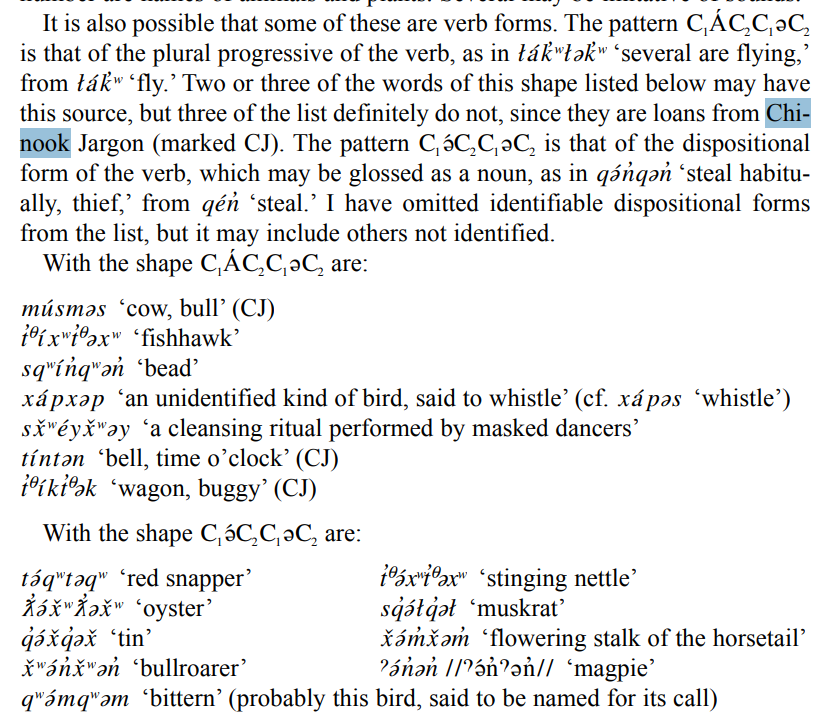
Wayne identifies these 3 nouns as coming from the Jargon, quite rightly:
- músməs ‘cow, bull’
- tíntən ‘bell, time o’clock’
- t̓θíkt̓θək ‘wagon, buggy’– this word is Chinook Jargon t’síkt’sik (not from the variant, more White-oriented pronunciation c’híkc’hik!), having subsequently gone through the historical Musqueam sound change where “ts” sounds became “tth” sounds.
We can also comment that ƛ̓ə́x̣ʷƛ̓əx̣ʷ is identical to a Jargon word for ‘oyster’ — althought it’s definitely native to Musqueam!
