Suttles, “Musqueam Reference Grammar”, Part 4
Naika wawa masi kopa Paisley pi Mokwst Alex, for reminding me of a great book by a great anthropological linguist!
Typically I’ll rake through a dictionary of a Pacific NW Indigenous language, and report to you here on the patterns of Chinook Jargon to be found there.
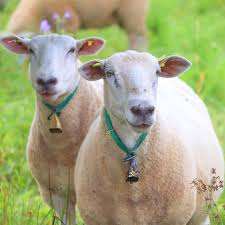
Image credit: New Life on a Homestead
Wayne Suttles’ “Musqueam Reference Grammar“, however, isn’t a dictionary, and I don’t know of one that’s available to me for this particular variety of what some folks have called a single, wide-ranging “Halkomelem” Salish language.
So instead, I’ll snoop through the aforementioned grammar, and…
I’m going to give you a reaction video. 🤩
Just kidding, what I’m gonna do is write my reactions to everything Wayne said about Chinuk Wawa. He had more experience than any living linguist with the Jargon, for a good stretch of years. (Then he taught Henry Zenk, and wow, look what we’ve learned!)
• Page 83:
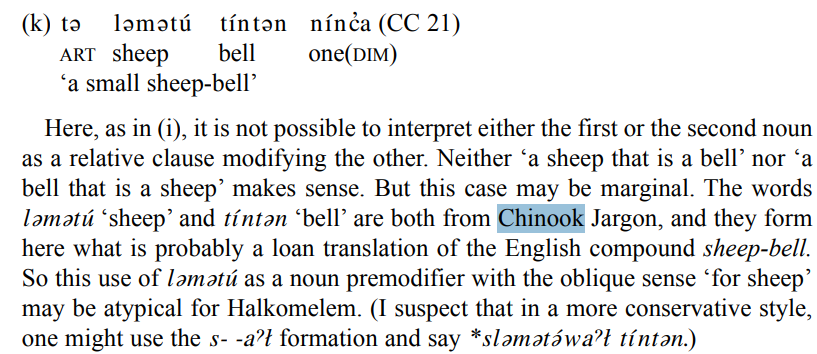
(k) tə ləmətú tíntən nínc̓a (CC 21)
ART sheep bell one(DIM)
‘a small sheep-bell’Here, as in (i), [within the grammar of Musqueam] it is not possible to interpret either the first or the second noun as a relative clause modifying the other. Neither ‘a sheep that is a bell’ nor ‘a bell that is a sheep’ makes sense. But this case may be marginal. The words ləmətú ‘sheep’ and tíntən ‘bell’ are both from Chinook Jargon, and they form here what is probably a loan translation of the English compound sheep-bell. So this use of ləmətú as a noun premodifier with the oblique sense ‘for sheep’ may be atypical for Halkomelem. (I suspect that in a more conservative style, one might use the s- -aʔł formation and say *sləmətə́waʔł tíntən.)
Yessir! Wayne is exactly on the money here.
It’s just that he doesn’t go the one additional step, to explicitly tell you that ləmətú tíntən is a perfectly formed Noun+Noun compound, according to the rules of Northern Chinook Jargon grammar!
So it’s likely a phrase that got borrowed intact into Musqueam.
And, therefore, it would be a new discovery for us within Chinook Jargon!
