“The Survey of Vancouver English”: Part 4, oolichan
Our final installment in this series looks at a really interesting Pacific NW coast word; do you know it?
This comes from “The Survey of Vancouver English“, which is subtitled, “A Sociolinguistic Study of Urban Canadian English”.
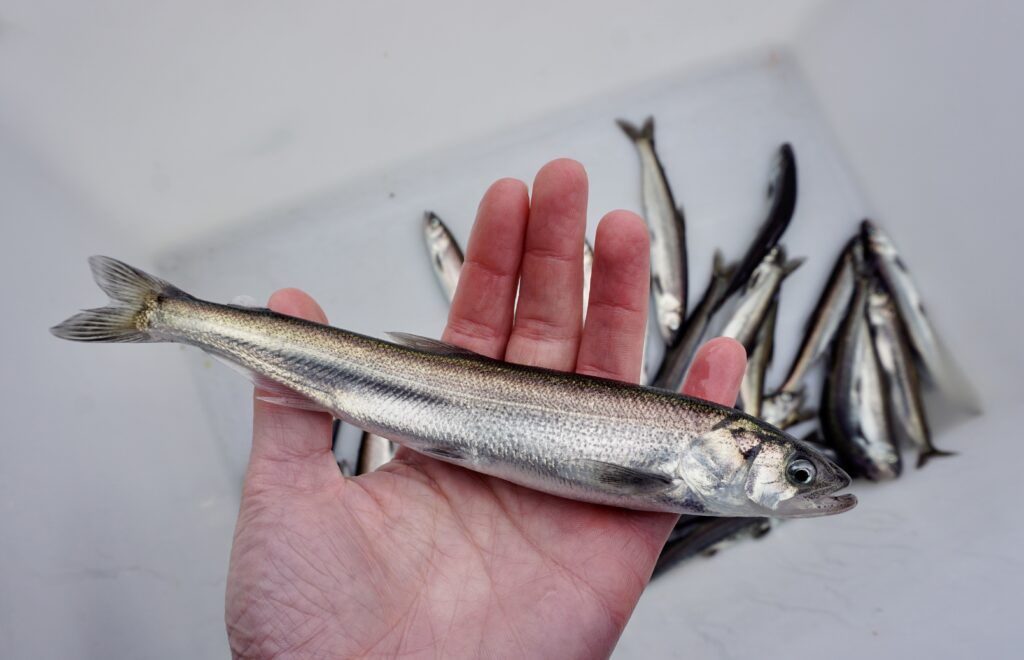
Salt-packed hooligan from Haines, Alaska (image credit: Edible Alaska)
It was published in 2004 by RJ Gregg et al. by Queen’s University in Kingston, ON, Canada. (Strathy Language Unit Occasional Papers number 5.)
(Click for all installments in this mini-series.)

4.1.5 OOLICHAN
Oolichan is derived from Chinook Jargon ûlakân “a small fish”; the technical name is Thaleichthys pacificus. Oolichan was known to 82% of our informants — to 85% of the men and 78% of the women; it was not known to 26% of the young males and to 44% of the young females. Of the men, 87% had heard the word and 72% had used it. Among the women 81% had heard it but only 58% had used it.
Most of the men said it meant “a small fish” (54%); others said “an oily or greasy fish” (19%); “a smelt” (11%). Similarly 58% of the women said it was “a small fish;” 10% said “an oily or greasy fish,” and 5% said “a smelt.” Under the heading of additional information, 13% of the men and 6% of the women gave another local synonym for oolichan, namely candlefish.
For this word we investigated the pronunciation and actually found some unexpected variables. Overall the preferred form was /’uləkən/ (55%) with strong stress on the first syllable, the second and third being weakly stressed so that the vowels (written as [ə]) have the neutral quality of the u in circus. In second place was the form /’uləgən/ (25%), in which the original /k/ sound was replaced by a /g/ sound, and some 6% fluctuated between these two pronunciations. The form /’ulιgən/ (7%) came in third place. Spelling pronunciations cropped up in a few cases: /’ulətʃən/ with /tʃ/ instead of the /k/ sound, and /jùləkən/ which reflects the less common alternate spelling eulachon. An initial aspirate /h/ was added to some of these forms by 4% of our speakers.
The male and female groups were in substantial agreement with the general preferences in pronunciation, although there were some minor fluctuations:
1. /ùləkən/ — men: 58%; women: 52%
2. /ùlagən/ — men: 23%; women: 27%
3. /ùlιgən/ — men: 7%; women: 7%Of the women, 5% prefixed the aspirate /h/, but only 3% of the men did so.
Once again, this is a word more familiar and more used among the men than the women and less so among the young speakers, especially the females. As for additional information, 196 (82%) provided none, but one said the term oolichan juice referred to the oil derived from the fish, and one knew that local Indians used oolichan oil in their lamps; six (3%) said these fish were caught by Indians and used as a source of oil as well, of course, as for eating; one said they were eaten raw or smoked; five were aware that the fish and its name had some connection with the Indians; one said 71 the word was known up the B.C. coast; three said the expression oolichan run referred to the seasonal appearance of the fish; three commented that some people confuse the word oolichan with hooligan, this confusion being reflected in the pronunciation (which we encountered and recorded) with initial /h-/.
In my experience, those who know this word on the coast are likely to say “hooligan”.
