1914: LBDB’s “Chinook-English Songs”, part 8 of 15 “Chaco Mitlite Sapolill” (Comin’ Thro’ the Rye)
Sure, Laura Belle Downey-Bartlett (1851?-1933) was a genuine pioneer (“of 1853” as they’d say) Settler kid.
She grew up around Chinuk Wawa, no doubt of that, starting at a time when there was still just the original Central dialect.

Image credit: Wikipedia
But land sake’s alive, all of her songs are awful translations from English.
(A link to all installments in this mini-series.)
From this point on in our series on her songs, I’ll no longer show such deep analysis of them. I’ll just say:
- LBDB’s bad Chinuk Wawa is definitely more Central- and Southern-dialect than Northern.
- “DON’T TALK LIKE L.B.D.B., FOR PETE’S SAKE!” She doesn’t make much sense.
- Don’t sing like L.B.D.B., because even if the following lyrics made much sense, they wouldn’t fit the tune very well…I’m shuddering.
Today I’ll examine pages 26 & 27 of LBDB’s book, “Chinook-English Songs” (Portland, OR: Kubli-Miller, 1914): this is song #8, “Chaco Mitlite Sapolill”:
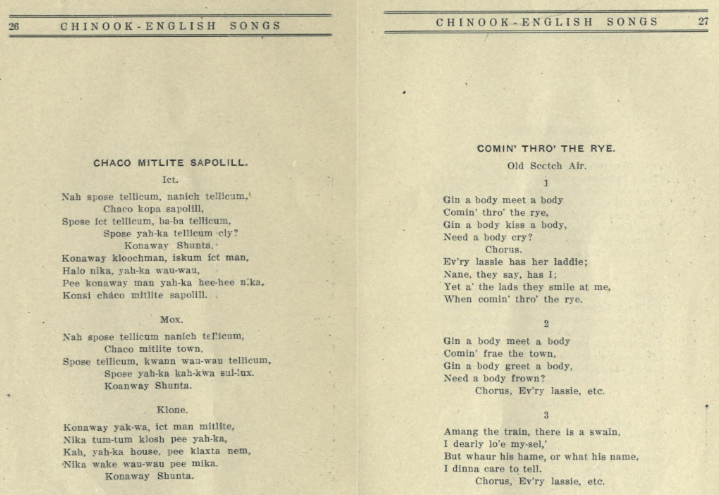
CHACO MITLITE SAPOLILL. ‘Come, there’s wheat.’
Ict. ‘One.’
Nah spose tellicum, nanich telllicum, ‘Hey, if a person sees a person,’
Chaco kopa sapolill, ‘Come to the wheat,’
Spose ict tellicum, ba-ba tellicum, ‘If a person kisses a person,’
Spose yah-ka tellicum cly? ‘So her/his person cries?’Konaway Shunta. ‘All Sing.’
Konaway kloochman, iskum ict man, ‘Every woman marries a man,’
Halo nika, yah-ka wau-wau, ‘Not I, she says,’
Pee konaway man yah-ka hee-hee nika, ‘And every man laughs at me,’
Konsi chaco mitlite sapolill. ‘When coming, there’s wheat.’Mox. ‘Two.’
Nah spose tellicum nanich tellicum, ‘Hey, if a person sees a person,’
Chaco mitlite town, ‘Come to be in town,’
Spose tellicum, kwann wau-wau tellicum, ‘If a person talks gladly to a person,’
Spose yah-ka kah-kwa sul-lux. ‘If she’s sort of mad.’Koanway [SIC] Shunta. ‘All Sing.’
Klone. ‘Third.’
Konaway yak-wa, ict man mitlite, ‘Everyone here, there’s one man,’
Nika tum-tum klosh pee yah-ka, ‘I think it’s all right and he,’
Kah, yah-ka house, pee klaxta nem, ‘Where is his house and what’s the name,’
Nika wake wau-wau pee mika. ‘I’m silent and (so are?) you.’Konaway Shunta. ‘All Sing.’
Compare that with famous poet Robert Burns’s Scots (sorta English-language) original lyrics of a very popular song of the era:
Old Scotch Air.
1
Gin a body meet a body
Comin’ thro’ the rye,
Gin a body kiss a body,
Need a body cry?Chorus.
Ev’ry lassie has her laddie;
Nane, they say, has I;
Yet a’ the lads they smile at me,
When comin’ thro’ the rye.2
Gin a body meet a body
Comin’ frae the town,
Gin a body greet a body,
Need a body frown?Chorus, Ev’ry lassie, etc.
3
Amang the train, there is a swaln,
I dearly lo’e my-sel,’
But whaur his hame, or what his name,
I dinna care to tell.Chorus, Ev’ry lassie, etc.
For extra fun, you can go to the Wikipedia article on this song, which reveals that it was originally quite filthy!
