1885, Nesbit: “Tide Marshes of the United States”
The title (no pun intended) page of David Montgomery Nesbit’s “Tide Marshes of the United States” (Washington, DC: Government Printing Office, 1885) mentions our Chinook-speaking friend Eldridge Morse!

The Stillaguamish River (image credit: Western Rivers Conservancy)
Morse’s statements are acknowledged as the basis of Chapter VIII, “Tide Lands of Washington Territory”. Page 67 of it says the following almost entirely true information, probably garbled by whoever was taking it down from Mr. Morse:
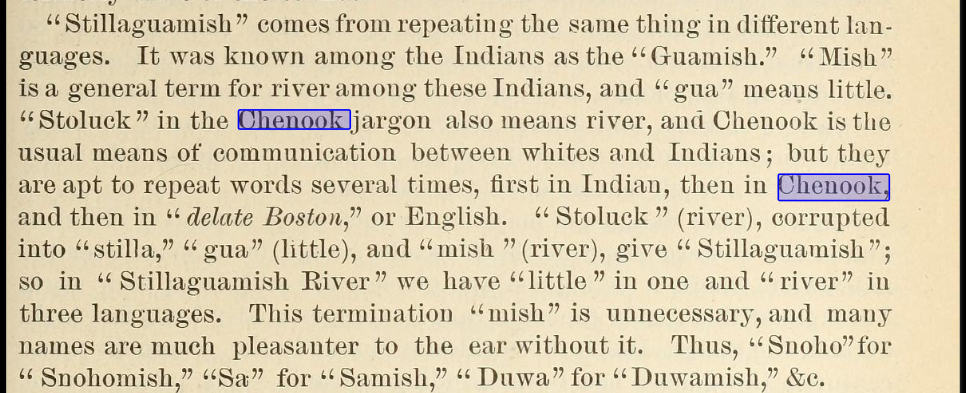
“Stillaguamish” comes from repeating the same thing in different languages. It was known among the Indians as the “Guamish.” “Mish” is a general term for river among these Indians, and “gua” means little. “Stoluck” in the Chenook jargon also means river, and Chenook is the usual means of communication between whites and Indians; but they are apt to repeat words several times, first in Indian, then in Chenook, and then in “delate Boston,” or English. “Stoluck” (river), corrupted into “stilla,” “gua” (little), and “mish “(river), give “Stillaguamish“; so in “Stillaguamish River” we have “little ” in one and “river” in three languages. This termination “mish” is unnecessary, and many names are much pleasanter to the ear without it. Thus, [the fictitious names!] “Snoho“for “Snohomish,” “Sa” for “Samish,” “Duwa” for “Duwamish,” &c.
Actually Stillaguamish is pure Lushootseed, that is Dxʷləšucid Salish. Beyond that:
- No, I don’t think this supposed name Guamish existed among speakers of it or of any other language.
- Yes, –Mish is indeed that language’s suffix for ‘river’.
- No, the supposed gua didn’t have any existence, as far as I’ve found in my research.
- Yes, Stoluck is an accurate representation of that language’s word for ‘river’ — no, it’s not Chinook Jargon, although it’s a close relative of the BC CJ stalo for ‘river’.
I think Morse was trying to express to the writer the fact, already shown numerous times in my blog, that much intercultural contact on Puget Sound in the Settlement era was a blend of Chinuk Wawa, Lushootseed, and English.
I’ll reproduce just one more section from the chapter, occurring on pages 77-78:

…Chenook Village, the headquarters of the Chenook Indian tribe, now a small remnant, stood near the east shore. The Chenook jargon is the language of this tribe, with French, Spanish, English, Chinese, and other words and phrases added. These are often corrupted in pronunciation and meaning, but through the influence of the old Hudson Bay Company, and the necessity for a common language, this medley has been familiarized by use, and is now the usual means of communication between whites and Indians, as well as between Indians of different tribes, throughout the Pacific coast region north of California.
That’s also essentially true, except that any Spanish component in Chinuk Wawa is more or less negligible, and that, despite the large number of ethnic Chinese speakers of CW, we have not found any Chinese words integrated into it.
