Any CJ in Hupa?: The southern boundary of Jargon use
Is there even a single trace of Chinuk Wawa in northwest California’s Hupa language?
We’re talking about a Pacific Coast Athabaskan language that’s closely related to its northern neighbor Taa-laa-wa Dee-ni’ (Tolowa).
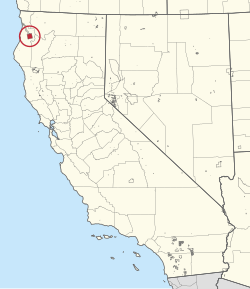
Hupa land is in the circle (image credit: Wikipedia)
(The latter being a language of the Siletz reservation in Oregon not too far from Grand Ronde. Note, Hupa calls them dilwa:sh, literally a diminutive form of ‘they babble’!)
The usual suspects for NW California languages to have borrowed from Chinook Jargon have purely Hupa creations to express e.g. ‘money’, ‘cow’, ‘horse’, ‘bread’, ‘Chinese’, and ‘Black person’, when I consult the Hupa Online Dictionary and Texts.
About those purely Hupa formations: I LOVE that this dictionary explains the literal meaning of each word!
Anyhow, using the “browse by topics” feature helps…although even under the “Modern” topic, there’s scant in the way of borrowed words.
That way, but only with some effort, I do find:
- da:la ‘money’ (which the dictionary attributes to English, not to the Jargon)
- ka:n ‘corn’
- ka:whe ‘coffee’
- bo:se ‘cat’
- jikin ‘chicken’
- whilba ‘wheelbarrow’
Such an assortment suggests English as the source of these loans, rather than Chinuk Wawa.
So I’ll say there’s no probable trace of CW in Hupa.
This helps us conclude that it’s only the Indigenous languages of north-central California, bordering on Oregon, that carry any indications of direct contact with the Jargon. That is, Modoc-Klamath and Shasta. (And not Northern Paiute, Karuk, or Tolowa, nor languages traditionally spoken south of the 5 I’ve just named.)
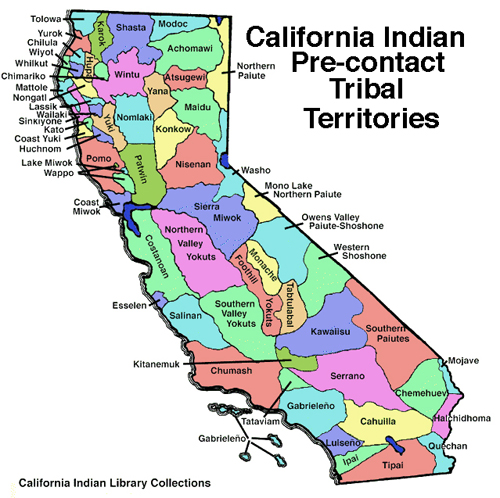
Image credit: NCIDC
Some tribal languages neighboring Modoc-Klamath & Shasta to the south (such as Achumawi) do show faint traces of having gotten a couple of Jargon words via those 2.
