1910, Nanimo, BC: Indian Shaker Church service
[Oops, I misspelled Nanaimo, sorry!] We can thank reader Alex Code for this neat item, too…
It’s a rare document of the Chinook Jargon as it was used in Indian Shaker Church services.
I’m only excerpting the larger article, but by all means go read it for an excellent telling of the cultural misunderstandings that happen in “first contact”.

[photograph:] OLD DICK OF NANAIMO.
… The manner in which the members of the congregation conducted themselves when they arrived interested me greatly. As each one entered the door at the right hand corner of the building, he — or she — turned himself around where he stood, and then, crossing himself with his left hand with lips murmuring a prayer, eyes half closed and downcast, he placed his right palm to the palm of the doorkeeper and lifted it above his head. Thus he continued his way, greeting all who had arrived before him — even including my friend and self — and making a complete circle of the room before going to his seat. As he passed the altar he turned two or three times and occasionally picked up a bell and rang it. The “service,” throughout which the congregation remained standing, was conducted in Chinook, by an Indian who, like every one else, had divested himself of his coat and hung it on a peg above his seat. He intoned everything and frequently repeated the words “Mahsie-Mahsie-Mahsie, Wawa Mahsie, Kloshe Nezika Mahsie Kopa Saghalie Tyee (Let us pray to God, etc. — Mahsie Kopa Saghalie Tyee — the Doxology.)
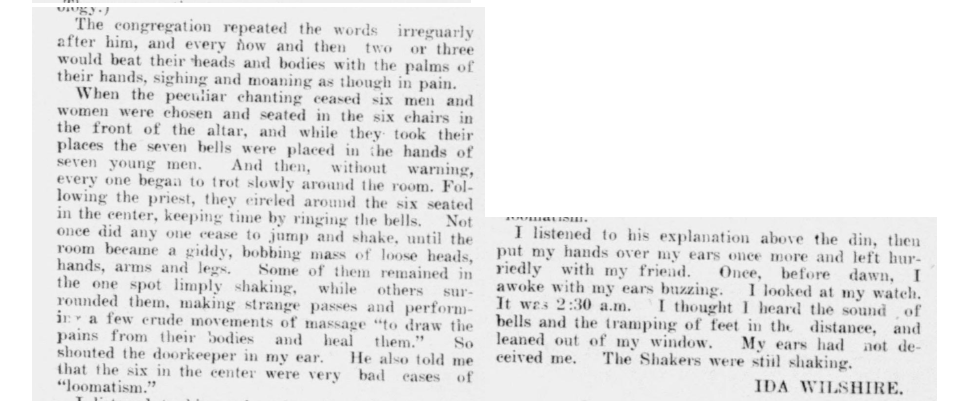
The congregation repeated the words irregu[l]arly after him, and every now and then two or three would beat their heads and bodies with the palms of their hands, sighing and moaning as though in pain. When the peculiar chanting ceased six men and women were chosen and seated in the six chairs in the front of the altar, and while they took their places the seven bells were placed in the hands of seven young men. And then, without warning, every one began to trot slowly around the room. Following the priest, they circled around the six seated in the center, keeping time by ringing the bells. Not once did any one cease to jump and shake, until the room became a giddy, bobbing mass of loose heads, hands, arms and legs. Some of them remained in the one spot limply shaking, while others surrounded them, making strange passes and performing a few crude movements of massage “to draw the pains from their bodies and heal them.” So shouted the doorkeeper in my ear. He also told me that the six in the center were very bad cases of “loomatism.” I listened to his explanation above the din, then put my hands over my ears once more and left hurriedly with my friend. Once, before dawn, I awoke with my ears buzzing. I looked at my watch. It was 2:30 a.m. I thought I heard the sound of bells and the tramping of feet in the distance, and leaned out of my window. My ears had not deceived me. The Shakers were stiil shaking. IDA WILSHIRE.
