CA: traces of Chinuk Wawa in Shasta
Shasta speakers were one of the Indigenous groups who wound up at Grand Ronde and Siletz Reservations in Oregon, thus participating in the re-creolization there of Chinuk Wawa.*
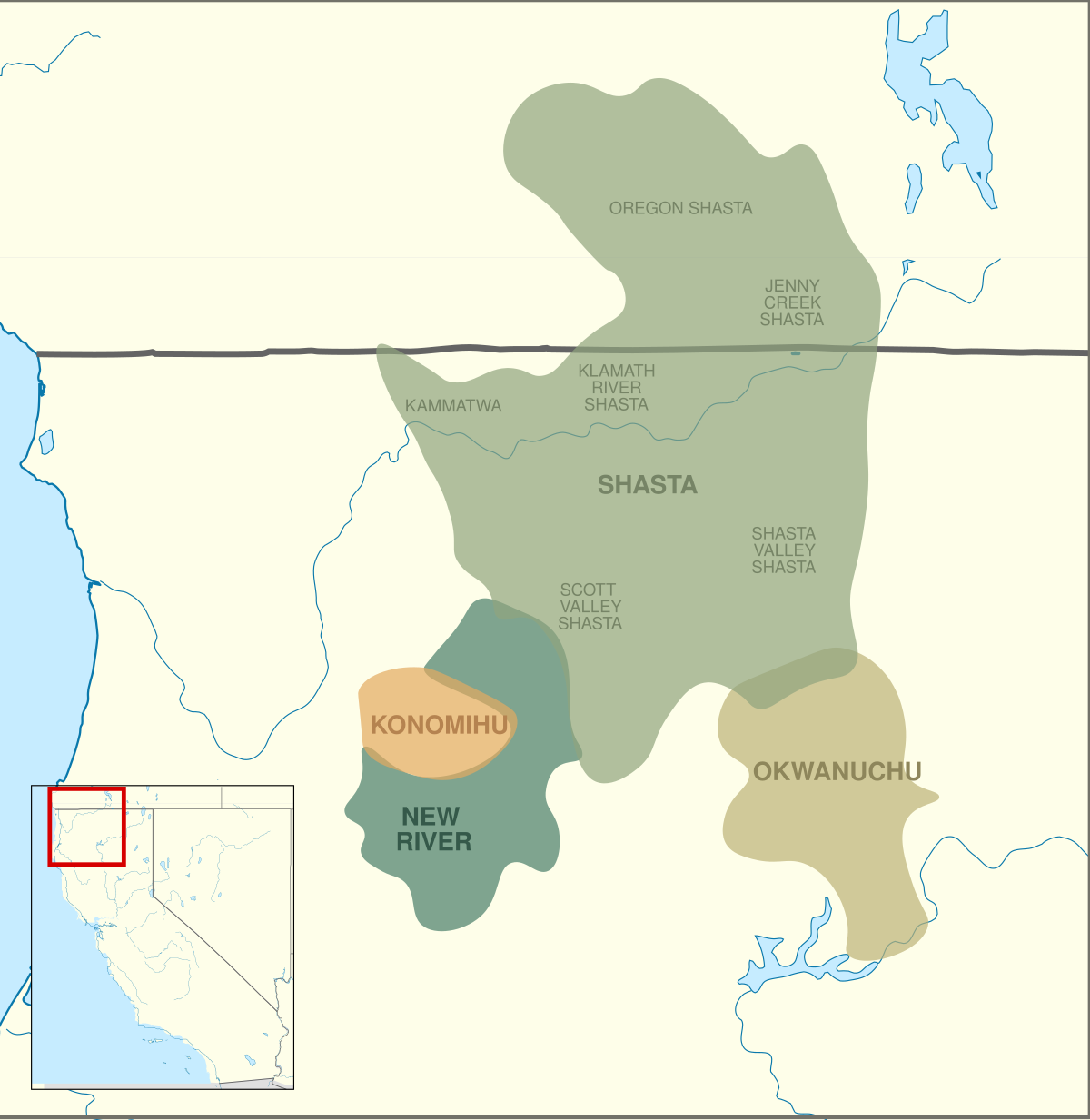
Where the languages of the Shastan family are traditionally spoken (image credit: Wikipedia)
In “A Shasta Vocabulary“, William Bright & D.L. Olmsted do a fine job of pointing out when acculturated concepts of White culture are expressed by repurposed Shasta words, e.g. ‘flour’ and ‘sugar’.
They also label most of the loan words, and very accurately, with the result that we’ve discovered where a previously mysterious Chinook Jargon word came from; see below.
Here’s a tally of the relatively few Jargon words we can dredge up in Shasta. These tribes were at the far south end of the regions where CJ was used, and could well have gotten these few words indirectly, from tribes who had more exposure to the Jargon, such as Klamaths and Modocs.
- sapirí ‘bread’, from CW saplel
- cani[-]ʔárapxa ‘Chinese woman’, where cani is from CW/English/Chinese Pidgin English cháyni; –ʔárapxa ‘woman’ is native to Shasta
- mú•smu•s ‘cow’, from CW músmus
- Note: the Shasta word for ‘horse’ is thought to come from a Klamath term meaning ‘horses of the Snake Indians’. (“Snake Indians” would mean Northern Paiutes, whose Yahooskin division settled among the Klamaths in Oregon. Earlier, the word had meant the Shoshone-Bannocks, who White folks heard of before they knew of Paiutes.) I’m always interested in figuring out how horse culture dispersed among Pacific NW tribes, and this is one nice clue.
- cíkiman ‘money’, from CW chíkʰəmin
- ʔáwkʷaci•k ‘money, Indian (beads)’: Bright & Olmsted valuably point out that this originated in the unrelated Yurok language. It may in fact be thanks to the Shastas who wound up at Grand Ronde that we got the word alíkʰuchik in Chinuk Wawa!
- nika[-]ʔárapxa• ‘Negro woman’ is from CW/English (the N-word), with the Shasta –ʔárapxa ‘woman’
- kúsa ‘pig’, from CW kúshu
- pá•stin ‘white man’, from CW bástən
Bonus facts:
The question of the source of the regional English (and probably Chinook Jargon) word “ipos/epos“, among other spellings of it, appears to be solved — evidently it’s a meaningful word within Shasta, and an English noun plural -s would then account for the rest:

ipos bulb (Calochortus sp.). ip’-haws, ip’-haw M; ípha Cu, ipha B397 ‘potato’, ipxəʔ DLO, / ʔipxaʔ SS
Also:
A possible clue towards understanding the offensive-sounding northeast Oregon “Bring out the wapsina!” is in the Shasta words wapsahós ‘bride (until first visit home)’ and wa•psáhuʔ ‘menstruating woman’. These use a different root form from generic ‘woman’ — compare ‘Chinese woman’ and ‘Negro woman’ above — to specify a female who is of fertile reproductive age. Maybe some oldtime Settlers picked up such a word in Shasta territory during the frontier era?
————————————————————-
(*) My understanding is that Shastas signed one or both of the 1853 Table Rock Treaties, and/or 1854 Treaty with the Chasta etc., and were designated there as “Chastas”, thus the modern Confederated Tribes of Grand Ronde usage. Note that “Shasta/Chasta” is not these folks’ word for themselves, and is of unknown etymology, says Shirley Silver 1978:223 in Volume 8 (California) of the Handbook of North American Indians.
I’ve double-checked this, due to the possible, in fact probable, confusion with the “Chasta Costa/Shasta Costa” Athabaskan folks from farther west in SW Oregon.
Both cultural groups, it seems to me, are included in the common Grande Ronde community term “Rogue Rivers“. The Rogue River region of Oregon is in fact traditionally a tribally diverse region…
I’m trying here, folks! Be clearly warned, there’s a good deal of confusion around the recorded names of various southern Oregon tribes, such as the now-mysterious “Scotons” who signed the 1854 Chasta treaty.
