1860: The Abridgement — Chenook jargon — cussin’ — and back-translation
I don’t know why a title “The Abridgement” comes up online for this 750-page item; it’s one of those US government compendiums of reports from the various “Indian agents” and land surveyors.
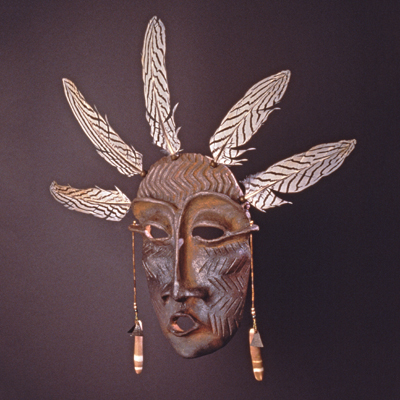
Kalama Stick Indian, 1988, by Lillian Pitt, Warm Springs (image credit: ARTSWA)
Published in 1858, this volume is packed with useful information from a really crucial time in Pacific Northwest history. There’s discussion of
- the need to follow through on the promises of the 1855 Stevens Treaties with Washington Territory tribes;
- the hope that a settlement will be reached to get the Hudsons Bay Company (and Puget Sound Agricultural Co.) to leave their properties in W.T.;
- the great opportunities W.T. had for supplying the vast numbers of prospectors in the “Frazer” (Fraser) River gold rush;
- the “school for the deaf, dumb, and blind” in Washington, DC;
and lots more.
It was linguistically an interesting time, in that the Settler population was sparse and dependent on Indigenous people — conditions ripe for the wide use of Chinuk Wawa (Chinook Jargon).
Page 575 shows report #80, from Bellingham Bay Agency’s E.C. Fitzhugh, Special Indian Agent. He notes among other things a new ferry on the Neuk-sack (Nooksack) River, causing great resentment among the Indigenous people through whose territories White gold seekers are traveling to reach the Fraser. Overt evidence of Chinook Jargon in use is in the form of the repeatedly used noun “pot-lach”, i.e. potlatch, in this case a giveaway of goods to Native leaders.
On pages 576-588, you’ll find #81 from Puget’s Sound District, by M[ichael] T. Simmons, Indian Agent. This report is so voluminous because it contains an extremely precious resource, lengthy quotations of Indigenous people’s sentiments (e.g. “Hiram, a Skokomish” and “Bonaparte, a Snohomish chief”) in English but clearly back-translatable to Chinook Jargon, a language Simmons used with great fluency. Those folks make clear their wish to retain hunting & fishing rights, etc. Explicit evidence of CJ includes the use of words such as “the Wood or Stick” Indians; “Custis Bostons” (i.e. kʰə́ltəs bástən-s); and this on page 581, reinforcing my constant claim that Chinuk Wawa knowledge and use of English cussin’ went hand in hand:
 “
““This governor (McMullen) told us if any bad white men worried
us to tell him, and that he would punish them. Whenever I tell the
bad white men this they say ‘God damn the old fool, he is ‘cultus,’
(an expressive Chenook word.)[“]
Various mentions are made of a perceived need to get the Native kids talking English (pages 579; 598-599; and so on).
Of background use are the discussions on pages 585-586 of (Lower!) Chehalis chiefs Te-la-ek (“lower or salt water” Chehalis) and Moottech (Grays Harbor). On page 602, the Lower Chehalis bands mentioned are the Wanootchie (Wynoochee) and Um-too-leaux (Humptulips).
I’ll leave off by repeating to you this volume, and the many others like it from the US government in that era, are treasures of deep information.
