WA: Ned Chambreau’s phenomenal 1876-1880 journals
Some great information from an eyewitness of the later frontier era of Washington is to be found in Ned (Edouard) Chambreau’s journals.
Chambreau was US Army General O[liver] O[tis] Howard‘s Chinuk Wawa interpreter.
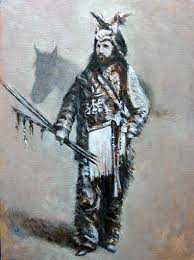
Edouard (Ned) Chambreau (born in France in 1821; to Montreal 1825; to Oregon Territory in 1847)
(image credit: Offbeat Oregon)
He was not literate in his native language, French! But he could write good English.
It’s clear from Chambreau’s notes that Chinook Jargon was already widely known in interior Washington Territory in the 1870s.
Here’s an index, but it appears the PDF pages aren’t numbered as the following would imply:

On the first page of Notebook One, Chambreau stays in an Indigenous man’s “wigwam”, where quite a few of his friends gather upon hearing a Settler is there; he has “a game of ecluckama with them”. (íɬukuma = ‘the bone-in-the-hand gambling game’, per the 2012 Grand Ronde Tribes dictionary of Chinuk Wawa.) This is in the area between Goldendale and “Yakima City”, south-central Washington Territory, in November to December of 1878.
“Homily told me his tum‐tum was very good towards the soldier Tyees” — PDF page 12, Wallula, WA, circa January 13th
“He was told the Bostons would kill him if he was let go, but replied that that was the least of his troubles.” — PDF page 16, February 19th, Yakima, WA
Wapato John is mentioned on PDF page 47.
Tenas George is noted on page 31 of the PDF.
“Does General Howard know we like him? I said he does. Well then tell him we don’t want him to kish kish (drive us away) us from our homes or let the Bostons take this land from us. We are glad you came to see us. We hear so many things it makes us foolish. I am done.” — PDF page 38
Page 40 of the PDF: “This man seems to be an excitable Dutchman.” (German)
“They tell the officers and the whites they are going to dig camas…” PDF page 47
John of Priest Rapids “said he had a closed tum tum (heart)” (page 48).
Chinese immigrants speak Chinook Jargon, as we already knew: “It is very amusing to hear Chinamen talk Indian. These Chinamen are very clever, and hospitable. Lord bless them.” — PDF page 34
Certain people, typically described as “an old settler” or “an old Indian”, speak French. — PDF pages 4, 5, 10, etc.
The Métis community of Frenchtown, WA is also referred to as simply “French”.
Page 41: the required qualifications of a US government employee such as Chambreau (he’s in fact asking for work for himself with this!) include “11. a good constitution of great endurance and hardship, not subject to sickness, water or diet, King George French, and no stranger among the Indians”, on PDF page 41. I’m not exactly sure how to take this: does it mean he should be a French Canadian, or that he should speak both English and French?
Page 51: the oldest man in the Spokan[e] tribe, Chil-appen-ansum, remarks that “the French” were the first non-Natives among them; they camped on the Little Spokane. (That’s where Spokane House fur-trading post was, at the north end of the modern city.)
I feel sure that there’s much more linguistic information and speeches needing to be back-translated to Chinook Jargon in these journals.
