1877, (Fort) Wrangell, AK: School in Chinook Jargon and English
[Updated in my comment below, thanks to Robert!] Those old Department of the Interior reports, published as thick books by the US government, have lots of Chinuk Wawa gold.
From an 1885 report out of Sitka, Alaska, we hear of the well-known “Tsimpshean” a.k.a. Tsimshian man [Arthur Wellington] Clah having come over in 1876 from the Fort Simpson, BC area leading a group of tribespeople cutting wood on contract for the Fort Wrangell, AK army post.
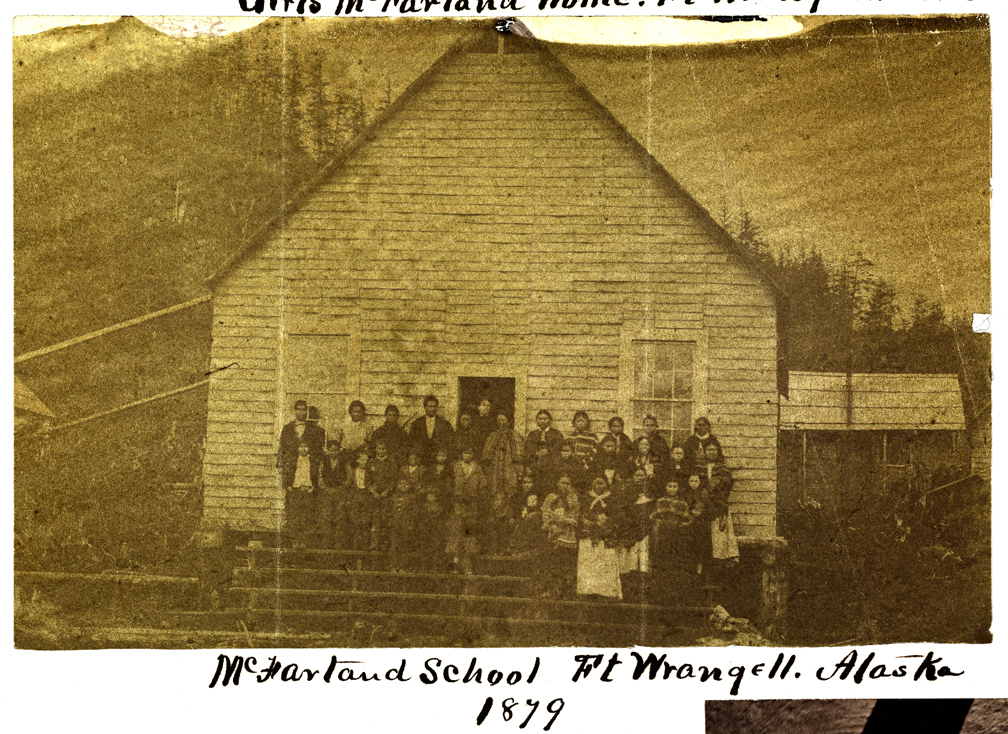
“McFarland School, Ft Wrangell, Alaska, 1879” (image credit: Sitka Art Blog)
At the end of their contract, the already literate Clah (who wrote English & Chinook Jargon) was persuaded to stay and teach school to something like 70 local (Lingít = Tlingit) people including lots of adults. “These people are crazy to learn,” a sailor is quoted.
Soon a teacher, Mrs AR McFarland of Portland, Oregon, was hired to replace Clah. She was put in charge, with Clah as her assistant, and Mrs Sarah Dickinson (“a Christian Tongass woman”) as interpreter.
Here’s a description of how the school was being conducted at the time of the new teacher’s arrival:

Going ashore upon our arrival, August 10, I heard the ringing of the bell for the
afternoon school, and went directly to the school-house. About twenty pupils were
in attendance, mostly young Indian women. Two or three boys were present; also,
a mother and her three little children. As the women took their seats on the rough
plank benches each one bowed her head in silent prayer, seeking divine help in her
studies. Soon a thoughtful Indian man of about twenty-five years of age came in
and took his seat behind the rude desk. The familiar hymn “What a friend we have
in Jesus” was sung in English; a prayer followed in the Chinook jargon, which is
the common langnage of the various tribes on this coast, closing with the repetition,
in concert of the Lord’s Prayer in English. After lessons were studied and recited,
the school arose, sung the long-meter doxology, and recited in concert the benedic-
tion. Then the teacher said, “Good afternoon, my pupils,” to which came the kindly
response, “Good afternoon, teacher.”

Thanks for this great anecdote. But a question. Weren’t there two men named Clah? There was Arthur Wellington Clah, of Port Simpson, BC, possible grandfather to William Beynon, and the author of an extensive diary (partly in the BC Archives), and who lived a good long life. Then there was Philip McKay, also called Clah, who I think died relatively young (his 20s?) I forget if there was a relationship between the two, and what the shared derivation of the name might be. I think it’s the latter who was helping out at this school. (Now you have me wondering how much CJ that AWC has in his extensive diaries…!)
LikeLiked by 1 person
Thanks Robert, I bet you know more than me here. Now I see THIS!
Dave Robertson
LikeLike