G Demers article, and missionaries adapting to Indigenous understandings
I try to read what’s said about Chinook Jargon in the scholarly literature — so you don’t have to!
Ginette Demers published an article in 2004, “Colombie-Britannique: Les missionaires catholiques et les activités langagières (1842-1952)” in the journal Meta 49(3):656-668.
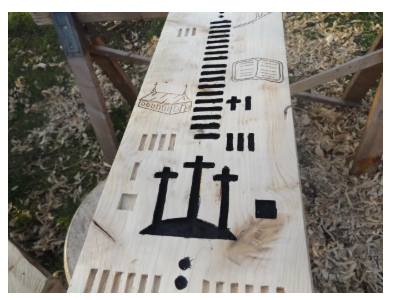
Image credit: “The Making of the Sahale Stick (Catholic Ladder)“
The French title translates as “British Columbia: Catholic missionaries and language activities 1842-1952”.
Here’s the introductory Summary and list of keywords:

ABSTRACT
Because the different languages spoken by the First Nations of British Columbia were
extremely difficult, most Catholic missionaries preached and taught in the Chinook Jar-
gon, a trade language. However, the Jargon was not known to all natives, so they often
had to use interpreters as well. This article shows some of the problems the missionaries
had with interpreters, especially in the 19th century. Moreover, the linguistic activities of
a few missionaries serve to illustrate what was done during the mission era as far as
translation, writing, lexicography and invention of alphabets go.MOTS-CLÉS / KEYWORDS
Colombie-Britannique, missionnaires catholiques, interprétation, Chinook Jargon, inven-
tion d’écritures
I’ll skip right to the section where Demers discusses Chinuk Wawa, here shown to you in an English translation. Note, she’s unusual in nicknaming the language as “Sabir”, which was a name of the old Lingua Franca of the Mediterranean:
Chinook Jargon
Because the languages spoken west of the Rockies were extremely difficult, virtually all missionaries first learned Chinook Jargon, which was widely used on the West Coast during the first half of the 19th century and then gradually spread inland. In fact, it was the only language many would use in their dealings with Native Americans.
Scholars disagree on the date of this jargon’s appearance. Some believe that Native Americans used it before the arrival of Europeans and that it was then composed of words from different Native American languages. These authors argue that words from the Jargon appear in one or two Nootka-English lexicons developed in the late 18th or early 19th centuries (Thomas 1970: ix). However, no explorer or fur trader suspected the existence of this language before the 1810s. Many linguists, moreover, believe that it appeared during this decade, following trade trade between the Native Americans and employees of the Northwest Company, which had a trading post at the mouth of the Columbia River. At that time, this Sabir included Native American words (especially Chinook and Nootka) and onomatopoeia, as well as English and French words, often distorted (the word “mother,” for example, had become “lamai“). [Oops, that’s actually the word for ‘hand’, from French “la main”.] Since the first missionaries were French-speaking, all the religious vocabulary they added, with the exception of the word “God” (Sahaletaye), was borrowed from French (Jesu-kri, laconfirmatio, lebatem, legliz, lemaliaj, etc.). The grammar, however, was extremely simple.
The great advantage of this language was that it could be learned in a few months. Furthermore, when missionaries had to work with Native American groups who did not understand Chinook, it was much easier for them to find a person who spoke both Chinook and the dialect of these Indigenous people
than a person who could translate from French or English.However, one may wonder whether this was an adequate vehicle for transmitting the mysteries of the faith. Indeed, Modeste Demers laments the fact that the Sabir does not have participles and that a large number of words have multiple meanings. “It follows,” he says, “that it is not easy to translate French expressions into this language; one must use paraphrases” (quoted by Blanchet 1996: 58). Adrien-Gabriel Morice, an Oblate who worked in British Columbia from 1880 to 1903, believes that Chinook did more harm than good because too many missionaries were content with it rather than learning Native American languages, which, according to him, could have conveyed the Church’s teachings much more appropriately (1923: 256). In any case, the rarity of negative comments and the long use of Sabir suggest that, on the whole, missionaries considered it acceptable.
I’ve already interpolated a small correction into the above.
But on balance, Ginette Demers has written a reasonably balanced and well-informed summary there.
Here’s the next section, about her namesake, Modeste Demers 🙂
The Pioneer: Modeste Demers
In his instructions to Fathers Blanchet and Demers, Bishop Signay of Quebec asked them not only to apply themselves, upon their arrival in Oregon, to learning Native American languages, but also to try to derive general principles so as to be able to publish a grammar within a few years (quoted by Blanchet 1996: 31). However, the missionaries quickly realized that they might never be able to speak the language of the Chinook (Chinook proper), with whom they were to work upon their arrival west of the Rockies. Therefore, they instead learned the jargon which, as we have seen, made it possible to instruct a large number of Native people, either directly or through interpreters.
Beginning in the winter of 1838-1839, Father Demers developed a Chinook-English lexicon to assist those who would come after him. He subsequently translated hymns, numerous prayers, and the Short Catechism into Chinook. After his death in 1871, his early companion, François-Norbert Blanchet, published the translations and the revised and expanded lexicon in a single volume.
The missionary used eighteen letters of our alphabet to transcribe the Chinook vocabulary. He explained that all the letters of a word are pronounced, and that words borrowed from French or English are spelled the way Indigenous people pronounce them (for example, medicine is written metsin).
He therefore did not resort to a writing system different from ours, even though he felt that the pronunciation of certain words—Sahaletaye (God) and hihkt (unique), for example—was so difficult that he had difficulty finding letters to represent it (Blanchet 1996: 58). This surely limited the usefulness of the lexicon. Indeed, in a journal that takes the form of a long letter to a friend, Abbé Jean-Baptiste Bolduc includes a translation of the Pater Noster [Our Father], specifying that he has underlined the words whose pronunciation is impossible to know unless one has heard them (1844: 93). A third of the words are underlined.
According to De Roo (quoted by Hanley 1965: 30), Modeste Demers eventually learned about fifteen Native American dialects despite their difficulty, and is credited with a small fifteen-page publication entitled Dictionary of Indian Tongues […] which contains Tsimshian, Haida, and Chinook words with their English equivalents (Thomas 1970: 168). [This would be news to me. I would think any Tsimshian and Haida vocabulary at that time was documented by Protestant missionaries; Catholics were not much of a presence in those territories. Also, I’m unaware of Modeste Demers being able to speak any Pacific NW language other than Chinook Jargon.]
In a later section, Ginette Demers correctly notes (page 661) that Father Adrien-Gabriel Morice was motivated to create a Dakelh (Carrier Athabaskan) writing system by the fact that speakers of that language were dispersed over a large territory. This is the same factor that played such a big role in Father JMR Le Jeune’s later introducing Chinook Writing farther south in British Columbia.
She goes on to discuss Le Jeune’s career in BC. On page 663, she muddles the actual timeline, making it sound as if Le Jeune, on arriving in the province in 1879, had immediately begun experimenting with using Morice’s syllabics to write Chinook Jargon and “several dialects”, i.e. Salish languages. In fact, Morice’s writing system wasn’t created until 1883, and Le Jeune wasn’t ordered by his superiors to try writing more languages with it until later, around 1890.
On that same page, she also cites, but doesn’t quote from, sources claiming Chinook Writing was even used on Vancouver Island, BC. I’ve not found evidence of that yet, although some of its users from the Sliammon and Sechelt areas are likely to have spent some of their time there.
On page 665, Ginette Demers quotes from an archival interview with Father John Hennessy that Chinook Jargon was spoken only by old people by 1934. The priest who trained him in the Cariboo region, FM Thomas, insisted he must preach in CJ, having an interpreter put his words into the local Indigenous language, in order to follow the traditional behavior of chiefs (page 664)!
Page 665 makes a point that’s of paramount importance — that missionaries typically failed to explain what their Christian terminology meant, when they simply used the French words for ‘grace’ (there’s a humorous and revealing anecdote she tells of this), and others.
She’s right.
Maybe now’s a good time for me to translate the French words she mentioned above: Jesu-kri ‘Jesus Christ’, laconfirmatio ‘confirmation’, lebatem ‘baptism’, legliz ‘church’, lemaliaj ‘marriage’.
I should thank Ms Demers for making me think to point out something she couldn’t have known without learning & reading an enormous amount of Northern Chinook Jargon in the Chinook Writing:
Father JMR Le Jeune and the other Catholic missionaries of southern BC must have actually noticed, and then fixed, this problem to a great degree. Evidence of this: Those heavy users of CJ made real efforts to accomodate their Indigenous audiences’ understanding, by replacing many of the old-school (Modeste Demers, FN Blanchet, Fort Vancouver-era) French religious words of CJ with Coast Salish ones, such as (in Chinook Writing spellings) —
- haha ‘sacred’
- haha milalam ‘confession’
- styuil ‘pray(er)’
- styuil haws ‘church’
- siisim ‘story, report, preach’
- pyusim ‘make the Sign of the Cross’
- ili ‘alive’
- sili ‘soul’
- shhulí ‘spirit’
- skulkwaliol ‘mind’
- shilalam ‘year’
And from Interior Salish —
- iilhit ‘examine (one’s conscience)’
- shmamaim ‘catechism’
- lahanshut ‘confess(ion)’
I don’t have a lot more to say about Ms Demers’s article. It’s a good read, and you can grab the French text to plop into Google Translate if needed.
I’m delighted that reading it has led me to articulate an important finding from my own research!
