Lempfrit’s legendary, long-lost legacy (Part 25a, Ave Maria) (Part 25b, Credo)
We’ve seen H-T Lempfrit’s manuscript dictionary; and now for some rare old Chinook Jargon texts on its following pages!
The 25th pair of pages (mis-numbered as “24” on the original page) from this precious document again brings us plenty of stuff worth knowing about Chinook Jargon — this time moving from lists of words into texts.
(Here’s a link to the other posts in this mini-series.)
“[SIC]” shows that someone mis-wrote a word. It wasn’t necessarily Lempfrit, since he was copying from someone else’s manuscript, Modeste Demers’ now-lost original to be exact.
For today’s installment, Alphonse Pinart’s “Anonymous 1849” copy (read it for free online) lacks any pages that correspond to what we’re seeing from Lempfrit.
Where you see [le]tters in square brackets, they’re not visible on the page copy that I’m working from, but we infer that they really are there!
By the way, the notation ___ means that the preceding entry is repeated in that position, along with some additional word(s).
See if you recognize words in these unusual spellings! I think we have a couple more small discoveries today, again showing the value of examining every Chinuk Wawa document — even those that appear to be straight copies of each other!
Beginning with today’s textual materials, we have the rewarding experience of seeing how a French-speaker (in the pre-Anthropology era, no less) conceptualized the word-to-word flow of spoken Jargon. Lempfrit’s “glosses” of each Chinook Jargon word might be pretty different from how you think of each word’s meaning!
If you need some quick proof that Chinook Jargon is an Indigenous language, take a look at how different Lempfrit’s French, and the conventional English lines, are from what the Jargon here is literally — and fluently — saying.
When I say that this Chinuk Wawa is fluent, I’m saying that it’s totally characteristic stuff from what I’ve now come to call the Central Dialect. That’s the oldest variety of the language, the early-creolized Jargon associated with Fort Astoria and Fort Vancouver. The document we’re looking at here was created before the Northern or Southern dialects (associated with British Columbia and with Oregon’s Grand Ronde Reservation, respectively) even existed.
Here I’ll suggest punctuation marks such as (.) or (:), to help my readers. I’ll also help you understand Lempfrit’s word-for-word translations from Chinook Jargon into a pidgin-like version of his native French, which give us an idea of how he thought about CJ — they’re very interesting.
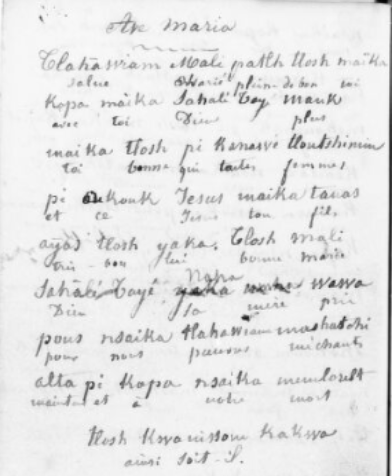
Ave Maria
Tlah̃awiam(,) Mali(,) patlh tlosh maïka(.)
hello, Mary, full.of good.things you.
[literally:] ‘Hello, Mary, you’re full of good things.’
[conventionally:] ‘Hail Mary, full of grace.’
salue Marie pleine.de bon toi
[literally:] ‘Greetings Mary, full of god you.’Kopa maïka Sahalé Tayé(;) mank
to/with you sky-chief; the.most
[lit.] ‘God is with you; more’
[conv.] ‘The Lord is with thee;’
avec toi Dieu; plus
[lit.] ‘with you is God; more’maika tlosh pi kanawé tloutshimin
you good and all woman
[lit.] ‘you’re (more) good than all women’
[conv.] ‘Blessed art thou amongst women’
toi bonne que* toutes femmes
[lit.] ‘you good than all women’pi oukouk Jesus maika tanas
and this Jesus your child
[lit.] ‘and this Jesus, your child,’
[conv.] ‘and blessed is the fruit of thy womb, Jesus.’
et ce Jésus ton fils
[lit.] ‘and this Jesus your child’ayas tlosh yaka. Tlosh Mali(,)
very-good he. good Mary
[lit.] ‘he’s very good. Good Mary,’
[conv.] {see previous line} ‘Holy Mary,’
très bon lui bonne Marie
[lit.] ‘very good he. good Mary,’Sah̃alé Tayé
yaka mamanaha(,) wawa
sky-chiefhis mothermother(,) talk
[lit.] ‘God’s mother, talk’
[conv.] ‘mother of God, pray’
Dieu sa mère prie
[lit.] ‘God his mother, pray’pous nsaika tlahawiam mashatschi(,)
for us poor bad.one,
[lit.] ‘for us poor bad ones,’
[conv.] ‘for us sinners,’
pour nous pauvres méchants
[lit.] ‘for us poor wicked ones,’alta pi kopa nsaika memloust(.)
now and at our dying.
[lit.] ‘now and at our dying.’
[conv.] ‘now and at the hour of our death.’
maint[en]ant et à notre mort
[lit.] ‘now and at our death.’tlosh kwanissom kakwa(.)
good always like.this.
[lit.] ‘Let it always be like this.’
[conv.] ‘Amen.’
ainsi soit-il.
[lit.] ‘So be it.’
