1891: A “Chinook and Clatsop” word for ‘legging(s)’
Professor Franz Boas, long may his name be remembered with respect, was not perfect.
Boas was engaged in an ideology-driven project of “salvage ethnography”. He and like-minded researchers in the late 1800s and early 1900s were working hard to document as much as they could of the oldest traditional cultural memory of Indigenous peoples. I’m glad they bothered!

The gentleman would seem to be be-legging-ed (image credit: Mary Evans Picture Library)
But mistakes were made.
One booboo, not even an oversight but a conscious choice made by such workers, was that they removed all traits in their data that they could tell dated from after Contact with the newcomer Euro-Americans. By doing so, they robbed us of a lot of knowledge now lost to us about how Native people were living during the time of that research.
I’ll show you a single example of that kind of data destruction here.
Alexander Francis Chamberlain was a Canadian grad student of Boas’s. AFC received the first anthropology PhD granted in the USA. On Boas’s advice, he went out west to study the Ktunaxa people (Kootenays) in British Columbia.
Chamberlain published a number of scholarly articles based on his field research, including one on “Words of Algonkian Origin“, i.e. items in Chinook Jargon that he believed or knew to trace back to the Algonquian language family farther to the east.
For one of those words, which we know from the phenomenal 2012 Chinuk Wawa dictionary of the Grand Ronde Tribes as mítás ‘leggings’, Chamberlain’s article tells us (p.261):
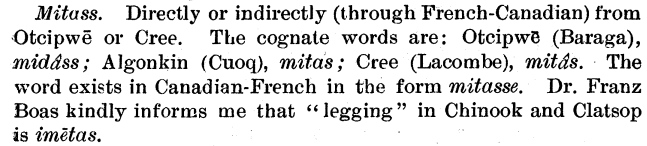
Mitass. Directly or indirectly (through French-Canadian) from
Otcipwē [Ojibwe] or Cree. The cognate words are: Otcipwē (Baraga),
midâss; Algonkin (Cuoq), mitas; Cree (Lacombe), mitâs. The
word exists in Canadian-French in the form mitasse. Dr. Franz
Boas kindly informs me that “legging” in Chinook and Clatsop
is imētas.
All of this is information we know from other sources…except that form borrowed into Chinookan.
It’s our good luck that professors often share valuable information with their graduate students! Boas personally told Chamberlain about a word that doesn’t show up in Boas’s published “Chinook: An Illustrative Sketch” nor in his “Chinook Texts“.
Boas had cut this word < imētas > out of his published data, due to his knowledge that it’s not an old traditional Chinookan form. It does have the Lower Chinookan i- prefix of a Masculine Singular noun, but the rest is our Chinuk Wawa (etc.) stem.
But, for us modern speakers, learners, and researchers of Chinook Jargon, it’s valuable to know that any speakers of this one particular parent language of CJ had felt a need to borrow the Métis/Canadian French word for ‘leggings’.
There was, I suppose, an indigenous Chinookan word for that item; compare in neighboring Kathlamet Chinookan tiáx̣iɬat̓awulx̣tix ‘his leggings’ and tiásak̓aluks ‘his leggings’ (which uses the same word stem that gave us the Chinuk Wawa word for ‘pants’). Similarly, I find homegrown words for ‘leggings’ in the Sahaptian languages, based for instance on a word stem for ‘sticking a leg into something long and narrow’.
(‘Leggings’ are mentioned in the published stories in Clackamas and Kiksht/Wishram Chinookan, but without any Chinookan words for this being shown to us. Fascinating.)
In my research, I try to track every example I can where Chinook Jargon words went on to be borrowed into Pacific Northwest languages. This often tells us something additional: about PNW history, about the pronunciation of the words, about cultural practices, and more. And I intend to show these loans out of Chinook Jargon in the eventual Grand Dictionary of CJ that needs to be created.
So I’m grateful to AF Chamberlain for his offhand remark about Boas’s Chinookan knowledge!

Wow. So good that you noticed and put these pieces of information together! We are lucky to have you!
LikeLiked by 1 person