1856: The Causes of the Present Indian Difficulties in Oregon and Washington Territories (Métis, treaties, etc.)
The excellent observer, James G. Swan, syndicated his descriptions of life in Washington Territory nationwide.
Here he pretty accurately discusses the Hudsons Bay Company and its role in the formation of a new, distinct Métis culture in the Pacific Northwest (altho’ I disagree that the HBC did all of the following with crafty intentionality):
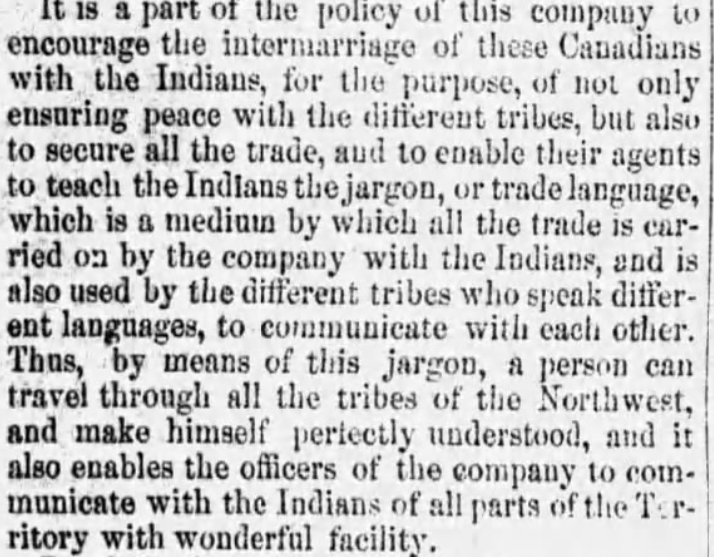
It is a part of the policy of this company to
encourage the intermarriage of these Canadians
with the Indians, for the purpose, of not only
ensuring peace with the different tribes, but also
to secure all the trade, and to enable their agents
to teach the Indians the [Chinook] jargon, or trade language,
which is a medium by which all the trade is car-
ried on by the company with the Indians, and is
also used by the different tribes who speak differ-
ent languages, to communicate with each other.
Thus, by means of this jargon, a person can
travel through all the tribes of the Northwest,
and make himself perfectly understood, and it
also enables the officers of the company to com-
municate with the Indians of all parts of the Ter-
ritory with wonderful facility.
JG Swan says lots more in this article, and it’s just one of several he got published in farflung newspapers. Here’s his expert, and damning, view of US treaty-making and breaking with the Chinook Indian Nation, with a valuable quotation that needs to be back-translated into Chinuk Wawa:
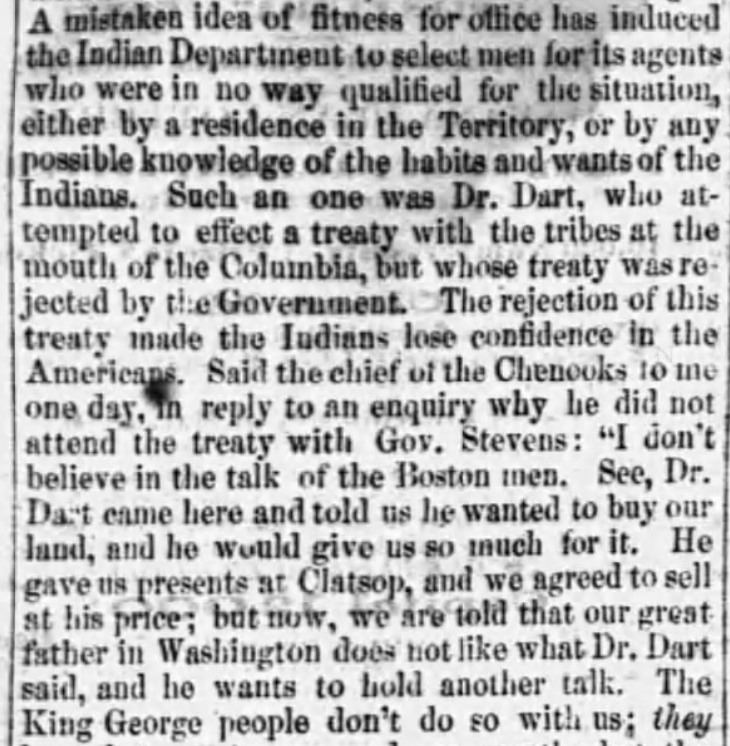
A mistaken idea of fitness for office has induced
the Indian Department to select men for its agents
who were in no way qualified for the situation,
either by a residence in the Territory, or by any
possible knowledge of the habits and wants of the
Indians. Such an one was Dr. [Anson] Dart, who at-
tempted to effect a treaty with the tribes at the
mouth of the Columbia, but whose treaty was re-
jected by the Government. The rejection of this
treaty made the Indians lose confidence in the
Americans. Said the chief of the Chenooks to me
one day, in reply to an enquiry why he did not
attend the treaty with Gov. Stevens: “I don’t
believe in the talk of the Boston men. See, Dr.
Dart came here and told us he wanted to buy our
land, and he would give us so much for it. He
gave us presents at Clatsop, and we agreed to sell
at his price; but now, we are told that our great
father in Washington does not like what Dr. Dart
said, and he wants to hold another talk. The
King George people don’t do so with us; they
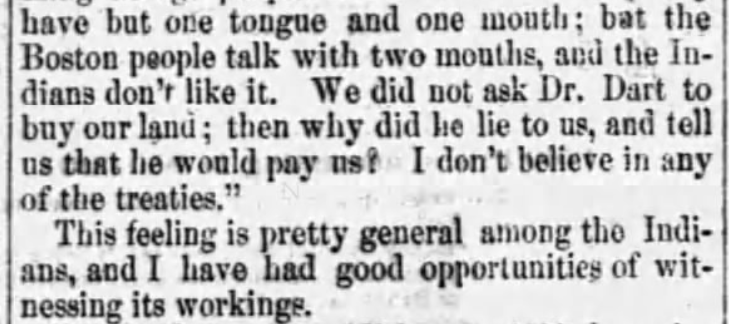
have but one tongue and one mouth; but the
Boston people talk with two mouths, and the In-
dians don’r like it. We did not ask Dr. Dart to
buy our land; then why did he lie to us, and tell
us that he would pay us? I don’t believe in any
of the treaties.”This feeling is pretty general among the Indi-
ans, and I have had good opportunities of wit-
nessing its workings.
— from the Montgomery (AL) Weekly Advertiser of April 2, 1856, page 4, columns 1-3
The whole article is worth reading at the link above.
And if you have a subscription to Newspapers.com, you can easily look for more of James G. Swan’s nationally published 1850’s accounts of life in the Great PNW.
