2008: Unseth on certain people’s awareness
I try to scour the world for every scholarly mention of Chinook Jargon…
(“So you don’t have to!”, as Harry Shearer would say.) Here’s a citation:
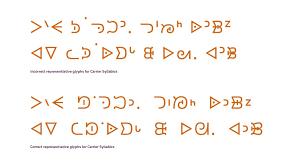
Image credit: “Dakelh language to get standardized writing system for keyboard use”, CBC
Unseth, Peter. 2008. Missiology and Orthography: The unique contribution of Christian missionaries in devising new scripts. Missiology 36(3):357-371.
And here’s something Unseth says, in passing, as a non-linguist, about Chinuk Wawa. This is in reference to Father Adrien-Gabriel Morice‘s invention of a writing system for Dakelh, the central BC Dene/Athabaskan language also known as Carrier (italicized emphasis is mine; this is from page 363):

Morice’s Carrier script, then, is another example of a devised script. It is clear
that he was aware of other languages’ previous adaptations of Evans’ syllabary. He
was also aware of a shorthand system, his order (Oblates of Mary Immaculate) having
earlier discussed and adopted the use of Duployan shorthand for Chinook Jargon. [footnote 9 reference]
And here’s that footnote 9:

9. Morice opposed the use of shorthand for Chinook Jargon ([William] Poser, to appear).
I’d like to correct this picture, based on my specialist knowledge.
Morice’s Dakelh syllabics were created about 7 or 8 years before the Chinuk Pipa shorthand-based alphabet, so Unseth’s saying vaguely that Morice “was aware of” that orthography is misleading.
The historical record is definite that the OMI or “Oblates” of BC were inspired by Morice’s writing system, but through experimentation, found that a syllabary doesn’t work well for the Salish family of languages that were the majority of those that their missionaries were involved with.
(This is a point that my friend Bill Poser just misses, by following Morice’s self-protective version of the events. Click the link above to fact-check what I say.)
So it was by second choice, forced by necessity, that Father JMR Le Jeune’s knowledge of French Duployé shorthand was enlisted — and that it worked so well for Chinook Jargon that the usual name for it among Indigenous people was “Chinook Writing”, Chinuk-Pipa.
And it’s not so much the case that Morice “opposed the use of shorthand for Chinook Jargon” as that he, a notoriously cranky fella and a control freak, was against folks using anything but his Dakelh syllabics for anything Native-related!
The one other point made by Unseth that I’d like to discuss is on his page 365:

A French priest, Jean-Marie Raphael LeJeune, used Duployan shorthand to write
Chinook Jargon, publishing the newspaper [Kamloops] Wawa in Kamloops, British Columbia,
between 1891 and 1923 (Dutilly 1944). Most readers likely assumed that the unusual
script in their newspaper was originally and uniquely theirs, unaware that it had been
developed from a shorthand script from France.
Talking about what’s “likely” needs to be based on the deepest possible knowledge.
Unseth hasn’t set eyes on the Chinook Jargon newspaper he’s speculating about — he even gets the title of it wrong.
And in the pages of that same newspaper, when you read it, you see Father Le Jeune talking all the time about the links between France and his student days learning Duployan, to an Indigenous audience.
This said, I can add from my research that the Chinuk Pipa script was seen by Native and Settler alike as a writing system totally distinct from those of White people. Le Jeune encouraged Indigenous people to see White folks’ writing as a slow and clunky “bull team”, and Chinuk Pipa as a quick and efficient “train”.
