Boas 1892: Many discoveries in a short article (Part 25: ‘to mend’)
There’s plenty more of value to examine in Prof. Franz Boas’s quite brief 1892 article on “The Chinook Jargon“…
 “Ojibwa man mending canoe by lake with teepees in 1913” (image credit: Wikimedia Commons)

We’re lucky a collection of Chinuk Wawa words got documented by someone as knowledgeable and reliable as Boas was.
(Click here for the previous installments in this series.)
Here he tells of a Causative-inflected verb that had previously been documented with a different meaning:
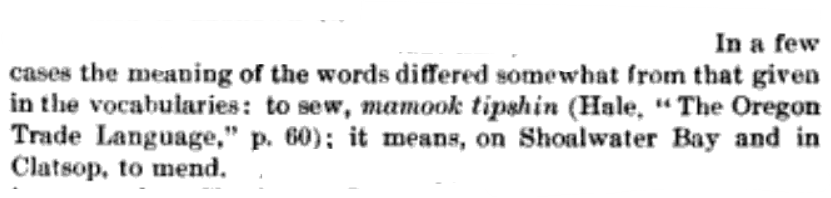
In a few
cases the meaning of the words differed somewhat from that given
in the vocabularies; to sew, mamook tipshin (Hale, “The Oregon
Trade Language,” p. 60); it means, on Shoalwater Bay and in
Clatsop, to mend.
In the more modern spelling of the fine 2012 Grand Ronde Tribes dictionary, this is mamuk-t’ə́pshin.
This t’ə́pshin ‘to mend, to patch; a patch’, as GR 2012 points out, is from a Salish source.
I can add that it’s specifically from the Ɬew̓ál̓məš language, also known as Lower Chehalis Salish. That’s the Salish language, historically known as “Chinook” (how confusing!), that my research has come to indicate as one of the co-parents of Chinook Jargon.
Of the 4 southwest Washington Salish languages, it’s only in Lower Chehalis that we find an exact match for t’ə́pshin. It’s a verb, t̓ə́p-š-ən ‘patch (a canoe or clothes)’, literally ‘(s)he patched it (for her/him)’.
Bonus fact:
It’s possible Horatio Hale didn’t exactly misunderstand t’ə́pshin, back when he documented it in 1841 around Fort Vancouver.
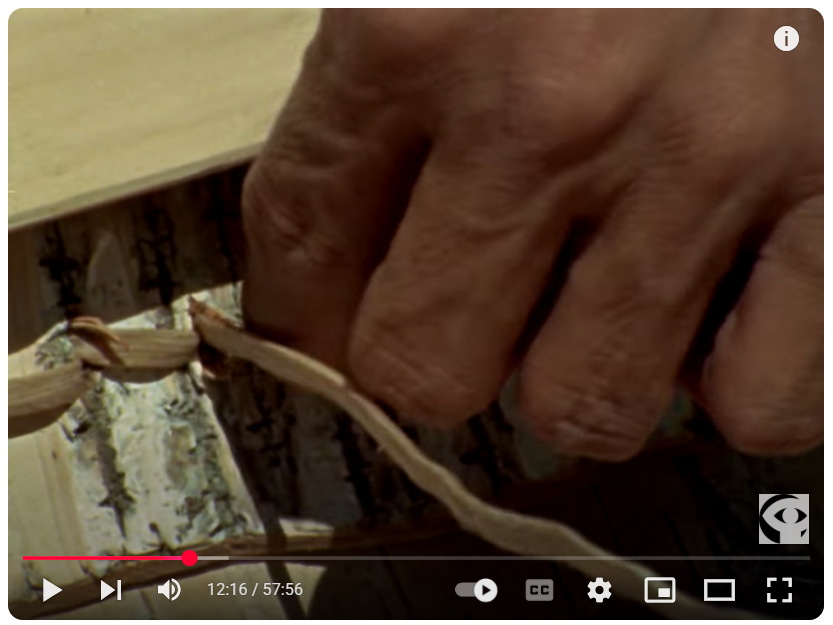
He would’ve seen folks using the standard technique of building & patching bark canoes by stitching with spruce roots and suchlike. You see?
Anyway, if you need to speak of ‘sewing’ clothing and such, you can say k’ípʰwat. That’s both a verb and the noun for a ‘needle’.
The Northern Dialect prefers to say mamuk-k’ípʰwat, to make clear that it’s a verb.

