“Frazer’s River” BC timeline, 1858 — how the Jargon suddenly got brought into New Caledonia
A rare clear starting point in language history is the introduction of Chinook Jargon into mainland British Columbia (New Caledonia then), which we can place in 1858.
The Fraser River gold rush abruptly brought lots of non-Indigenous people into that region, which if a census could’ve been taken would prove 99% Indigenous.
The sudden desire and need for communication between establishment and arrivistes in the North American New Caledonia ensured that the handiest tool anyone knew of, which was the Chinook Jargon known by a significant portion of the miners crowding in — and crucially associated with Native people in their minds — got pressed into service.
I’ve been featuring some news coverage from that time which shows New Caledonia’s Indigenous folks, beyond Fort Langley at the lowest reaches of the Fraser, did not know Jargon until 1858.
Today I want to share a few observations of the trend of reporting about “Frazer’s River”, as it was normally spelled, in the newspapers of that time.
(What I write here is based on using my subscription to Newspapers.com, unless I specify otherwise.)
This is a very simple picture.
Virtually all reporting that mentioned the region at all appeared in papers published far away. There were less than a handful of papers in Washington and Oregon Territories back then. California had the nearest cluster of such publications, but the big majority of existing newspapers were located in the still-frontier Midwest USA and eastward.
Prior to January of 1858, you mostly saw vague mentions of “Frazer(‘s) River”, which were in connection with the Boundary Commission sending out surveying parties to establish the border between “British” territory (not “Canadian” yet!) and United States lands.
There’s also the rare reference to HBC forts on Frazer’s River (Alexandria, George, and [St] James).
We hear nothing about gold seekers on the Fraser until early 1858. That’s why it’s astonishing when the January 6, 1858 edition of the Weekly Chicago Times quotes the Nevada [City], California Democrat saying this:
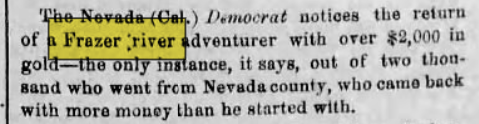
The Nevada (Cal.) Democrat notices the return
of a Frazer river adventurer with over $2,000 in
gold — the only instance, it says, out of two thou-
sand who went from Nevada county, who came back
with more money than he started with.
Here’s an incredibly crucial point — the Fraser River gold rush began upstream, at the forks of the Fraser & Thompson Rivers, as a spinoff of north-central Washington Territory’s “northern mines”, the Fort Colville-area gold rush of 1855. So, miners who already were able to use Chinook Jargon with some (far from all) Indigenous folks in that part of Washington wandered northwards. Realizing this helps us grasp how there were already 2,000 miners on the Fraser by the time reports of the gold strikes there filtered to the outside world. And the remoteness of that region from any established settlement zone explains why it took another several months for even Washington and Oregon folks to be convinced this was not just a rumor. (This via Historic Oregon Newspapers.)
Rephrasing that for emphasis: the Fraser River gold rush didn’t start on the coast. Non-Indigenous folks hadn’t yet shown up in appreciable numbers on the lower Fraser River, which was the only Chinuk Wawa-speaking portion of BC until 1858.
By February of 1858 there’s news of a more optimistic nature (via the California Digital Newspaper Collection): “At the new gold mines on Frazer’s River the excitement is increasing. Governor Douglas has issued a proclamation, as an advertisement, warning foreigners off from the mines unless they pay the tax.”.
In March a Boston (MA) newspaper is reporting that “the mines there are said to be rich”.
By April it’s being reported that people are abandoning their jobs at one of Washington Territory’s main industries, the coastal lumber mills, to pursue gold on the Fraser.
And already by late April the mining operations are reported as located “twenty miles above Fort Hope at the rapids“. That’s near Spuzzum, quite a ways upstream from the coast! There’s also mention of gold prospectors on the Thompson River, so branching off the Fraser at Lytton or beyond.
By that same time, the Indigenous people of the BC gold regions are represented as proud, independent, and potentially deathly violent towards the newly arriving Whites. This is an important consideration; the incoming Americans were conscious of needing to negotiate with, and honor the wishes of, Native people — a strong motivator for finding a language both could understand.
April wasn’t yet finished when the Fraser River gold rush was on everyone’s tongue, so a California restaurant owner with a sense of humor wanted to make sure his customers didn’t forget him:
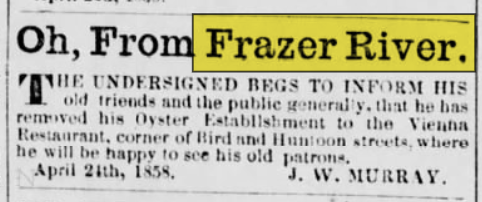
Oh, From Frazer River.
THE UNDERSIGNED BEGS TO INFORM HIS
old friends and the public generally, that he has
removed his Oyster Establishment to the Vienna
Restaurant, corner of Bird and Huntoon streets, where
he will be happy to see his old patrons.
April 24th, 1858. J. W. MURRAY.
Similarly, a smart California saloon owner wanted to make a few last bucks from would-be miners before they headed north…
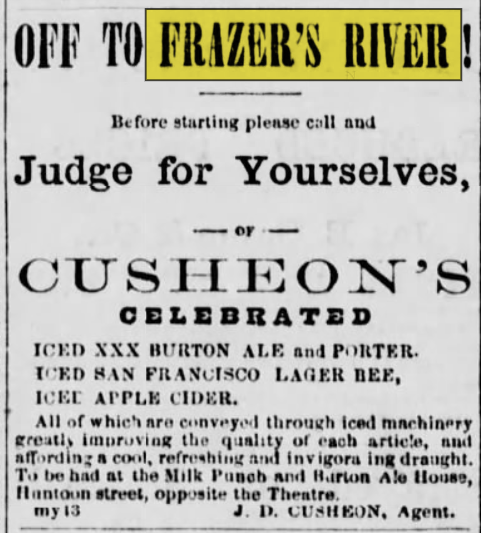
OFF TO FRAZER’S RIVER!
Before starting please call and
Judge for Yourselves,
of
CUSHEON’S
CELEBRATED
ICED XXX BURTON ALE and PORTER,
ICED SAN FRANCISCO LAGER BEER,
ICED APPLE CIDER.All of which are conveyed through iced machinery
greatly improving the quality of each article, and
affording a cool, refreshing and invigorating draught.
To be had at the Milk Punch and Burton Ale House,
Huntoon street, opposite the Theatre.
J. D. CUSHEON, Agent.
A steady theme in 1858 in many newspapers, especially in California, is that the Fraser River gold rush will turn out to be a big old “humbug” (fraud; disappointment), like so many of California’s recent rushes.
All of this is to demonstrate to you that the Fraser and Thompson gold excitements, which brought Chinuk Wawa to British Columbia, happened in the blink of an eye. One moment the trade language of BC was Métis/Canadian French, and the next moment it was the Jargon.
Bonus fact:
Researching today’s little post, I learned that folks in 1858 were already using the slang expressions “hang out” and “keep cool”!

Pingback: Do you hang out speaking Oregon Latin? | Chinook Jargon