1899, WA: Canoes article, with loan words and much more
A person we’ve previously found talking Northern Chinook Jargon makes a further show of expertise.
This is a gorgeously illustrated article, for a newspaper!
And it incidentally contains further evidence of how Lushootseed and Chinuk Wawa tended to intertwine in the frontier era.

Charles Milton Buchanan wrote the huge article “Canoes, Canoeing and Canoe Building among the Indians of the Puget Sound” in the post-frontier era, and among the proof that he knew what he was talking about is that he documented Snohomish (Lushootseed Salish) words for canoe technology.
There’s very little of direct Chinook Jargon interest in Buchanan’s article, other than his discussion of how it’s British Columbia Indigenous people who were keeping traditional “Chinook” canoe-making alive at the time he was writing. This rings true, as Settlers hadn’t overrun BC nearly as thoroughly as they had Washington by 1899.
Here’s a graphic showing various types of Native canoe from Puget Sound:
- < tlie > (ƛ̓əláyʔ) ‘shovenose canoe’
- < stee-whattl > (stiwátɬ)
- < stee-wheettl > (sdəxʷíɬ ‘hunting canoe’ or maybe st̓ik̓í[-]wiɬ ‘a double-ended canoe’ apparently from “Stikine” i.e. Lingít a.k.a. Tlingit)
- < ah-oh’-tuss > (ʔəʔútx̣s) — ‘Nootka-style canoe’, ultimately a Quileute loan word

And an Indigenous canoe race:

Some tool vocabulary: < pee-yah-kud > ‘hand adz’, p̓áyəqəd.
A canoe builder is a < dus-py-yuk >, apparently a previously undocumented word dxʷsp̓áyəq ~ ‘professional adzer’.
‘White people’ are < pah-stud totobsch >*. This is of course a direct borrowing from Chinook Jargon’s bástən-mán ‘White/American’, involving a semantic borrowing (calque) from CJ’s mán as what’s properly the Lushootseed word stúbubš ‘men’. (Buchanan’s/the P-I typesetter’s < totobsch > would imply the incorrect or insulting Lushootseed stúutubš ‘boys’ or stúʔtəbš ‘a single man (among women)’!)
An illustration of traditional paddles and a bailer, < kwad-gwild >, k̓ʷádgʷild ‘bailer (made out of cedar bark)’:

Buchanan mentions how every celebration of any kind on Puget Sound is bound to include canoe races, not just by men but also a < kloochman race > (‘women’s race’).
Here’s an illustration of traditional canoe-making tools:
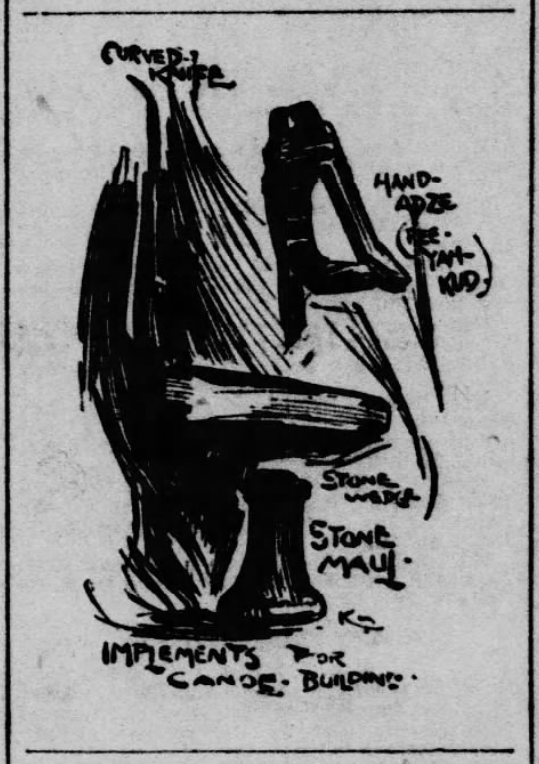
— from the Seattle (WA) Post-Intelligencer of August 20, 1899, page 16, columns 1-5
I’ve left out enormous amounts of informative details that Buchanan provides, so go read the article yourself!
