1892, WA: Kikisoblu (daughter of Chief Seattle) speaks
Early settler Henry L. Yesler’s death is reported in the Seattle (WA) Post-Intelligencer of December 18, 1892, page 8, columns 1-2, in an article headlined “House of Mourning”, with Chinook Jargon prominent.

A quotation from Kikisoblu a.k.a. Queen Angeline a.k.a. Princess Angeline (circa 1828-1896), daughter of Chief Seattle of the Duwamish Tribe, is worth reproducing here. She speaks recognizably Northern Dialect Chinook Jargon very fluently:

When asked if she wished to make a state-
ment about Mr. Yesler, she said:“Nowitka. Nika tumtum hias sick. Mr. Yes-
ler delate close tilacum capa nika; close tila-
cum capa nika papa Chief Seattle, hias ancudy.
Conaway mimaloose[,] Boston elip charco.”Translated this means: “Tell the people that
I feel very badly over Mr. Yesler’s death. My
heart aches. Mr. Yesler has always been a good
friend to me, and he and my father — Chief Seat-
tle — were good friends. The old settlers are
rapidly passing away.”
We’re told more of Angeline’s words, in a combination of Jargon and English (which we need to back-translate to Chinook):

After taking a breath, she continued: “Dr.
Maynard died first; then Charley Terry and
Tom and Bob Russell; then old man Bell, and
now Mr. Yesler is gone. Soon I will have no
friends left. Arthur Denny, Dave Denny, Amos
Brown. Butler and Fred Gasch are good friends
of mine.“Chee Boston halo cockwa nika.” That is: <===this one is a bad translation!
“The white people who have come here of late
years do not know me; they are not like the old
settlers.”.Speaking further, Angeline said: “The first
time I saw Mr. Yesler was a very few days after
he arrived in Seattle. I had been up to Black
river visiting some friends, and on returning
went to the home of Dr. Maynard. Mrs. May-
nard was away from home, and Yesler was
cooking supper for Dr. Maynard and himself.
Since that time I have known him well. For
yeare after Mrs. Yesler came I did the washing
for the family.”

The only white men living in Seattle when
Mr. Yesler came, she says, were Dr. Maynard,
Arthur A. and David T. Denny, C. D. Boren and
W. N. Bell. A man named Roubin lived on the
flats south of town, and Collins lived where the
race track now is. After a while the white
folks came by twos and threes and then by the
score, until finally they became like the pebbles
on the shore. She continued:“Mr. Yesler was always good to me, and since
I have been unable to work and support myself,
he has always contributed to my support. A
few days ago I heard he was sick and went to
see him, but the servants did not know me and
could not understand what I said and drove me
away. When I heard he was dead I cried all
day. Today I went to the house and Mr. Low-
man let me in to see my old friend, and I just
got back. I went in and saw him laying there
dead. It made my heart ache and I had to cry.
I stayed by the coffin a long time, because I
knew I would never see him again on this
earth.”In order to find out Angeline’s age the re-
porter asked her how old she was when Mr.
Yesler came to Seattle. To this she replied that
at that time she was a woman grown and had a
daughter sbout 10 years of age.“Do you fear death, Angeline?”

“No, I am not afraid to die, because I know I
will go to heaven and live with the Socale Twee“
(God).“What, are you a Christian?”
“Nowitka; I am a Catholic, and have a cruci-
fix and beads,” and, reaching up on a shelf, she
took down a little brass cross with an image of
the Savior nailed to it and a number of other

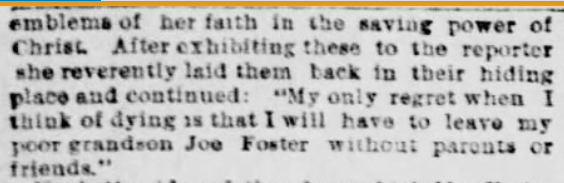
emblems of her faith in the saving power of
Christ. After exhibiting these to the reporter
she reverently laid them back in their hiding
place and continued: “My only regret when I
think of dying is that I will have to leave my
poor grandson Joe Foster without parents or
friends .*
