Lempfrit’s legendary, long-lost linguistic legacy (Part 11) (published out of sequence as Part 22A!)
Among the very early sources to point out that ‘1’ also means ‘(an)other’ in Chinuk Wawa —
— Is this one that we’ve been closely examining…
(That Indigenous metaphor also shows up, my research indicates, in the Salish etymology of the word “Chinook” — literally something like ‘at the neighbors’ place’!)
Let’s look into the 11th pair of pages in H-T Lempfrit’s handwritten copy, with additions of his own, of pioneering Fort Vancouver priest M Demers’s Chinook Jargon dictionary manuscript.
Material added or changed by Lempfrit, which tends to prove his good knowledge of the language, is underlined.

-
Lakit tatlelam – 40
Literally ‘four tens’.
-
Kwanam [-] id[em] [that is, kwanam tatlelam] – 50
Literally ‘five tens’.
-
Takamonak – 100
-
Makoust takamonak – 200
Literally ‘two hundreds’.
-
tatlélam takamonak – 1000
Literally ‘ten hundreds’.
remarque
‘Note.’On dit communément hihkt[,] une fois[,]
‘One says commonly “hihkt“, ‘once’;
Makoust[,] 2 fois — hiht le* dit
‘ “makoust“, ‘twice’ — “hiht” he* says’
quelquefois pour autre, l’autre vg
‘sometimes for ‘(an)other, the other one’ e.g.’
je demande en parlant de deux personnes
‘I ask in speaking of two people’
la quelle as-tu vue? Klaksta maïka
‘ “Which did you see?”, ‘Who did you’
nanitch? okouk na? Waik okouk
‘ see? Was it this one?” “No(,) that’
hihkt.
‘ other one.” ‘
[DDR: The klaksta here might be an early example of the use of this word for ‘who’ as ‘which’, although we really only find much of that in the later, northern dialect. The punctuation of the last Jargon sentence here is unclear; it might be a single clause Waik okouk hihkt ‘Not this one’!]
-
hihste – premier
‘first’
Anonymous 1849 has “le premier”
-
kimta – dernier
‘last’ -
kanamokoust – tous deux
‘both’ -
hihkté – une fois
‘once’ -
makousté – deux fois
‘twice’
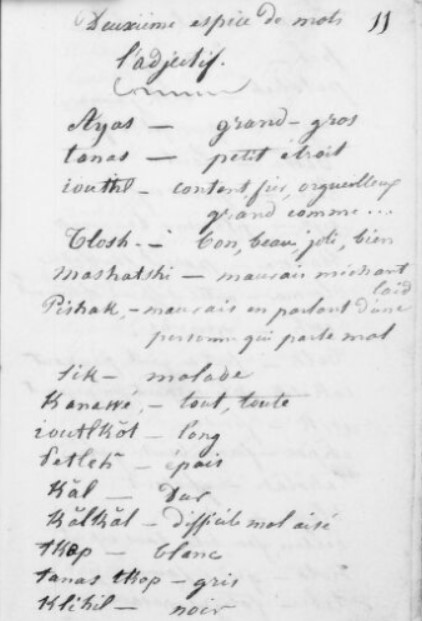
Deuxième espèce de mots
‘Second sample of words’l’adjectif.
‘The adjective.’
- Ayas – grand – gros
‘big, large’- tanas – petit(,) étroit
‘small, narrow’
The meaning ‘narrow’ is not one that we see much these days for this word!
- iouthl – content, fier, orgueilleux
grand comme… [sic]
‘happy, proud, proud, big as…’
Anonymous 1849 has the more accurate “grand causeur” ‘big talker’ — compare that with pishak below! “Grand comme” may be a misreading and/or miswriting of “grand homme”, ‘great man’.
- Tlosh – bon, beau, joli, bien
‘Good, beautiful, nice, well’- Mashatshi –mauvais, méchant[,]
laid
‘bad, bad, ugly’- Pishak – mauvais en parlant d’une
personne qui parle mal
‘bad when speaking of a person who speaks badly’
Compare this definition, which seems like it may reference Indigenous culture’s high value on oratory, with iouthl above!
- sik –malade
‘sick’- Kanawé– tout, toute
‘all’- ioutlkŏt – long
‘long’- Petleh̃ – épais
‘thick’- Kăl– dur
‘hard’- Kălkăl– difficile, mal aisé
‘difficult, not easy’
A reduplication, literally, ‘hard hard’.- tkop– blanc
‘white’- tanas tkop – gris
‘grey’
Literally, ‘little white’.- Klihil – noir
‘black’
qʰata mayka təmtəm?
What do you think?
