1890s, BC: kíkwəli-háws takes on new life
In 1896, BC Indigenous people and others still remembered traditional underground “pithouses”, which in Chinook Jargon were known as kíkwəli-háws.
That’s literally a ‘below-house’ or ‘low-house’.
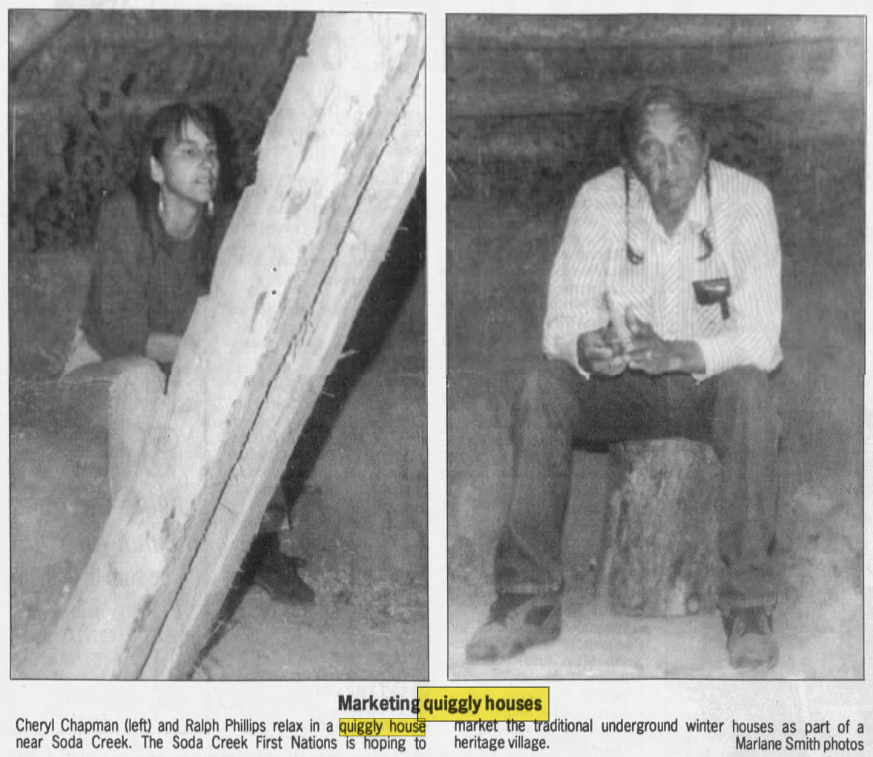 Image credit: Williams Lake Tribune
The CJ phrase was widely used in the Northern Dialect, especially in southern interior British Columbia.
There, it entered local English too, taking forms as varied as “giggly” or “kekuli house” and “quiggly hole” and “quicklich huts“.
Here’s one of several occurrences of the phrase in the Chinuk Wawa newspaper Kamloops Wawa, where the phrase always got used metaphorically, as in this Bible story:
Klaska lolo Sh[isyu]K[ri] kopa kah klaska mamuk mitlait
‘They brought Jesus to where they’d put’Lasaryus iaka itluil, iht kikuli ston haws. Aias
‘Lazarus’s body, a stone pit-house. A big’ston ihpui ukuk kikuli haws.
‘stone was keeping that pit-house shut.’
— KW 136 (January 1896), page 16
I’ve also found this phrase in issues 151, 166, and 210.
asdf

When we were talking about this the other day, the reference I was mentioning was in the Chinook Bible History p. 22 #195:
iht pulakli sol pi iaka solshirs chako drit til pus kuli kanawi kah kopa mawntin pus tlap divid(.) klaska nanich iht ***kikuli kopa ston kakwa haws***. klaska klatwa slip kopa ukuk ***kikuli kakwa haws***. iawa divid mitlait. iawa iaka ipsut.
LikeLiked by 1 person