1858, BC: “The Indians Friendly!” — Arrival of the “Sea Bird”
“The Indians Friendly” was one of several stacked-up breathless headlines from the start of a gold fever.
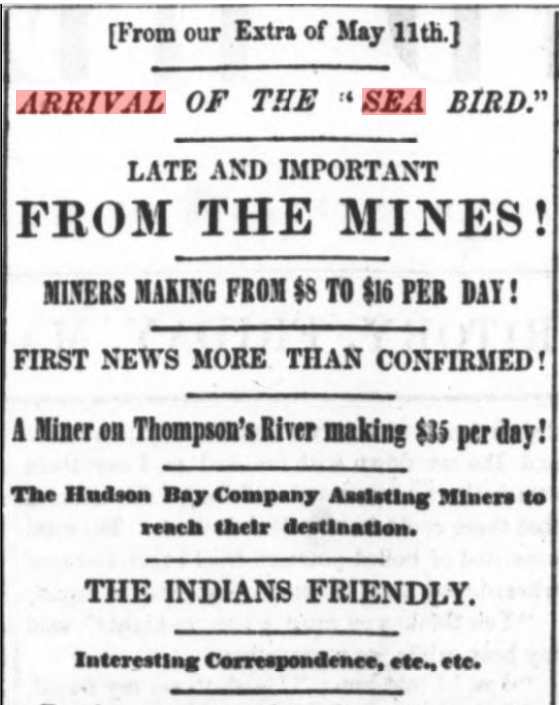
[From our Extra of May 11th.]
ARRIVAL OF THE ” SEA BIRD.”
LATE AND IMPORTANT
FROM THE MINES!MINERS MAKING FROM $8 TO $16 PER DAY!
FIRST NEWS MORE THAN CONFIRMED!
A Miner on Thompson’s River making $35 per day!
The Hudson Bay Company Assisting Miners to
reach their destination.THE INDIANS FRIENDLY.
Interesting Correspondence, etc., etc.
That’s the early news of the Fraser River gold rush of 1858 that brought Chinook Jargon into the interior of British Columbia, as linguist Bill Turkel showed in a 2004 paper.
Highly relevant stuff, in terms of communication and of establishing a new language in the area. Unfriendly Indigenous people wouldn’t do much talking with you, would they, my colonizer?
It’s of related interest that this article tells of Samuel McCaw bringing back 50 ounces of gold, the largest pieces having been gotten not by mining but “in trade with the Indians”. This, too, suggests good relations between cultures.
The letter from McCaw, boldly datelined “McCaw’s Rapids, Fort Yale” (!), also notes that Indigenous folks are hard at work mining gold for themselves.
Another notable fact pointed out in today’s article is that the Hudsons Bay Company, already established in BC and whose staff included some folks who already spoke Jargon, was encouraging the (American) miners to come in and settle.
There’s not much Chinuk Wawa to be found in any of the earliest reports from mainland BC. The following from McCaw is typically terse, consistent with CJ being a new lingo in the place:
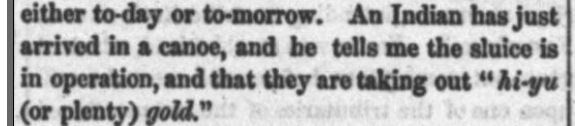
An Indian has just
arrived in a canoe, and he tells me the sluice is
in operation, and that they are taking out “hi-yu
(or plenty) gold.”
McCaw advises newcomer miners to find Indigenous help who speak “Chenook” jargon, apparently because none speak English whereas many Americans arriving in BC had some grasp of Jargon:

When at Fort Hope, they should be very
careful to select good and smart Indians, and to
have one who can speak the Chenook jargon.
This is immediately followed by more detailed advice showing the newcomers’ huge dependence on Indigenous knowledge and good will:
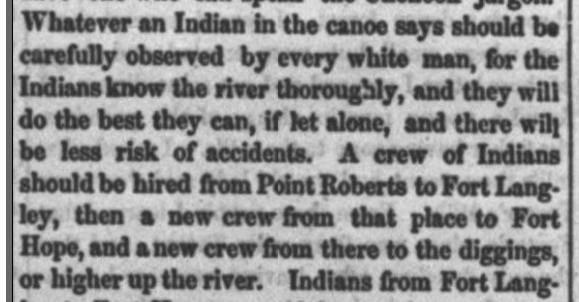
Whatever an Indian in the canoe says should be
carefully observed by every white man, for the
Indians know the river thoroughly, and they will
do the best they can, if let alone, and there will
be less risk of accidents. A crew of Indians
should be hired from Point Roberts to Fort Lang-
ley, then a new crew fromn that place to Fort
Hope, and a new crew from there to the diggings,
or higher up the river.
— from the Steilacoom (Washington Territory) Puget Sound Herald of May 14, 1858, page 2, columns 3-4
Bonus fact:
Sea Bird Island, BC — an Indigenous community — is named for this ship the Sea Bird.
