1869, WA: “Paddle Your Own Canoe” doggerel
I’m convinced Washington Territory was the world’s capital of Chinook Jargon-related doggerel poetry!
However, this one is credited to a Victoria, BC author, whose initials “G.C.” may eventually lead us to an identification. The poem was published in Victoria’s suburb of Port Townsend, Washington, where G.C. was probably well known.
Like so many pieces in our doggerel file, this one relies on the trusty workhorse folk rhythm of trochaic hexameter. Kids of my generation will recognize the beat of “Ask me no more questions, tell me no more lies!”
I salute G.C. for achieving a solid AABB rhyme in the stanzas, and CDCD in the chorus. Chinook Jargon is unhelpful towards that goal!
The writer also helps me make my eternal point that Chinuk Wawa existed as a spoken language, therefore one that folks used in a conversational tone of voice — and in close contact with informal North American English. You’ll see plenty of slang words in today’s poem.
The subject matter is common stuff for Pacific NW doggerel poetry in the frontier era: intercultural love’s perils.
The tone is one frequently found in such poems, a sort of humorous melancholy. Country music, more or less.
The neat twist here is that it seems set on Victoria’s waterfront, where Indigenous people came from far and wide for wage work, forming a lively community where we also find them composing an entirely different style of Chinook Jargon songs. Many of those are also about lost love.
The racism level in today’s poem is the usual for this PNW genre.
For all that, these folk poems are a fascinating part of our regional culture, and are worth knowing about.
I’ll add some interpretation of the Jargon, as we go:
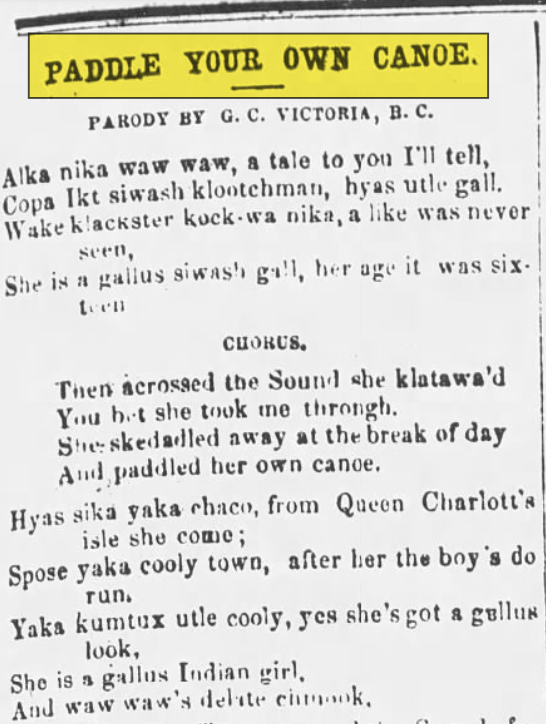
PADDLE YOUR OWN CANOE.
PARODY BY G. C. VICTORIA, B. C.Alka nika waw waw, a tale to you I’ll tell, ‘Now I’ll talk…’
Copa Ikt siwash klootchman, hyas utle gall. (gal) ‘About a Native woman, a very proud’…
Wake klackster kock-wa nika, a like was never ‘(There’s) nobody like me…’ [SIC]
seen,
She is a gallus siwash gall, her age it was six- ‘…Native…’
teen,CHORUS.
Then acrossed the Sound she klatawa‘d ‘…went’
You bet she took me through.
She skeda[d]dled away at the break of day
And paddled her own canoe.Hyas sika yaka chaco, from Queen Charlott[e]’s ‘She came from very far away…’
isle she come;
Spose yaka cooly town, after her the boy’s do ‘When she walks around town…’
run.
Yaka kumtux utle cooly, yes she’s got a gallus ‘She knows how to walk proud…’
look,
She is a gallus Indian girl.
And waw waw‘s delate chinook. ‘…talks straight Chinook.’CHORUS. — Then acrossed the Sound, &c.
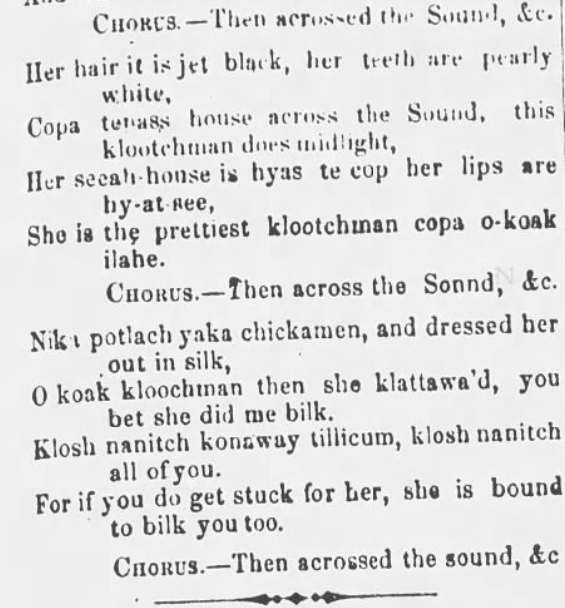
Her hair it is jet black, her teeth are pearly
white,
Copa tenass house across the Sound, this ‘In a hut…’
klootchman does midlight, ‘woman…lives,’
Her seeah-house is hyas te cop her lips are ‘…face…very pale…’
hy-at-see, ‘very sweet.’
She is the prettiest klootchman copa o-koak ‘…woman in this’
ilahe. ‘country.’CHORUS. — Then across the Sound, &c.
Nika potlach yaka chickamen, and dressed her ‘I gave her money…’
out in silk,
O koak kloochman then she klattawa‘d, you ‘That woman…left…’
bet she did me bilk.
Klosh nanitch konaway tillicum, klosh nanitch ‘Beware, everyone, beware,…’
all of you.
For if you do get stuck for her, she is bound
to bilk you too.CHORUS .- Then acrossed the sound, &c
— from the Port Townsend (Washington Territory) Weekly Message of September 8, 1869, page 3, column 1
