1779, Nootka (BC) et al.: Riobó confirms no Chinook Jargon yet
“Relación del viage que hizo el P.P. Fr. Juan Riobó” is yet another firsthand source — this one unpublished — about the earliest contacts that happened between Indigenous people and Newcomers.
Like other documents of its era, it shows us that there was no already-existing pidgin language encountered on the Northwest Coast. There was no easily learned way of communicating with folks whose native language you’d never encountered before.
I was happy to learn about this manuscript as I researched the earliest part of the “contact era” out here. And, I was relieved to find that Riobó had very neat handwriting and used a kind of Spanish that’s very close to the 2025 standard. So I can understand what he wrote.
This is a brief (14-page) telling of the 1779 voyage of the Spanish vessels Princesa and the Favorita, under the command of Bodega y Quadra, from Mexico to explore the northern Pacific NW coast. They went as far as south-central Alaska.
It can be read and downloaded online, free of charge, from Santa Clara University archives.
From its first line, here’s what amounts to its title, translating as ‘Relation of the voyage made by the pious* priest Brother Juan [Antonio García] Riobó’ (I think the first P = pío)…

I won’t comb through this particular document for you point-by-point, but the following sample shows what I mean when I report that Riobó only speaks of Indigenous and non-Indigenous folks “giving to understand” this or that broad idea. It’s clear they share no language.
Page 10:
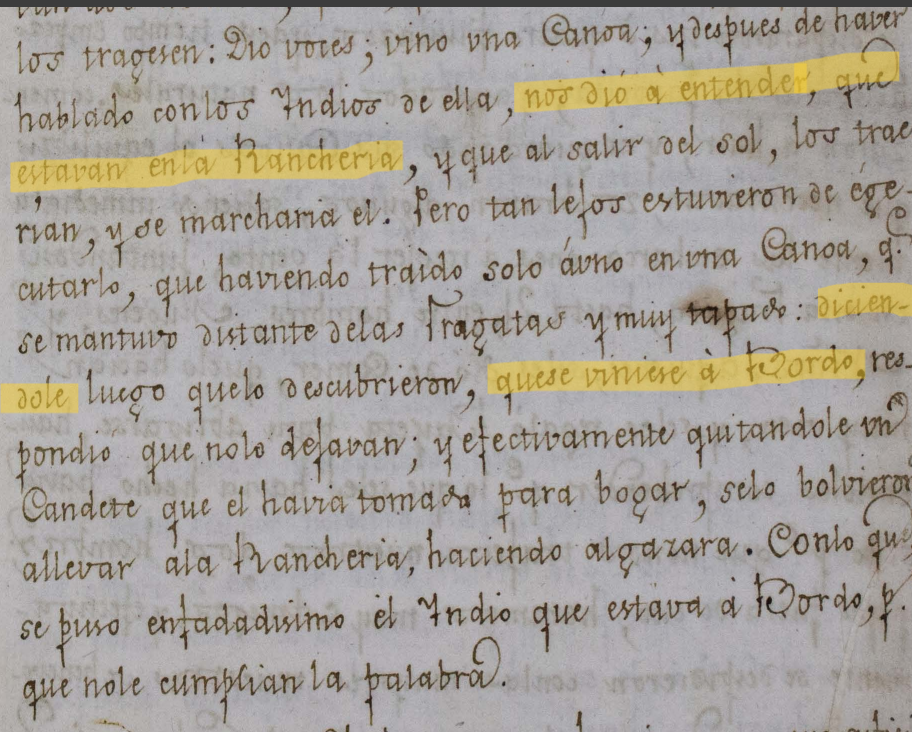
The relevant passages here being:
- “nos dio a entender que estaban en la ranchería” (‘he gave us to understand that they were at the Indigenous village’)
- “diciéndole…que se viniese a bordo” (‘telling him to come on board’).
In both of these cases, hand gestures are the most probable means of communication, as we’ve found any number of times when I’ve looked at the earliest Northwest Coast contacts.
