Even more about ‘dog’ and Lower Chinookan
Thinking some more about Chinook Jargon’s kamuks(h) ‘dog’ here. In the “Chinook Texts” told by Q’ltí (Charles Cultee) to Franz Boas, ‘dog’ is usually -kíwu/iš/sx̣.
That is, it’s this always-bound root/stem, shaped like kíwušx ~ kíwišx ~ kíwusx ~ kíwisx.
(Personally, I’d be tempted to take that pattern to mean that it’s fundamentally kíwəš/sx.)
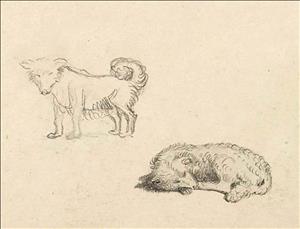 Salish wool dogs (image credit: Paul Kane, 1847 via Wikipedia)
This is not really pursued in the excellent Grand Ronde Tribes dictionary of Chinuk Wawa, 2012, which only mentions the variant stem form –kamuks(h), citing Boas’s “Chinook: An Illustrative Sketch”, 1910:585.
Today, I’d like to spotlight more data, from Boas’s 1894 publication, “Chinook Texts”.
The Lower Chinookan (Clatsop-Shoalwater) word is mostly, to my surprise, of Neuter gender, as on Page 14, where Boas’s steampunk phonetic alphabet uses capital “L” for the Neuter prefix ɬ-:
It’s Neuter also on page 43, where we see a slightly different shape of the stem:
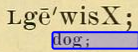
But it can be Feminine gender, as on page 211, where Boas’s “ō” is the Feminine u- (which makes the “k” at the start of the stem become kʷ, here written “ku”):

(A fun fact: in Lower Chinookan, using 2 words to say ‘female dog’ is unnecessary, since the gender is obvious from the prefix on ‘dog’. I suspect speaker Q’ltí was powerfully influenced by the Chinuk Wawa that he routinely spoke; in that language, we do normally specify gender, if wanted, by putting ɬúchmən ‘woman’ or mán ‘man’ before a noun.)
No cognate of this ‘dog’ word turns up when I look into the next Chinookan language up the Columbia, Kathlamet. Instead there’s a root –k̓útk̓ut there, which I’ve been personally told is from a typically reduplicated ideophone for gnawing on bones.
That activity is explicitly spoken of in connection with a dog in at least one story in Clackamas, the next Chinookan language upriver, where this same stem –k̓útk̓ut is ubiquitous for ‘dog’.
I don’t see what the stem for ‘dog’ is in Kiksht (Wishram), the farthest upriver of the Chinookan languages.
The broad contours of the evidence just described suggest, as so often, a situation where the farthest downstream Chinookan language differs lexically from its sisters. I hope I’m known by now as the linguist who suggests Lower Chinookan’s long-term intimate contact with Salish (and specifically the Lower Chehalis language) as the reason for many such differences.
I’ve been advocating a view that Lower Chinookan’s stem for ‘dog’ is influenced by a neighboring Salish root for ‘nipple’, which helps explain the otherwise puzzling presence of the Chinookan Noun Plural suffix -uks in Chinook Jargon’s kʰámuks(h). In fact, in the “Chinook Texts“, the stem variant –kamuksh seems to be limited to female dogs (‘bitch’ in German-speaker Boas’s translation), thus literally ‘many nipples’.
The more frequent variant –kíwušx can be any dog. I suspect it’s to be understood as being effectively the same root as -kamuks(h), thus also from Salish:
- …But with a quirky “metathesis”: /kš/ ~ /šx/. As the 2012 Grand Ronde Tribes CW dictionary notes, a /k/ ~ /x/ mutation is routine stuff in Chinookan, so, yes, this is a valid correspondence. Also, you might be interested to know that metathesis (switching 2 segments’ positions with each other) is far more common historically in Salish languages than in Chinookan ones!
- There are also well-known phonological rules in Lower Chinookan that let /m/ and /w/ vary with each other quite freely.
- The vowel variation between /a/ and /i/ is less routine for Chinookan, but it strongly calls to mind Lower Chehalis Salish with its emotionally affective /ə́/ ⇒ /í/ mutation. In Chinuk Wawa, we see traces of such a thing in the pair kə́mtəks ‘to know, remember’ ~ kímtəks ‘to feel deeply about, regard with respect’.
I don’t know if this will be the last word on kamuks(h). But it’s been fascinating to examine Chinookan-Salish interactions ever more deeply.
I come away with a solid sense that Chinook Jargon owes just about equally to both language groups for its heritage. It makes all the more sense to call it “Chinook” Jargon, because that name itself is Salish!

