1871, OR: An “abergwine” and his friend
Well within the frontier era, an Oregon newspaper was using various synonyms for ‘Indigenous person’.
One was, not surprisingly, siwash from Chinuk Wawa.

Image credit: Eugene Weekly
Another was the more comical “abergwine”, i.e. aborigine.
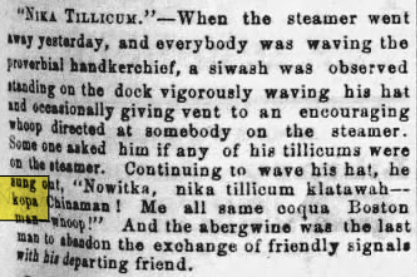
“NIKA TILLICUM.”-When the steamer went
away yesterday, and everybody was waving the
proverbial handkerchief, a siwash was observed
standing on the dock vigorously waving his hat
and occasionally giving vent to an encouraging
whoop directed at somebody on the steamer.
Some one asked him if any of his tillicums were
on the steamer. Continuing to wave his hat, he
sang out, “Nowitka, nika tillicum klatawah —
kopa Chinaman ! Me all same coqua Boston
man whoop!” And the abergwine was the last
man to abandon the exchange of friendly signals
with his departing friend.
— from the Portland (OR) Oregonian of April 5, 1871, page 3, column 1
Compare “abergoine” previously on my website. “Abergwine” might bring to mind further notes, for instance of Mark Twain — as in this random example.
“Nowitka, nika tillicum klatawah — kopa Chinaman! Me all same coqua Boston man”
= nawítka, nayka tílixam ɬátwa — kʰupa cháyna-mán! Me all same kákwa bástən-mán
= ‘Yes, my friend is leaving — for the Chinese people [to China?]! I’m just like a White person!’
The sequence of words, …Chinaman! Me all same…, is Chinese Pidgin English, as well as being understandable in Chinook Jargon. We have often found that CPE elements sometimes blended into Jargon, and vice versa.
