2016: Fiola, Dakelh, Métis/Canadian French
I have the feeling this will be an ongoing series of corrections…
In today’s installment, a researcher who isn’t known in the Chinook Jargon scholarly community makes the reverse of the classic mistake of assuming certain words in Pacific NW languages are “from French” when they’re really from Chinuk Wawa.

“Mme. Sundayman et sa petite-fille, Vallée du Bella-Coola, Colombie-Britannique”, 1924
(image credit: Canadian Museum of Civilization)
I’m looking at “The Carrier Language: A Grammar and Dictionary (1932): Translation, Adaptation or Re-creation?” by Marco A. Fiola, in the volume “Words across History: Advances in Historical Lexicography and Lexicology“, edited by Maria Victoria Dominguez-Rodriguez et al. (Las Palmas, Spain: Universidad de Las Palmas de Gran Canaria, 2016).
Here, Fiola takes quite a number of words in Dakelh (Carrier, a Dene/Athabaskan language of British Columbia) as “Chinook Jargon”, when in fact there’s no need to assume they’re anything but Métis/Canadian French.
For instance, I can point out that the personal name Mali ‘Mary’ need not have been filtered via Chinook in order to have the form it takes in Dakelh. Also, there’s no known form of ‘Mary’ that’s unique to the Jargon…
Also, I’ve already written about how the Dakelh term for ‘Jesus Christ’, here written Sezicli, is pretty clearly from Canadian/Métis French.
In case Fiola is making the same claim for them, the French-derived words for ‘pope’ and ‘Sunday’ aren’t particularly associated with Chinuk Wawa, either. In fact, the actual CW word for ‘Sunday’ did get borrowed into local Dakelh usage, and is still a family name to this day there: Sundayman.
Also relevant: Fiola takes the pronunciation of /r/ in whatever French source donated to Dakelh to be the uvular approximant [ʁ] (Parisian style), whereas it’s essentially certain that this phoneme was instead [ɾ], an alveolar tap.
While I’m at it, I’ll correct Fiola about the origins of CW — at its beginning, the French language played no role whatsoever. The Métis/Canadian French stratum (historical layer) of the Jargon began almost a generation after the demonstrably earliest date of this new language’s existence.
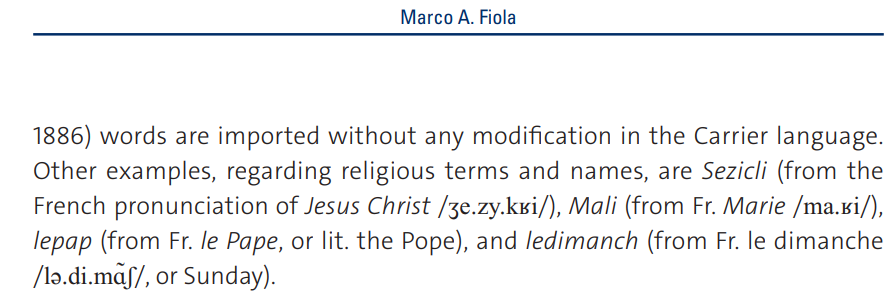
Read for yourself the relevant portion of Fiola’s book chapter; you can also click the link I’ve provided to the book, and read the entire piece.
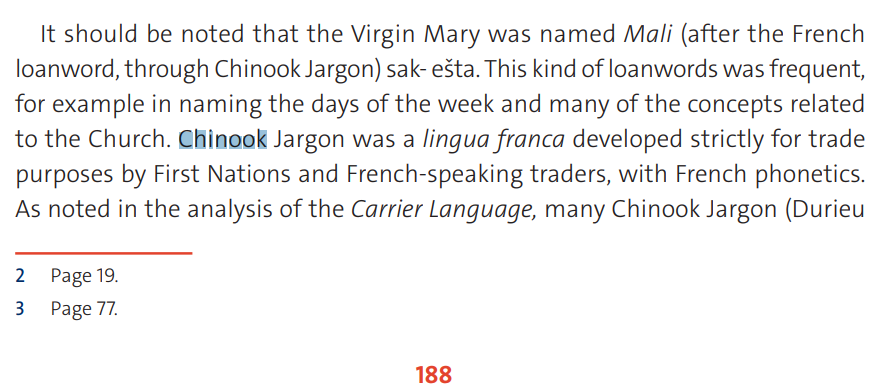
It should be noted that the Virgin Mary was named Mali (after the French
loanword, through Chinook Jargon) sak-ešta. This kind of loanwords was frequent,
for example in naming the days of the week and many of the concepts related
to the Church. Chinook Jargon was a lingua franca developed strictly for trade
purposes by First Nations and French-speaking traders, with French phonetics.
As noted in the analysis of the Carrier Language, many Chinook Jargon (Durieu
1886) words are imported without any modification in the Carrier language.
Other examples, regarding religious terms and names, are Sezicli (from the
French pronunciation of Jesus Christ /ʒe.zy.kʁi/), Mali (from Fr. Marie /ma.ʁi/),
lepap (from Fr. le Pape, or lit. the Pope), and ledimanch (from Fr. le dimanche
/lə.di.mãʃ/, or Sunday).
