1861?: Early BC Chinook Jargon
The book is “The History of the Northern Interior of British Columbia (formerly New Caledonia) [1660 to 1880]” by A[drien] G[abriel] Morice (London, UK: John Lane, 1909).Morice’s volume can’t be expected to tell us a lot about Chinook Jargon…
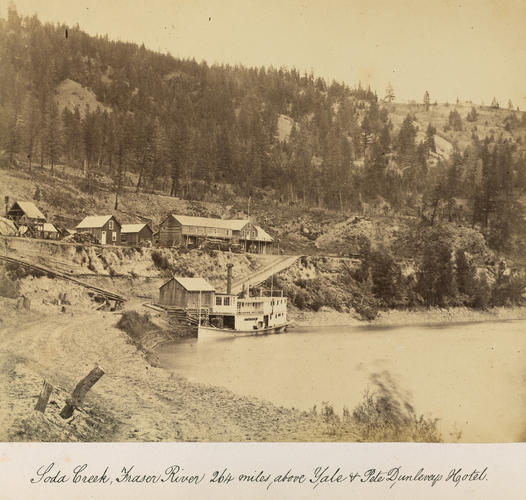
Peter Dunlevy’s hotel at Soda Creek, Fraser River circa 1870 (image credit: Royal Collections Trust)
…but here’s one nice bit on page 329.
It shows Chinook Jargon just as it was starting to be present in the interior of BC, and taking over from the formerly useful Canadian/Métis French.
This is in Dakelh (Carrier) country.
It comes from 1858 Horsefly gold rusher Peter Dunlevy, set in 1861 or so on the way to the Omineca gold rush:
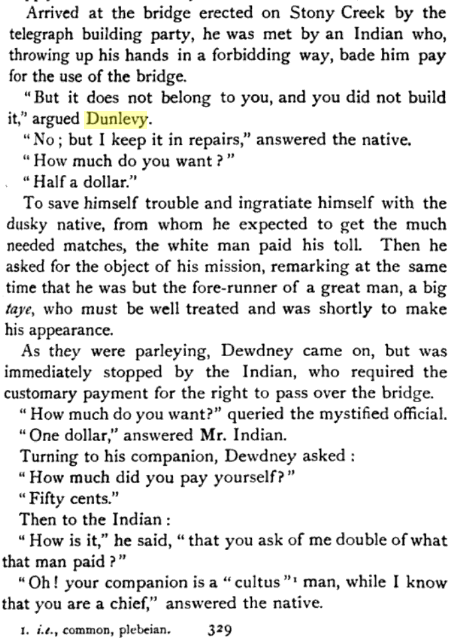
Arrived at the bridge erected on Stony Creek by the
telegraph building party, he was met by an Indian who,
throwing up his hands in a forbidding way, bade him pay
for the use of the bridge.“But it does not belong to you, and you did not build
it,” argued Dunlevy.“No; but I keep it in repairs,” answered the native.
“How much do you want?”
“Half a dollar.”
To save himself trouble and ingratiate himself with the
dusky native, from whom he expected to get the much
needed matches, the white man paid his toll. Then he
asked for the object of his mission, remarking at the same
time that he was but the fore-runner of a great man, a big
taye, who must be well treated and was shortly to make
his appearance.As they were parleying, Dewdney came on, but was
immediately stopped by the Indian, who required the
customary payment for the right to pass over the bridge.“How much do you want?” queried the mystified official.
“One dollar,” answered Mr. Indian.
Turning to his companion, Dewdney asked :
” How much did you pay yourself?”
“Fifty cents.”
Then to the Indian :
“How is it,” he said, ” that you ask of me double of what
that man paid ?”“Oh! your companion is a “cultus”[1] man, while I know
that you are a chief,” answered the native.[1.] i.e., common, plebeian.
- Taye = táyí = ‘chief; boss’
- Cultus man = kʰə́ltəs mán = ‘lower-class man’
