1869, OR: thank golly Jenny’s not dead!
Solidly within the frontier period, after Oregon became a state, we find this neat quotation of a Northwest Oregon Native man’s Chinuk Wawa.
Image credit: Amazon.com
You’re about to read some Chinook Jargon from the early reservation period, before the Grand Ronde folks had innovated what came to be some different ways of saying the following:
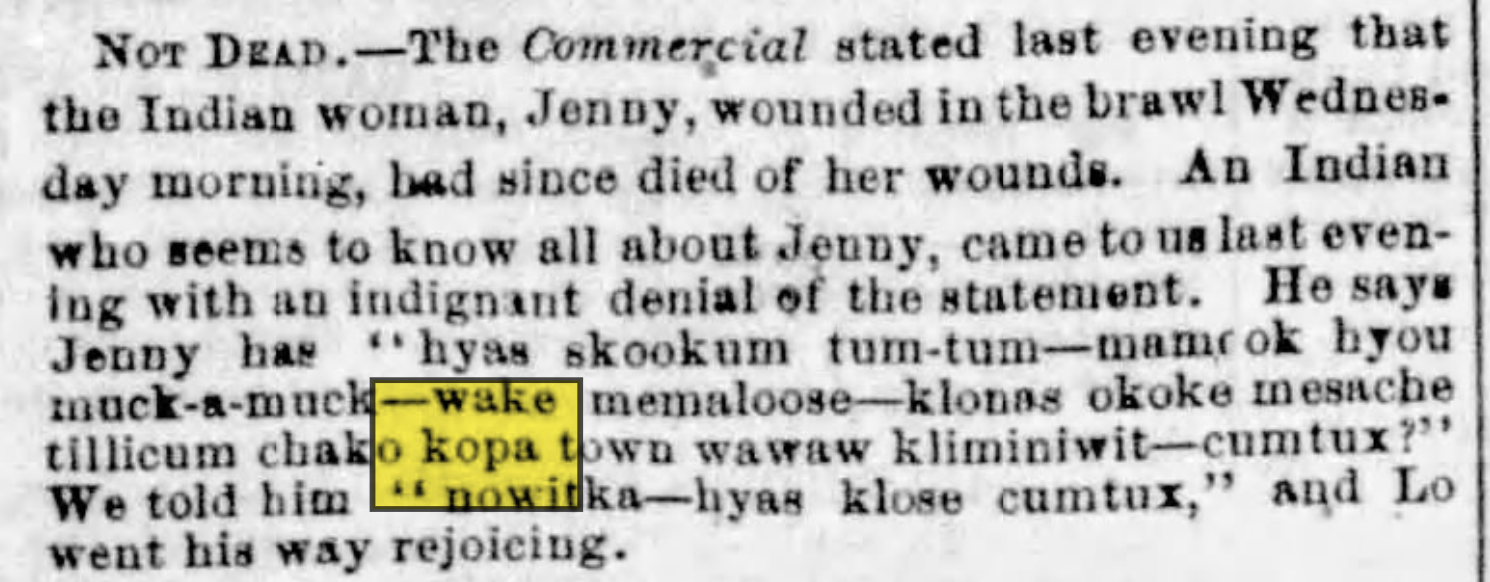
NOT DEAD. — The Commercial stated last evening that
the Indian woman, Jenny, wounded in the brawl Wednes-
day morning, had since died of her wounds. An Indian
who seems to know all about Jenny, came to us last even-
ing with an indignant denial of the statement. He says
Jenny has “hyas skookum tum-tum — mamook hyou
muck-a-muck — wake memaloose — klonas okoke mesache
tillicum chako kopa town wawaw kliminiwit — cumtux?”
We told him “nowitka — hyas klose cumtux,” and Lo
went his way rejoicing.
— frm the Portland (OR) Oregonian of Jul 31, 1869, page 3, column 1
Some interpretation, because it’s no longer 1869 and not everybody reading this knows good Jargon yet:
- hyas skookum tum-tum
= hayas-skúkum tə́mtəm
= ‘a very strong heart;’ - mamook hyou muck-a-muck
= mámuk háyú mə́kʰmək
= ‘is making (using/eating?) lots of food;’ - wake memaloose
= wík míməlus
= ‘isn’t dead.’ - klonas okoke mesache tillicum chako kopa town wawaw kliminiwit
= t’ɬúnas úkuk másháchi tílixam cháku kʰupa tʰáwn wáwa t’ɬəmínxwət
= ‘Maybe those bad folks came to town telling lies’ - cumtux?
= kə́mtəks?
= ‘Understand?’ - nowitka
= nawítka
= ‘Yes.’ - hyas klose cumtux
= hayas-ɬúsh kə́mtəks
= ‘Understand quite well.’
