1859, WA: “Irregular Lines to Julia Katompka” doggerel, with more Lushootseed words
This very early (by Pacific Northwest standards) tragic love poem may have been the one that originally started the answer poems that we’ve already looked at.
(I’m referring to “Lines to a Klootchman“, et al.)

Charles W. Prosch (1822-1913), founder & editor of the Puget Sound Herald (image credit: Wikipedia)
Thomas W. Prosch (18
Today’s poem shows us, again, some Dxʷləšucid (Lushootseed Salish) words known and used by Settlers in local Chinuk Wawa of Puget Sound.
Two words, to be precise.
One of them, stobsh, is the common Lushootseed word for a ‘man’ (stubš in Bates, Hess, and Hilbert’s 1994 dictionary of Lushootseed).
The other, mo-kwee-town, is mighty interesting — I instantly recognize it as ‘dead’ (originally ‘wrapped/covered’ in mats, in older times) from my acquaintance with the SW Washington (“Tsamosan”) Salish languages. But this word doesn’t show up in Bates, Hess, and Hilbert’s 1994, which only has ʔatəbəd! Nor do I find it in George Gibbs’s 1877 dictionary of Lushootseed. So we seem to have a new discovery here.
I think the location of the newspaper, in Steilacoom on south Puget Sound, is a clue for us, as that’s not terribly far from Upper Chehalis Salish lands, where this word mo-kwee-town was known. Maybe the author, “Dilate Boston” (Charles W. Prosch?), had earlier spent considerable time over there?
Now that you’re tired of reading about Salish 😁, let’s get to today’s poem, which has plenty of Chinook Jargon. I’ve translated all of that for you…
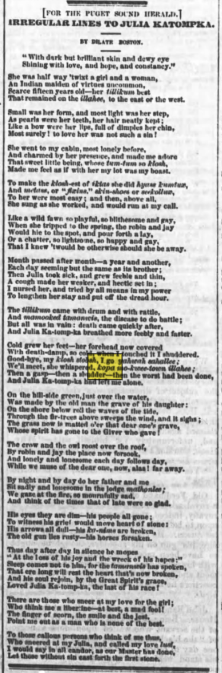
[FOR THE PUGET SOUND HERALD.]
IRREGULAR LINES TO JULIA KATOMPKA.BY DILATE BOSTON. [‘a real White person’]
“With dark but brilliant skin and dewy eye
Shining with love, and hope, and constancy.”She was half way ‘twixt a girl and a woman,
An Indian maiden of virtues uncommon,
Scarce fifteen years old — her tillikum best [‘people’]
That remained on the illahee, to the east or the west. [‘land’]Small was her form, and most light was her step,
As pearls were her teeth, her hair neatly kept:
Like a bow were her lips, full of dimples her chin,
Most surely ! to love her was not such a sin !She went by my cabin, most lonely before,
And charmed by gher presence, and made me adore
That sweet littte being, whose tum-tum so klosh, [‘heart’…’good’]
Made me feel as if with her my lot was my boast.To make the klosh-est of iktas she did hyass kumtux, [‘good’…’clothing’…’well know (how)’]
And metass, or “fixins,” skin-shoes or seekollux, [‘leggings’…’moccasins’…’pants’]
To her were most easy; and then, above all,
She sang as she worked, and would run at my call.Like a wild fawn so playful, so blithesome and gay,
When she tripped to the spring, the robin and jay
Would hie to the spot, and pour forth a lay.
Or a chatter, so lightsome, so happy and gay,
That I knew ‘twould be otherwise should she be away.Month passed after month — a year and another,
Each day seeming but the same as its brother ;
Then Julia took sick, and grew feeble and thin,
A cough made her weaker, and hectic set in;
I nursed her, and tried by all means in my power
To lengthen her stay and put off the dread hour.The tillikum came with drum and with rattle, [‘people/relatives’]
And mamooked tamanwis, the disease to do battle; [‘make’…’spirit power medicine’]
But all was in vain: death came quickly after,
And Julia Ka-tomp-ka breathed more feebly and faster.Cold grew her feet — her forehead now covered
With death-damp, so cold, when I touched it I shuddered.
Good-bye, my klosh stobsh, I go yahwah sahallee : [‘good’ ‘man‘…’there above’]
We’ll meet, she whispered, kopa mo-kwee-town illahee; [‘in’ ‘dead.person‘ ‘land’]
Then a gasp — then a shudder — then the worst had been done,
And Julia Ka-tomp-ka had left me alone.On the hill-side green, just over the water,
Was made by the old man the grave of his daughter:
On the shore below fell the waves of the tide,
Through the fir-trees above sweeps the wind, and it sighs;
The grass now is matted o’er that dear one’s grave,
Whose spirit has gone to the Giver who gave!The crow and the owl roost over the roof,
By robin and jay the place now forsook,
And lonely and lonesome each day follows day.
While we muse of the dear one, now, alas! far away.By night and by day do her father and me
Sit sadly and lonesome in the lodge mathonlee: [‘inshore’]
We gaze at the fires, so mournfully sad,
And think of the tumes that of late were so glad.His eyes they are dim — his people all gone:
To witness his grief would move heart of stone:
His arrows all dull — his ka-nims are broken, [‘canoe’]
The old gun lies rusty — his horses forsaken.Thus day after day in silence he mopes
“At the loss of his joy and the wreck of his hopes:”
Sleep comes not to him, for the tamanwis has spoken, [‘spirit power’]
That ere long will rest the heart that’s now broken,
And his soul rejoin, by the Great Spirit’s grace,
Loved Julia Ka-tomp-ka, the last of his race!There are those who sneer at my love for the girl;
Who think me a libertine — at best, a mad fool!
The finger of scorn, the smile and the jest,
Point me out as a man who is none of the best.To those callous persons who think of me thus,
Who sneered at my Julia, and called my love lust,
I would say in all candor, as our Master has done,
Let those without sin cast forth the first stone.
— from the Steilacoom (Washington Territory) Puget Sound Herald of Dec 23, 1859, page 2, column 5
