1904: El Comancho doggerel, plus Lushootseed plus sort of muskrats
This brings down my opinion of El Comancho…
That’s because he’s using “book Chinook” words here, which virtually no real speaker of Chinook Jargon would understand.
1.
I’m talking about his word swock-wan for ‘loon’. This word is probably real Jargon — but it’s highly localized: it matches Dxʷləšucid (Lushootseed Salish) swuqʷad ‘common loon’. We’ve previously demonstrated that earlyish Settlers in the Seattle and Puget Sound area often knew a number of Lushootseed words that they employed in their Chinook Jargon, but hardly anyone else knew those words, and they don’t show up in the dictionaries.
There’s also swáqʷən ‘loon’ in nearby Samish Salish, part of the Straits Salish language spoken just a bit north of Seattle. That’s a very good match for swock-wan, but I don’t know any reason to think El Comancho hung around Samish speakers.
(We can also compare nearby Skwxwú7mesh (Squamish Salish) swákwel ~ skwákwel ‘loon’, but that’s from the Canadian side of the border, so it’s much less likely El Comancho had much exposure to that language. And, his spelling swock-wan is a much better match for the Lushootseed swuqʷad, because historically Lushootseed’s /n/ became modern /d/. There’s no relevant sound correspondence in the Squamish word.)
2.
I’m also referring to Comancho’s enapoo for ‘muskrat’. Ouch. This word is the common term for a ‘louse’ or ‘lice’ in the Jargon! The 1909 edition of JK Gill’s Jargon dictionary does have (page 25) e-min′-te-pu for ‘muskrat’, but that is also a bookish word from a Chinookan language that none of us would understand from real-life usage. Especially when Comancho misspelled it!
Beyond that, here we have a typical specimen of Pacific Northwest folk poetry (I say doggerel) that relies on Chinuk Wawa for some local color…

THE SONG OF THE TIME OF SALMON
A-a-a-a-nah!
Young is the night. The moon is small;
Swock-wan, the Loon, from the sky doth call;
The Salmon swims below the fall —
O! A-a-a-a-nah!O! A-a-a-a-nah!
Cargo the canim [‘canoe’] with torch and spear;
Cole-snass [‘snow’] comes with the northern light;
The Salmon rests in the river clear —
O! A-a-a-a-nah!O! A-a-a-a-nah!
Cole-snass comes with the northern light;
Ena [‘beaver’], the Beaver, makes his lodge tight;
The Salmon leaps at the fall tonight —
O! A-a-a-a-nah!O! A-a-a-a-nah!
Fat and lazy is Chet-woot, the Bear;
Enapoo [‘louse’!], the Muskrat, smooth[e]s his hair;
The Salmon dries by the lodge fire there —
O! A-a-a-a-nah!EL COMANCHO.
— from Field and Stream (VIII:11, March 1904), page 935
Bonus facts:
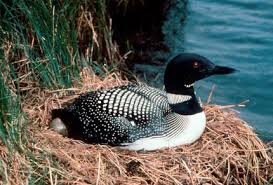
Image credit: WDFW
A really excellent speaker of Chinuk Wawa’s oldest variety, the Central Dialect that’s associated with the Columbia River, was Mr. Joe Peter.
In the 1940’s, Joe Peter routinely translated English ‘loon’ into his Jargon as tk’úp klákla, ‘the white bird’.
That’s valuable to know, since words for ‘loon’ are lacking in the Jargon dictionaries.
Less hard to find in the old dictionaries are genuine terms for ‘muskrat’. JB Good’s southern interior British Columbia dictionary (1880) gave us hyas soolee for ‘muskrat’, literally ‘a big mouse’. Granville Stuart’s 1865 Grand Ronde-style Jargon has cul′-tus e′-nah for this same animal, literally ‘a worthless beaver’.
