Ikta Dale McCreery yaka t’ɬap (Part 15: mills and donkeys)
What do donkeys and mills have in common?
(Here’s a link to all installments in this series.)
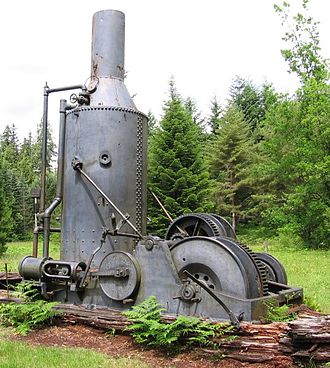
A steam donkey in BC (image credit: Wikipedia)
Back on December 21, 2016, our friend Dr Dale McCreery shared an observation from his work in the Bella Coola area of British Columbia’s coast. It’s a sentence in the Nuxalk (a.k.a. Bella Coola Salish) language…
Wicanap-a wa ksnmak alh ti mula t’ayc?
‘Is it you guys who work at this sawmill?’
Dale observes, “So mula also made it into Nuxalk.”
This word mula from Chinook Jargon also shows up in the form lemula, down at Grand Ronde, Oregon.
Both are from Canadian/Métis French le moulin for a ‘mill’ that grinds grain or processes lumber.
Interestingly enough, though, in non-coastal BC when you say mula in Jargon, it means ‘a donkey’! That word is one of the few from Spanish in the language.
There may have been some overlap between the meanings ‘donkey’ and ‘mill’, for good reasons.
It’s been noted that (le)mula often served as Chinuk Wawa’s generic word for any ‘machine’.
And, at least in Pacific Northwest English in later-frontier and post-frontier days, people routinely spoke of ‘steam donkeys‘, which were machines (engines) for dragging logs to be processed.
Steam donkeys were invented in 1881 in northern California, and came into widespread use very soon, during an era when Chinook Jargon was still very widely used.
We’ve found that PNW loggers mixed some Jargon into their occupational lingo.
So…maybe some Jargon talkers in BC used to mentally overlap mula and (le)mula?
