AF Chamberlain’s field notes of Chinuk Wawa from SE British Columbia (Part 14)
And still more new discoveries pop up in our next-to-last installment.
Plus, confirmation of stuff we’ve found elsewhere in the Northern Dialect of Chinook Jargon!
Chamberlain’s “c” is the “sh” sound, and his “tc” is the “ch” sound. His “ä” is the “a” in “cat”, a frequent sound in the Northern Dialect.
Any stuff in orange here seems like new discoveries to me — different from what we’ve found in other places’ use of Chinuk Wawa.
(A link to all installments in this mini-series)
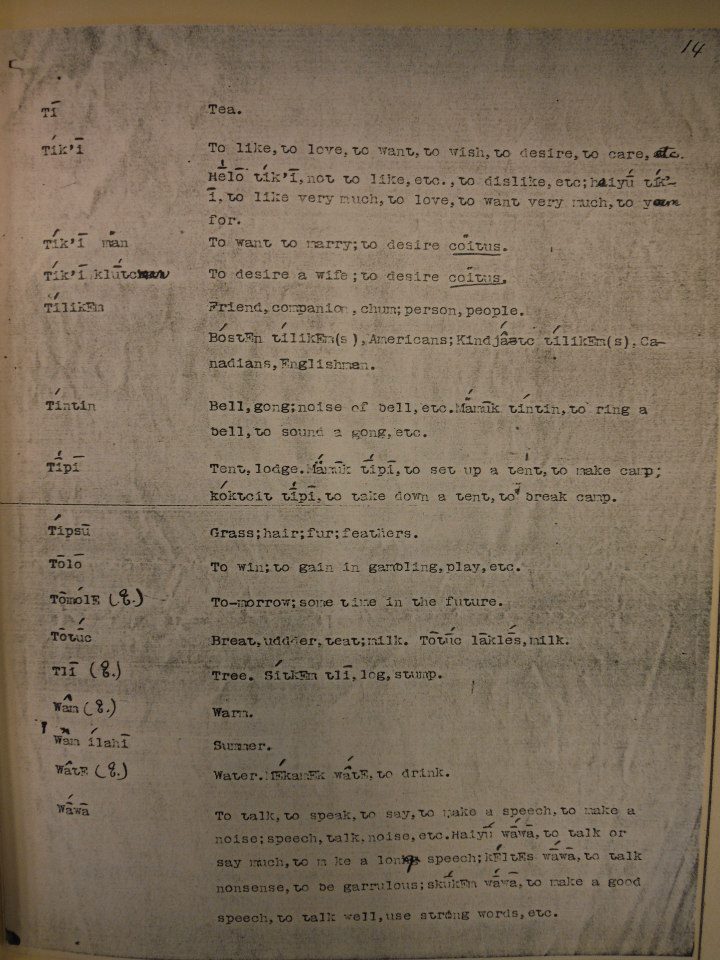
- tī ‘tea’
- tík’ī ‘to like, to love, to want, to wish, to desire, to care, etc.’
- hē′lō tík’ī ‘not to like, etc., to dislike, etc.’
[Literally ‘not want’.] - haiyū́ tík’ī ‘to like very much, to love, to want very much, to yearn for’
[Literally ‘much want’.] - tík’ī män ‘to want to marry; to desire coïtus‘
[Literally ‘want a man’.] - tík’ī klū́tc
man[i.e. tík’ī klū́tc] ‘to desire a wife; to desire coïtus’
[Literally ‘want a (Native) woman’, using the racialized shortened form “klooch” that was typical of Settler speech.]
- hē′lō tík’ī ‘not to like, etc., to dislike, etc.’
- tílikEm ‘friend, companion, chum; person, people’
- BóstEn tílikEm(s) ‘Americans’
[Literally ‘American people’.] - Kindjấtc tílikEm(s) ‘Canadians, Englishman’
[Literally ‘British people’.]
- BóstEn tílikEm(s) ‘Americans’
- tíntin ‘bell, gong; noise of bell, etc.;
- mä́mūk tíntin ‘to ring a bell, to sound a gong, etc.’
[Literally ‘to use a bell’.]
- mä́mūk tíntin ‘to ring a bell, to sound a gong, etc.’
- tī́pī ‘tent, lodge’
- mä́mūk tī́pī ‘to set up a tent, to make camp‘
[Literally ‘to make a tent’.] - kóktcit tī́pī ‘to take down a tent, to break camp‘
[Literally ‘to break a tent’.]
- mä́mūk tī́pī ‘to set up a tent, to make camp‘
- típsū ‘grass; hair; fur; feathers’
- tōlō [no stress marked] ‘to win; to gain in gambling, play, etc.’
- tōmólE (E[nglish]) ‘to-morrow; some time in the future’
- tōtū́c ‘brea[s]t, udder, teat; milk’
- tōtū́c lāklḗs ‘milk’
[Literally ‘breast grease’.]
- tōtū́c lāklḗs ‘milk’
- tlī (E.) ‘tree’
- sítkEm tlī ‘log, stump’
[Literally ‘half a tree’.]
- sítkEm tlī ‘log, stump’
- wâm (E.) ‘warm’
- wâm ílahī ‘summer’
[Literally ‘the land is warm’.]
- wâm ílahī ‘summer’
- wâtE (E.) ‘water’
- mÉkamEk wâtE ‘to drink’
[Literally ‘to ingest water’.]
- mÉkamEk wâtE ‘to drink’
- wā́wā ‘to talk, to speak, to say, to make a speech, to make a noise; speech, talk, noise, etc.’
- haiyū́ wā́wā ‘to talk or say much, to make a long speech’
[Literally ‘much talking / to talk a lot’.] - kÉltEs wā́wā ‘to talk nonsense, to be garrulous’
[Literally ‘worthless talking / talking for no purpose’.] - skū́kEm wā́wā ‘to make a good speech, to talk well, use strong words, etc.’
[Literally ‘strong words / to speak strongly’. This phrase is definitely found elsewhere in the Northern Dialect, for example in letters written by Indigenous people of British Columbia.]
- haiyū́ wā́wā ‘to talk or say much, to make a long speech’
