1905, BC (and WA): Early Days of Lower Okanagan
Here are some neat Chinuk Wawa-related recollections from the BC-Washington border area in the Okanagan a.k.a. Okanogan country.
This is the same region where we’ve found lots of frontier-era Chinook Jargon from U.E. Fries and other folks.

From the mountain named after JT Kruger (image credit: Steven’s Peak-Bagging Journey)
The old Hudsons Bay Company (“H.B.”) trading post in Osoyoos went on to be owned by Mr. Johann Theodore Kruger (1829-1899) (columns 1-2 on page 6):

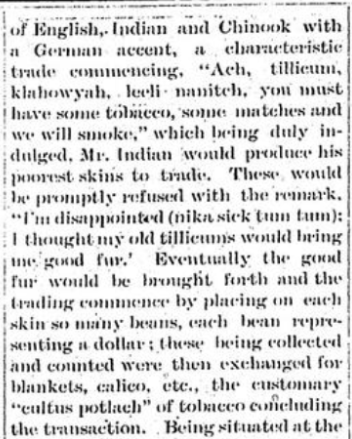
A
thorough German and a man of
splendid physique. Kruger had come
to British Columbia in the early days
of the Fraser river excitement [the 1858 gold rush], after-
wards entering the service of the
H. B. Co. He was an expert judge of
furs and a good Indian trader, and it
was nothing unusual to meet at his
store some of the noted chiefs from the
American side, Joseph, Saseptkin [Sarsarpkin],
Moses, Tonasket and others, besides
hunters and trappers with their furs
to trade for the “iktahs” so dear to the
Siwash. Very amusing it was to
watch a trade carried on in a mixture
of English, Indian and Chinook with
a German accent, a characteristic
trade commencing, “Ach, tillicum,
klahowyah, leeli nanitch, you must
have some tobacco, some matches and
we will smoke,” which being duly in-
dulged, Mr. Indian would produce his
poorest skins to trade. These, would
be promptly refused with the remark.
“I’m disappointed (nika sick tum tum):
I thought my old tillicums would bring
me good fur’ Eventually the good
fur would be brought forth and the
trading commence by placing on each
skin so many beans, each bean repre-
senting a dollar; these being collected
and counted were then exchanged for
blankets, calico, etc., the customary
“cultus potlach” of tobacco concluding
the transaction.
- Iktahs = íktas = ‘(valuable) items’
- Siwash = sáwásh = ‘Native person’
- Tillicum, klahowyah, leeli nanitch = tílixam, ɬax̣áwya(m), líli [hílu] nánich = ‘Friend, hello, long time [no] see’
- Cultus potlach = kʰə́ltəs-pá(t)lach = ‘free gift’
Same page, column 4, tells of Chinese immigrants when called to court, accurately if generically quoting Chinese Pidgin English in regard to the accepted form of oath-swearing for his nationality in the British Columbia justice system. We can’t be surprised at the mighty offensive ethnic slur used here:

Evidence sufficient to con-
vict was usually a matter of some
difficulty, owing to the unwillingness
of the Indian to testify for fear of
destroying his chances of getting the
forbidden fire water on some future
occasion and the invariable readiness
of the wise Chink to “smell um book,
burn um paper and kill um looster” in
support of his innocence.
Page 7, column 1, speaks of a visit locally by US General Sherman, a known speaker of Chinuk Wawa, but no overt connection is made between him and the language here.
The same column reminisces about visits by Hudsons Bay Co. factor Angus “Mac” (!) MacDonald and his “train of Indian attendants”.
Columns 1-2 recall an 1891 religious festival at Penticton (Head Lake) Indian Reserve, involving Catholic Bishop Paul Durieu and the missionary priests, surely including Father Le Jeune of Kamloops. I’ll have to check whether it got reported in his “Kamloops Wawa” Chinook newspaper at the time. The writer of the article (“H.N., Camp McKinney, March 1, 1905”) was a census taker at the time, and used the opportunity to go there and address the gathered chiefs — this had to be in Jargon — and getting a verbal dressing-down by them in response.
— all from the Hedley (BC) Gazette of March 23, 1905, page 6, columns 1-5 and page 7, columns 1-3
