Is CJ “wahpoos” actually ‘Snake TRIBE’?
The earliest, and effectively the only, occurrence of “wahpoos” as a word for a snake in Chinuk Wawa is found in George Coombs Shaw’s 1909 dictionary, published in Seattle.
It’s on page 60 of that book, and it’s only shown in passing, in the English-to CJ section, as an apparent synonym of “oluk” (the long-established word, from SW Washington Salish) and “snake” (the newer, more Northern Dialect CJ word).
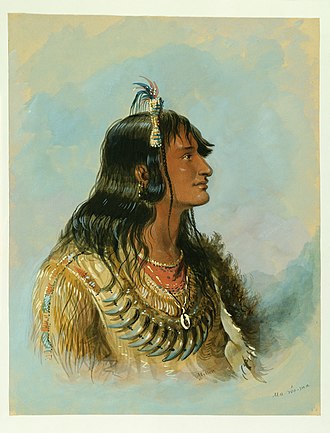
Ma-wo-ma, leader of 3,000 Snake people (image credit: Wikipedia)
A word that’s obviously identical to Coombs’s supposed Chinuk Wawa “wahpoos” is used in the Umatilla Sahaptin language for various Uto-Aztecan speaking tribes of the Pacific Northwest: ‘Bannock; Shoshone; Paiute’: wax̣púš[-]pal, literally ‘(rattle)snake-people’.
So, in the spirit of clarification, I want to suggest that Coombs didn’t discover yet another Jargon word for ‘snake’, the animal.
Instead, his valuable contribution with “wahpoos” was to show us a widely recognized term for the ethnic groups that everybody referred to historically as the ‘Snake’ Indians.
Various other ethnic groups around here referred to those Uto-Aztecan speakers as ‘Snakes’ using words native to their own languages. For example, we find ʔúl̓q̓ as the word for them in Upper Chehalis Salish, using the same word for ‘snake’ as we find in Chinook Jargon — the “oluk” that Coombs mentions.
asdf

Hi Dave,
Funny you should mention the word “wapoos”, which is how it been spelled here where I’m visiting in Ontario. There’s a village and an Island named this, and that would have had to have happened during the early fur trade days here. If my calculations are right, the trade language here would have included some Ojibwe, Cree, Wendat and Mohawk, as well as Quebec French and some anglais. If that’s the case, it’s a little easier to see how the word came west, either side of the 49th, long before its time.
J.
LikeLiked by 1 person
Hi Dave,
Re: my above comment, have a look here: https://en.wikipedia.org/wiki/Waupoos%2C_Ontario
J.
LikeLiked by 1 person
Thanks for your comments, Judy! The crucial factor here is the phonetic /x̣/ in the Umatilla (and other) Sahaptin word. I don’t think ‘rabbit’ is connected, although I agree that there was a significant number of people in the PNW fur trade who would’ve known that word from back East!
Dave Robertson
LikeLiked by 1 person
The mystery continues!
J.
LikeLiked by 1 person
Okay, this is even more interesting than it seems.
Peter Bakker proposed that the exonym “iroquois” is in a fact a pidgin Basque word used by Algonquian speakers. Its meaning? “Snake people”.
So, the question (DRUMROLL, PLEASE!): what connection, if any, existed between the use of “snake” as an exonym by Salish speakers designating Uto-Aztecan-speaking tribes, and the use of “snake” as an exonym by Algonquian speakers designating Iroquoian-speaking tribes?
LikeLiked by 1 person
I sense a research project being suggested to a grad student… 🙂
LikeLike