1898, WA: Shooting the Rapids of the Quinault
“Trade language”, as Chinuk Wawa has often been called, also means exchange of services, as well as goods…
…For decades in the Pacific Northwest, when you wanted to hail a ride or a guide, it meant approaching someone Native and negotiating a fare in CW.
An example comes in “Shooting the Rapids of the Quinault”, a travel article by F.J. Church in the outdoors magazine Recreation IX(3):186-190 (September 1898).

“Frank Hyasman, Quinault Indian” from page 186
Go read the entire piece at the link. It’s really fun.
The reason I’m featuring Church’s article is of course Chinook Wawa, a.k.a. Chinook Jargon, a.k.a. Chinook, which was alive and well in the Northern Dialect area around 1900. Lots of folks spoke the Jargon as well as their first language, such as Quinault Salish.
F.J. Church repeats lots of stereotypical labels for Chinook, such as “the court language” and “queer jargon”:
The Chinook, which these people speak.
is a queer jargon. It is said to have been
manufactured many years ago by an em-
ploye of the Hudson Bay Fur Company.
who taught the principal chieis of various
Indian tribes to speak it in order to facili-
tate traffic with them. From that time it
has grown and spread until almost every
Indian of the North Pacific Coast, and
many inland tribes of Washington, British
Columbia and Oregon speak it. White
men of all nations who live in this country
speak it, and even the almond-eyed China-
man learns it soon after locating here. In
short, it is the court language of the North-
west, as the sign language is of the plains.
It is made up from various Indian tongues.
with a few English, or rather pigeon-Eng-
lish, French, and Spanish words inter-
mixed. There are only about 1,500 words
in the language and it is very easy to learn.
That’s from page 186, where we also find the White visitors accurately labeled as “Boston men” (‘American people’).
Page 187 tells us about Frank Hyasman:
We intended to stay at the lake [Quinault] a few days
longer, so wandered on among the lean-
tos until we met an enormously fat and
jolly looking “Siwash” [Native] who told us his
name was Frank Hyasman. As Hyasman
means “big man,” he was appropriately
christened.
Also on page 187:

I then put in a cartridge
loaded with only 5 grains of powder,
telling him it was “hyos skookum” [‘very strong’] (tre-
mendously powerful). Frank, naturally
thinking if the bird cartridge kicked, the
larger one would nearly knock him over,
braced himself for the recoil. When the
light charge popped, he plunged forward.
on his hands and knees, to the delight of
all the other Siwashes, who rolled on the
sand and shrieked with laughter. Frank
laughed as much as any one, but told me
my words were “kultus wawa,” [‘worthless talk; BS’] meaning in
plain English, that the truth was not in
me.
Page 189:
The man in the bow was supposed to
pick the way, but George, having small
faith in the “kultus Boston man,” [‘no-good White people’] used his
own judgment. It is probably due to this
I am permitted to tell the story.
Same page, adding to our evidence that trout was a word of the Jargon:
When
we had camped for the night, George sug-
gested “iskum hiyu trout” [‘take lots of trout’]: so we got
out our rods. He sniffed at them, remark-
ing they were “hay-lo kloshe.” [‘not good; no good’]
Same page, still fishing, correctly using the “silent IT” pronoun of Jargon:

Reaching
the beach, he threw the rod over his shoul-
der and ran up the bank, shouting. “is-
kum! iskum!” (Catch him! catch him!)
[More like ‘Pick it up!’]
Page 190 illustrates that moment:
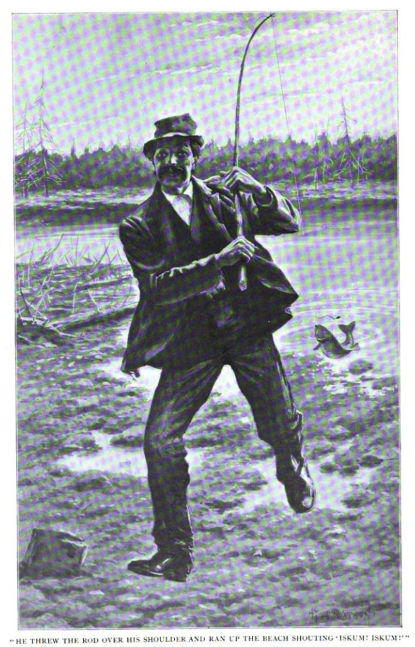
“HE THREW THE ROD OVER HIS SHOULDER AND RAN UP THE BEACH SHOUTING, ISKUM! ISKUM!'”
These are just scraps of Chinuk Wawa, but they’re accurately reported.
