More Chinook Jargon court oaths: “Shamrocks on the Tanana”
“Shamrocks on the Tanana: Richard Geoghegan’s Alaska” by David Richardson was published by Cheechako Books in Snoqualmie, WA in 2009.
I’m thankful to Leland Bryant Ross for directing my attention to this book!
(Here’s a link for plenty more about oaths in court in Chinuk Wawa.)
This book narrates the life of British-born 1903 Alaska immigrant Richard H. Geoghegan, who had quite an interest in languages himself, including Esperanto.

Image credit: Amazon
Pages 85-88 of this biography have a scene of a Copper River Athabaskan Native man called Billen (The Indian below), who seems to have had a formidable language toolkit, whereas the Whites in the courtroom had little more than English to work with.
What follows is recognizably similar to what we know of Chinuk Wawa use in this far northwestern end of its historical territory: Athabaskan influence on the syntax, a blending of Chinese Pidgin English with CW words, and a generally weak grasp of CW on everyone’s part.
There’s some humor in this anecdote of frustrated communication in Alaska circa 1903:
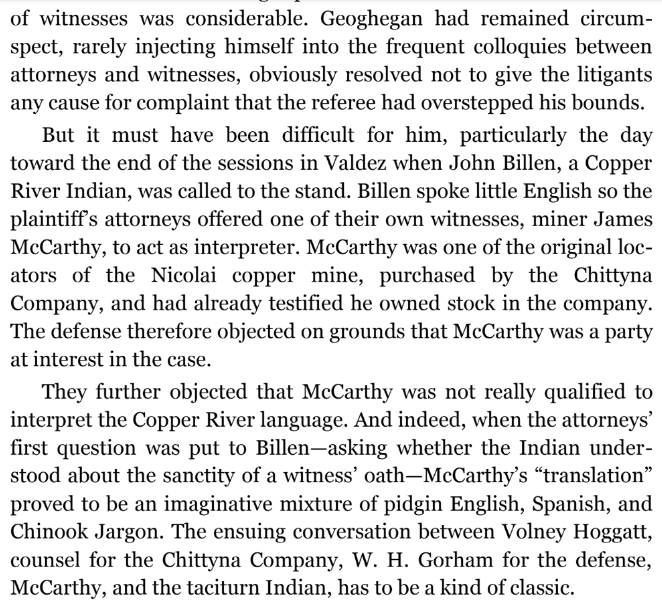


Geoghegan had remained circum-
spect, rarely injecting himself into the frequent colloquies between
attorneys and witnesses, obviously resolved not to give the litigants
any cause for complaint that the referee had overstepped his bounds.But it must have been difficult for him, particularly the day
toward the end of the sessions in Valdez when John Billen, a Copper
River Indian, was called to the stand. Billen spoke little English so the
plaintiff’s attorneys offered one of their own witnesses, miner James
McCarthy, to act as interpreter. McCarthy was one of the original loc-
ators of the Nicolai copper mine, purchased by the Chittyna
Company, and had already testified he owned stock in the company.
The defense therefore objected on grounds that McCarthy was a party
at interest in the case.They further objected that McCarthy was not really qualified to
interpret the Copper River language. And indeed, when the attorneys’
first question was put to Billen — asking whether the Indian under-
stood about the sanctity of a witness’ oath — McCarthy’s “translation”
proved to be an imaginative mixture of pidgin English, Spanish, and
Chinook Jargon. The ensuing conversation between Volney Hoggatt,
counsel for the Chittyna Company, W. H. Gorham for the defense,
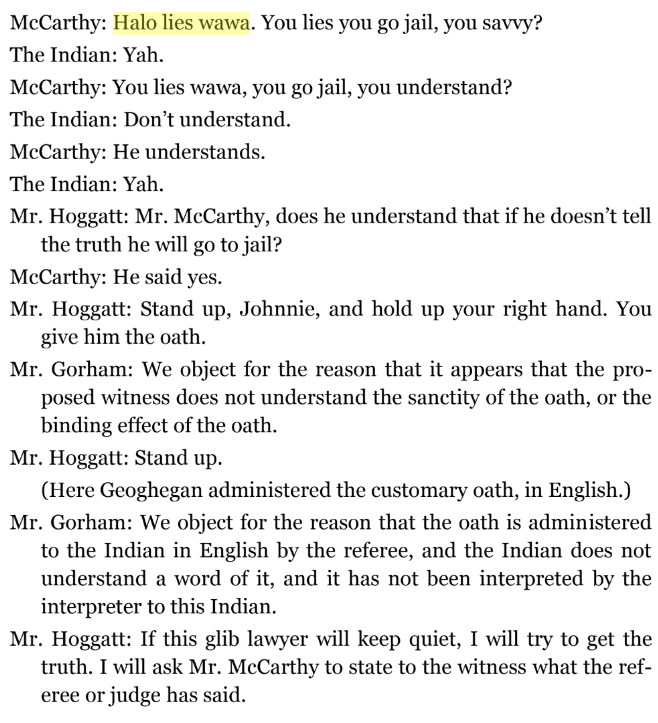
McCarthy, and the taciturn Indian, has to be a kind of classic.Mr. Hoggatt: Tell him when he stands up and holds up his right hand
when the white man tells him to tell the truth, if he doesn’t he will
go to jail for not telling the truth. State to him that.Mr. Gorham: Objected to as not a proper way to qualify the witness.
Mr. Hoggatt: Tell him that, Jim, the best way you can.
McCarthy: I could tell him more if I had him out with me in the
woods; if you fellows wasn’t around. The way I talk to them inside
when I want to find out anything about trails or game or horses or86
fish, I can find out anything I want to, right straight along; but
this is a different proposition …Mr. Hoggatt: Go on and tell him that.
McCarthy: Now, Johnny, you tell the truth, you understand; halo lies
wawa.*The Indian: Klooch.
McCarthy: Halo lies wawa. You lies you go jail, you savvy?
The Indian: Yah.
McCarthy: You lies wawa, you go jail, you understand?
The Indian: Don’t understand.
McCarthy: He understands.
The Indian: Yah.
Mr. Hoggatt: Mr. McCarthy, does he understand that if he doesn’t tell
the truth he will go to jail?McCarthy: He said yes.
Mr. Hoggatt: Stand up, Johnnie, and hold up your right hand. You
give him the oath.Mr. Gorham: We object for the reason that it appears that the pro-
posed witness does not understand the sanctity of the oath, or the
binding effect of the oath.Mr. Hoggatt: Stand up.
(Here Geoghegan administered the customary oath, in English.)
Mr. Gorham: We object for the reason that the oath is administered
to the Indian in English by the referee, and the Indian does not
understand a word of it, and it has not been interpreted by the
interpreter to this Indian.Mr. Hoggatt: If this glib lawyer will keep quiet, I will try to get the
truth. I will ask Mr. McCarthy to state to the witness what the ref-
eree or judge has said.
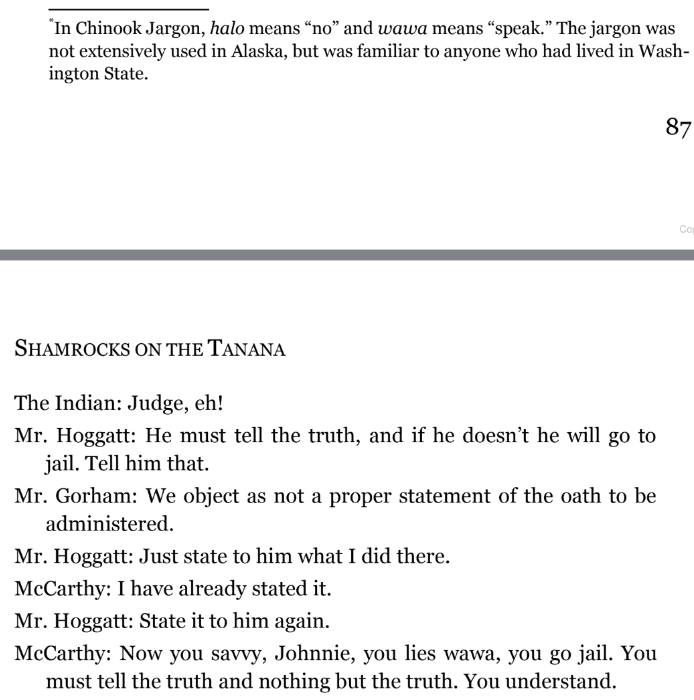
- “In Chinook Jargon, halo means “no” and wawa means “speak.” The jargon was
not extensively used in Alaska, but was familiar to anyone who had lived in Wash-
ington State.87
SHAMROCKS ON THE TANANA
The Indian: Judge, eh!
Mr. Hoggatt: He must tell the truth, and if he doesn’t he will go to
jail. Tell him that.Mr. Gorham: We object as not a proper statement of the oath to be
administered.Mr. Hoggatt: Just state to him what I did there.
McCarthy: I have already stated it.
Mr. Hoggatt: State it to him again.
McCarthy: Now you savvy, Johnnie, you lies wawa, you go jail. You
must tell the truth and nothing but the truth. You understand.Mr. Gorham: We object to the interpreter interpreting the oath in
English to this witness.Mr. Hoggatt: Don’t talk so much.
Mr. Gorham: I will talk as much as I want to.
Mr. Hoggatt: Let him get through the interpretation first.
Mr. Gorham: I am going to put my objection on the record. The inter-
preter is using the English language to the Indian in explaining
the oath.The Indian: Halo lies wawa.
McCarthy: Wait, you haven’t lies wawa yet! I will guarantee that he
will not tell anything but the truth.Mr. Gorham: Your guarantee is not worth anything, or mine.
Mr. Hoggatt: Mr. Billen, where do you live?
The Indian: Me lee Copper River.
Mr. Hoggatt: How long have you lived there; how many moons?
Mr. Hubbard (another counsel for the plaintiff): Snows-they don’t
go by moons.Mr. Hoggatt: How many snows are you old?
The Indian: Don’t know.
Mr. Hoggatt: How old are you?
The Indian: I don’t know.
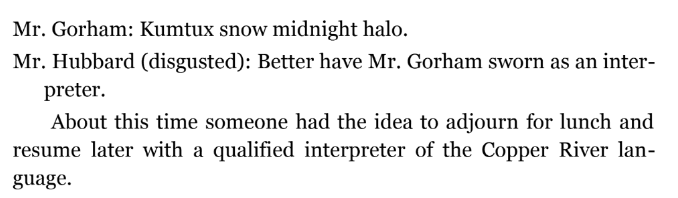
88
Mr. Gorham: Kumtux snow midnight halo.
Mr. Hubbard (disgusted): Better have Mr. Gorham sworn as an inter-
preter.About this time someone had the idea to adjourn for lunch and
resume later with a qualified interpreter of the Copper River lan-
guage.
