1885: The Indian Sign Language (William Philo Clark and Father Ravalli) — and “Chenook”
William Philo Clark (1845-1884) was a US Army officer who wrote a neat book, “The Indian Sign Language”, about that pidgin language of the Northern Plains…
And he was given some information by the Jesuit priest Antonio Ravalli, who was a missionary in Montana and had some experience of Chinook Jargon country.

WP Clark and Little Hawk in 1877 (image credit: Wikipedia)
On page 177 Father Ravalli speaks:
“…I came into the country via the
Cape [Horn] and [Fort] Vancouver. I was born in Italy in 1812.“The Chenook [Lower Chinookan] language is a very difficult one ; I think something
like the Nez Perce. It is a rich language, and has a profuse vocabu-
lary. The Chenook jargon is very easily acquired, and though it
contains only a very limited number of words, one has no trouble
in expressing by means of it any ordinary ideas. It is a mixture of
French, English, and Chenook.“The sign language was much used by the Flatheads [Montana Salish] and kindred
tribes when meeting others who did not use the same vocal lan-
guage, or when too tired or indolent to talk with the tongue. It is
a conventional language, the same among all tribes, with perhaps
some slight differences; in general it must be the same.
More from him on page 340:
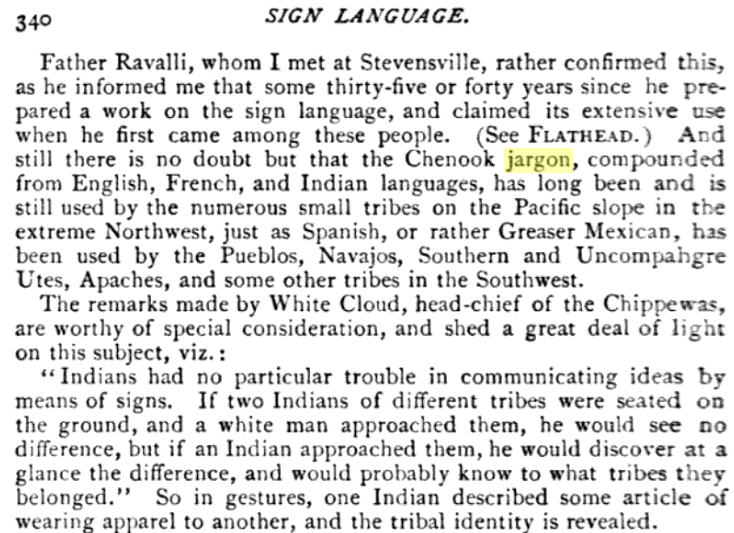
Father Ravalli, whom I met at Stevensville, rather confirmed this,
as he informed me that some thirty-five or forty years since he pre-
pared a work on the sign language, and claimed its extensive use
when he first came among these people. (See FLATHEAD.) And
still there is no doubt but that the Chenook jargon, compounded
from English, French, and Indian languages, has long been and is
still used by the numerous small tribes on the Pacific slope in the
extreme Northwest, just as Spanish, or rather Greaser Mexican, has
been used by the Pueblos, Navajos, Southern and Uncompahgre
Utes, Apaches, and some other tribes in the Southwest.The remarks made by White Cloud, head-chief of the Chippewas,
are worthy of special consideration, and shed a great deal of light
on this subject, viz.:“Indians had no particular trouble in communicating ideas by
means of signs. If two Indians of different tribes were seated on
the ground, and a white man approached them, he would see no
difference, but if an Indian approached them, he would discover at a
glance the difference, and would probably know to what tribes they
belonged.” So in gestures, one Indian described some article of
wearing apparel to another, and the tribal identity is revealed.
