1913: Jimhillkameen!
A Chinuk Wawa-only notice in a southern BC newspaper was well understood by the locals.

Image credit: British Columbia Regional Digitized History
This is quirky but okay Northern Jargon, Settler style, using the editor’s own spellings and a goofy civic booster nickname for the region (a seeming attempt to attract one of James J. Hill’s railways):
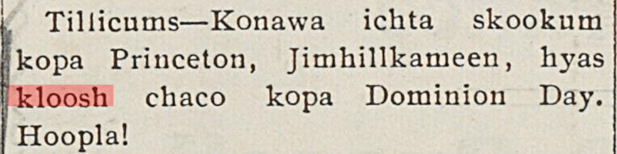
Tillicums — Konawa ichta skookum
kopa Princeton, Jimhillkameen, hyas
kloosh chaco kopa Dominion Day.
Hoopla!
— from the Princeton (BC) Similkameen Star of June 6, 1913, page 1, column 3
In modernized spellings:
tílixam-s, kʰánawi-íkta skúkum
kʰupa prínstən*, jimhílkamin*, hayas-
łúsh cháku kʰupa dəmínyən-déy*.
húpla*!
I’d suggest an English translation:
Friends, everything will be wonderful
at Princeton, “Jim Hill”-kameen; be
sure to come here on Dominion Day.
Hoopla!

Hello,
I read your publications with interest, first of all because I am interested in the history of the Pacific Northwest, I have also created a Facebook group on this subject which brings together nearly 3000 members. But also because I am of Normand origin and I am interested in the Normand language, a language which has largely influenced the English language, one third of the words in the English language are of Normand origin, but also the French of Quebec, and as a result we find several specifically Normands words in Chinook Wawa.
The Normand language was still spoken in Normandy until the mid-1900s, and the imposition of French as we speak it today only dates back to 1882. So before that date, French-speaking immigrants to Canada spoke their regional language. Currently, there are 30,000 Normand speakers in Normandy.
Have you ever made any connections between the Norman language and Chinook? That would be interesting.
Best regards
Rene Digard
LikeLike