1917, The Dalles, OR: Seufert Bros. Co. v. USA etc.
A US court case involving a Settler cannery at The Dalles, Oregon, trying to oust Yakama tribal people from their usual and accustomed fishing places in the post-frontier era, involved a considerable bit of Chinook Jargon.
 Image credit: Francis Seufert, Wheels of Fortune, Portland: Oregon Historical Society Press, p. 236.
This was Seufert Brothers vs. USA, heard at the United States Supreme Court in 1916-1917.
Let’s look at a number of interesting points that people make in their testimony for the case.
Witness George Tommy, a Warm Springs Native man about 55 years old, of “Skein and Wasco” heritage [i.e. Sahaptian & Chinookan], page 168, talking Jargon, and the judge understanding him from a lifelong personal acquaintance with this language:

Mr. Tommy’s words are Nicki kumtucks…Nicki kumtucks Seufert…Oh, nicki kumtucks long time (nayka kə́mtəks…nayka kə́mtəks Seufert…ó, nayka kə́mtəks long time, ‘I know (him)…I know Seufert…Oh, I’ve known (him) a long time’).
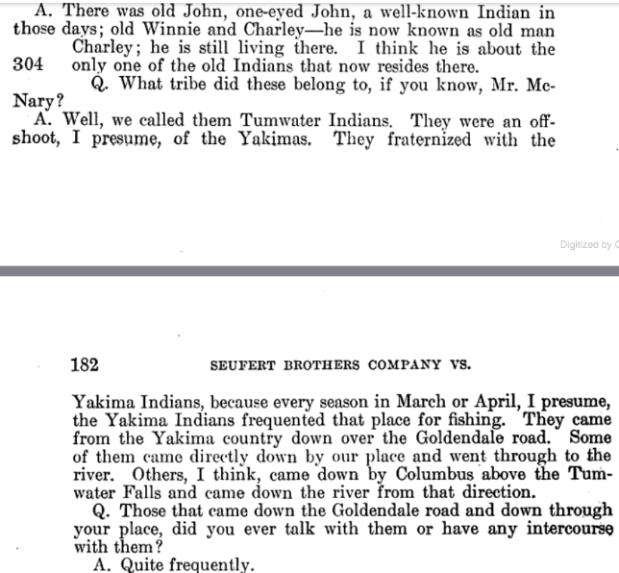
Witness LA McNary, testifying on pages 181-182, is one of several people who mention a place and a tribe called Tumwater (tə́mwáta, ‘waterfall’ in Jargon):
Page 217 mentions a Métis French word, cordelle, for the ropes used in, and apparently the act of, towing a boat by hand as you walk along the shore.
E.B. McFarland (1849-????), government witness, who lived at The Dalles from 1854 to 1891, except 3 years in the Klickitat Valley of Washington (1862-1865). Page 224 has him telling of his use of Chinuk Wawa with Native people:

Lancaster Spencer tells in his distinctive Native-style English on page 235 of “another one name they used to call him Boston.” That’s bástən, the Jargon word for ‘White person; American’.
On page 255 a Native man known as Doctor Shea-wa mentions a Yakima man called To-a-chlish: “His English name is Stick Joe…That was his English name, Stick Joe…” This is almost certainly, in fact, a Chinuk Wawa name, stík Joe (‘woods Joe; backcountry Joe’).
Since we often point out Indigenous metaphors on my website, I want to draw your attention to page 256, where Doctor Shea-wa emphasizes the friendliness of the traditional relations among tribes of the Celilo area by saying “The river, the Columbia River, was a table between them…Was a table, yes. Had nothing to fight for. Everything was free…The river, I might say, was a table for both, both sides of the river. It laid right in between them, and they came and ate and were gone.”
Procedural point: the judge keeps trying to order Native elders to talk English directly with him, rather than going through the sworn interpreter! 😥
JH Jackson (1832-????, Oregon immigrant of 1866, to The Dalles about 1868, there permanently from 1871, some time in the Yakima River valley), government witness, page 285, telling how all tribes and Settlers historically spoke Chinuk Wawa together in the area:
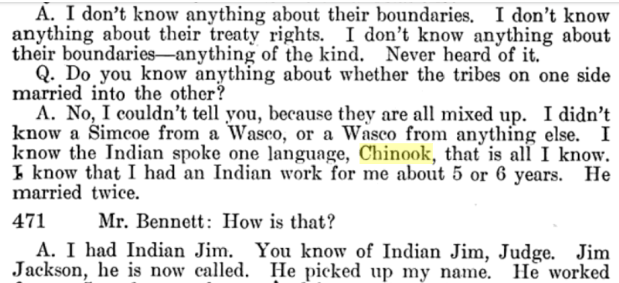
He goes on on page 286:

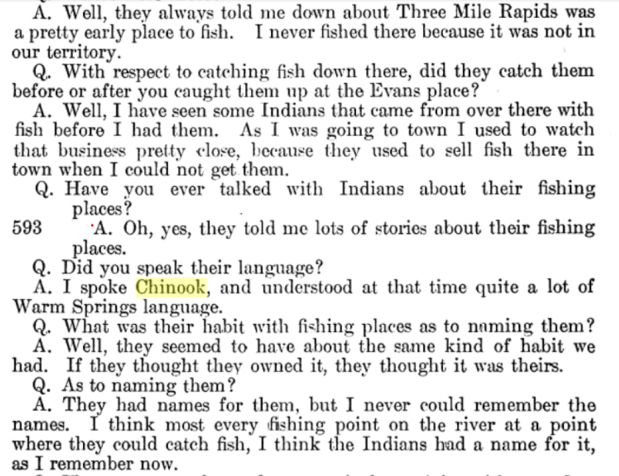
LA Whitcomb, government witness, born in Oregon 1860, to The Dalles 1879. On page 349 he observes that the map on display in the courtroom marks a certain place as “Grave Island. We always called it Memaloose Island.” Many people in the proceedings use this place name, míməlus-ílihi in Jargon, ‘dead people place’. On page 350, he comments that he can’t place the name “Tenino” on a map, because “a great many places might be called Tenino.” Is this evidence that this word was actually local Chinuk Wawa, a question I’ve previously written about? Page 358, he tells of speaking CW as well as some of the “Warm Springs language” which may mean Sahaptin, judging by other people’s comments in the proceedings:
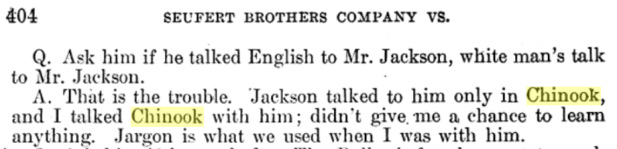
Jim Jackson, a Warm Springs & Wasco Native, a government witness. On page 400, through his interpreter, he says “that is the name I have now, that I have white blood in me.” On page 403, he expresses that he knows only “simple words of English”, and prefers to use an interpreter in court. Page 404 refers to his dealings in Chinook Jargon with JH Jackson (who is quoted above):
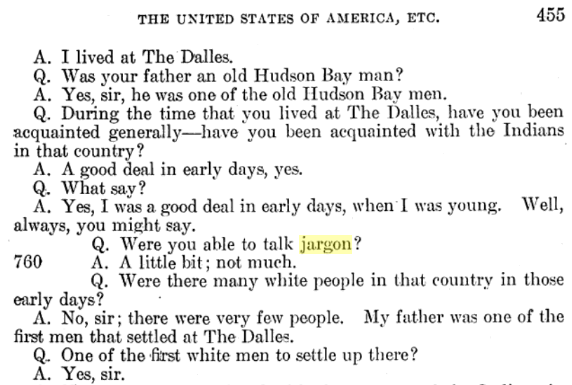
Page 455: John Crate, born 1850 and a resident of The Dalles since the age of three weeks, a witness for the defendants, speaks of knowing surprisingly little Chinuk Wawa, considering his age and his father having been a Hudson Bay Company employee:
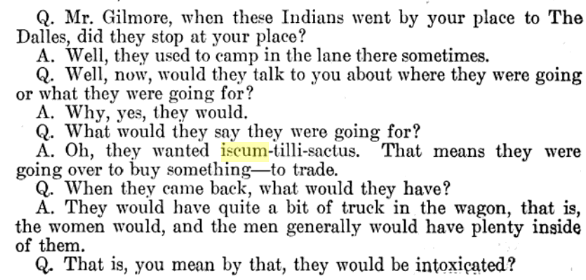
Page 539 — Robert J. Gilmore, witness for the defendants, testifies that he habitually spoke Chinook Jargon with Yakama tribal people:

Page 552, three words in Jargon, as (mis-)recorded by the court reporter from Robert J. Gilmore, defendant’s witness: “…iscum-tilli-sactus. That means they were going over to buy something — to trade.” (I.e. ískam tənəs(-)íktas), ‘to fetch/pick out/pick up a few/small things’.)
Mrs. Jennie Wellingham, witness for the defendant, lived at North Dalles 1877-1887, talks on page 574 about the same practice:
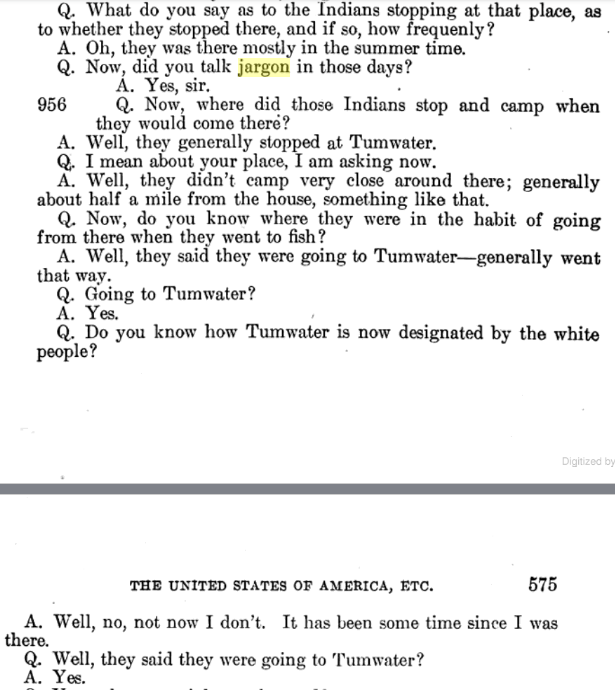
Leo F. Brune, defendant’s witness, 43 years old, born in the area, lived at a ranch near the road between Goldendale (WA) and The Dalles (OR) since 1877. Page 580 has him telling of speaking Jargon with Native people about every conceivable topic:

On the same page, Brune says “the only real fishing grounds, or exclusively where they fished, the Indians called it Tumwater, and some people call it Wish-ham. The Indians that lived there called it Nick-lub, and that is where the village is that is now called Speedus…” [Spedis]
So we can see that knowledge and use of Chinuk Wawa was widespread among various culture groups in The Dalles area from about the mid-1800s and well past 1900.
