1890, Salem, OR: The Chinook Club + earlier Grand Ronde pronunciation
The following long quotation in Jargon has all the earmarks of “Whites playing Indian”…
That’s to say:
- It invokes a fictional, and ridiculously named, Native chief whose persona the Settler speaker adopts.
- It has him bragging about how awesome he is.
- It also names fictional people and/or tribes.
As ridiculous and gross as all of that is, this is surprisingly good Chinuk Wawa.
- It’s written in idiosyncratic spellings, an indicator of someone working from their personal knowledge of this language.
- Some of those spellings (such as shix) strongly indicate an acquaintance with Grand Ronde and lower Columbia River area pronunciations, particularly (e.g. quopa) those of older generations.
- Even the apparently fictional name Chuchonnyhoo suggests an acquaintance with local K’alapuyan-language structures, and Oukskinny may be a nod to the real Dene (Athabaskan) tribe, Clatskanie.
Have a read, then I’ll show you my interpretation of today’s speech:
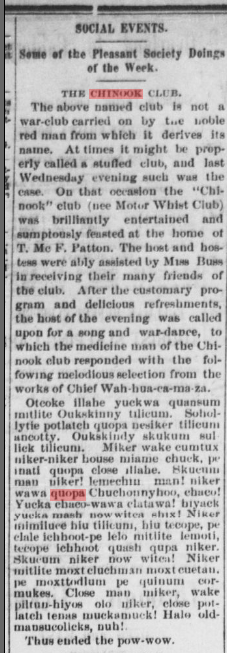
THE CHINOOK CLUB.
The above named club is not a
war-club carried on by the noble
red man from which it derives its
name. At times it might be prop-
erly called a stuffed club, and last
Wednesday evening such was the
case. On that occasion the “Chi-
nook” club (nee Motor Whist Club)
was brilliantly entertained and
sumpt[u]ously feasted at the home of
T. Mc F. Patton. The host and hos-
tess were ably assisted by Miss Buss
in receiving their many friends of
the club. After the customary pro-
gram and delicious refreshments,
the host of the evening was called
upon for a song and war-dance, to
which the medicine man of the Chi-
nook club responded with the fol-
fowing melodious selection from the
works of Chief Wah-hua-ca-ma-za.Otcoke illahe yuckwa quansum
mitlite Oukskinny tilicum. Sohol-
lytie potlatch quopa nesiker tilicum
ancotty. Oukskindy skukum sul-
lick tilicum. Miker wake cumtux
niker – niker house miame chuck, pe
inati quopa close illahe. Skucum
man niker! lemechin man! niker
wawa quopa Chuchonnyhoo, chaco!
Yucka chaco – wawa clatawa! hiyack
yucka mash nowwitca shix! Niker
mimiluce hiu tilicum, hiu tecope, pe
clale ichhoot – pe lelo mitlite lemoti,
tecope ichhoot quash qupa niker.
Skucum niker now witca! Niker
mitlite moxt cluchman moxt cuetan,
pe moxttodlum pe quinum cor-
mukes. Close man miker, wake
piltan – hiyos olo niker, close pot-
latch tenas muckamuck! Halo old-
mansucolicks, nuh!Thus ended the pow-wow.
— from the Salem (OR) Evening Capital Journal of April 12, 1890, page 4, column 2
My interpretation:
Otcoke illahe yuckwa quansum mitlite Oukskinny tilicum.
úkuk ílihi yákwá kwánsəm míłayt (Ø) awkskini* tílixam.
‘This land here has always belonged to the Oukskinny people.’
Sohollytie potlatch quopa nesiker tilicum ancotty.
sáx̣ali-táyí pá(t)łach (Ø) kʰwapa* nsayka tílixam ánqati.
‘The Creator gave it to our people long ago.’
Oukskindy skukum sullick tilicum.
awkskindi* skúkum sáliks tílixam.
‘The Oukskinny people are fierce-hearted.’
Miker wake cumtux niker –
mayka wík kə́mtəks nayka —
‘You don’t know me?–‘
niker house miame chuck, pe inati quopa close illahe.
nayka háws máyʔmi chə́qw, pi ínatay kʰwapa* łúsh-ílihi.
‘I live downriver, and across from a farm.’
Skucum man niker! lemechin man!
skúkum mán nayka, lamachín-mán!
‘I’m a powerful man, a medicine man!’
niker wawa quopa Chuchonnyhoo, chaco!
nayka wáwa kʰwapa* chachanifu*, “cháku!”,
‘(If) I say to Chuchonnyhoo, “come here!”,’
Yucka chaco –
yaka cháku —
‘(s)he comes here–‘
wawa clatawa!
wáwa “łátwa!”,
‘(If I) say, “go there!”,’
hiyack yucka mash
(h)áyáq yaka másh.
‘(s)he leaves right away.’
nowwitca shix!
nawítka, shíks!
‘It’s true, friend!’
Niker mimiluce hiu tilicum, hiu tecope, pe clale ichhoot —
nayka míməlus háyú tílixam, háyú tk’úp pi łíʔil ítsx̣ut —
‘I’ve killed lots of people, lots of white and black bears–‘
pe lelo mitlite lemoti,
pi líli míłayt (Ø) lamətáy,
‘and lived a long time in the mountains,’
tecope ichhoot quash qupa niker.
tk’úp ítsx̣ut k’wásh kʰwapa* nayka.
‘the white bear is afraid of me.’
Skucum niker now witca!
skúkum nayka, nawítka!
‘I’m powerful, indeed!’
Niker mitlite moxt cluchman moxt cuetan, pe moxttodlum pe quinum cormukes.
nayka míłayt mákwst łúchmən, mákwst kʰíyutən, pi mákwst-táłləm-pi-qwínəm kʰámuks.
‘I have two wives, two horses, and 25 dogs.’
Close man miker, wake piltan –
łúsh mán nayka, wík pʰíltən —
‘I’m a good man, not crazy — ‘
hiyos olo niker,
hayas-úlu nayka,
‘I’m mighty hungry,’
close potlatch tenas muckamuck!
łúsh pá(t)łach tənəs-mə́kʰmək!
‘you should give (me) some food!’
Halo oldmansucolicks, nuh!
hílu úlman sik’áluks, ná*!
‘Not old pants, eh!’
Did you notice that the editor didn’t go to the trouble of providing a translation into English? In 1890, we know from lots of other evidence that Chinook Jargon was still widely known and used around Grand Ronde reservation. Your average local Settler would understand the above speech in its entirety, as well as getting the jokes (well, stereotypes) that it puts across.
