Weather phenomena & Salish influence in {at least Northern} Chinook Jargon
We made an excellent lesson out of this once, in our BC Chinuk Wawa group (ask me about joining in)…
I’m going to condense our discussion of “Eclipses etc.” here.
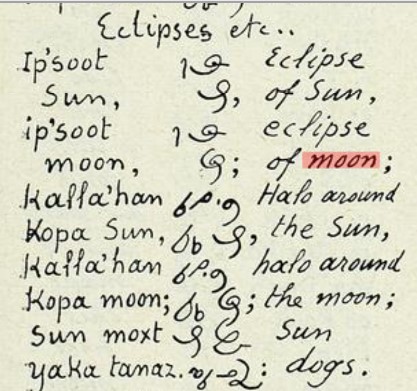
- < Ip’soot Sun > [which in Chinuk Pipa shorthand alphabet is:] ipsut son [is translated as:] ‘Eclipse of Sun’
- < ip’soot moon > ipsut mun ‘eclipse of moon’
- < kalla’han kopa Sun > kalahan kopa son ‘Halo around the Sun’
- < kalla’han kopa moon > kalahan kopa mun ‘halo around the moon’
- < Sun moxt yaka tanaz > son mokst iaka tanas ‘Sun dogs’
These are from the marvelous book “Chinook Rudiments” by JMR Le Jeune, 1924:23. Free to read at that link!
Quick explanations follow!
ípsət sán = ‘the sun is hidden’ … not ‘a hidden sun’! Likewise, ípsət mún = ‘the moon is hidden’, not ‘a hidden moon’. So, these 2 phrases are actually little sentence-comments, not adjective+noun phrases as you might’ve wrongly guessed from Le Jeune’s English translations.
(We don’t find ipsət used as a modifying adjective in Jargon. Even the phrase ipsət-wawa, translated as ‘secret language or code’ in the 2012 Grand Ronde Tribes dictionary, appears to me to be an adverb plus a verb.)
q’əláx̣an kʰupa sán & q’əláx̣an kʰupa mún = ‘fence around the sun, fence around the moon’. I love this metaphor!
(q’əláx̣an is the typical northern-dialect form corresponding to southern q’əláx̣.)
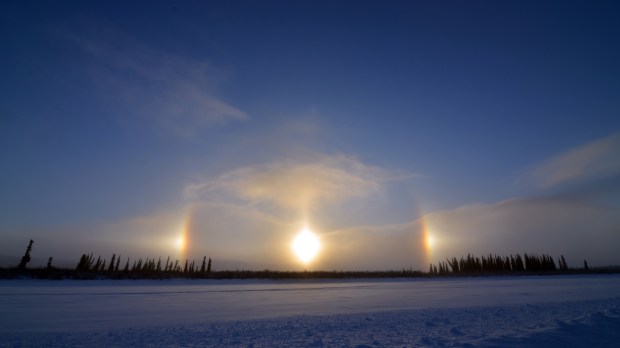
The sun’s 2 kids / sundogs / parhelion (image credit: Space.com)
sán mákwst yaka tənás = ‘the sun, both of its children’, i.e. ‘the sun’s 2 kids’. I believe that this — and the other phrases I’m showing you today — were in real use in BC Chinuk Wawa, and I believe they probably draw from Indigenous cultural and linguistic metaphors.
(Another perfectly valid word-order for this same expression would be san yaka makwst tənas.)
The drawback when it comes to proving a local Native source for these phrases is, I haven’t found much terminology for ‘eclipses’ and such in the available dictionaries of those Salish languages…You might have to live among folks a long time before you learned their words for these relatively rare celestial events. Most linguists and anthropologists haven’t done so.
Nonetheless, in the St’át’imcets a.k.a. Lillooet Salish dictionary by Jan van Eijk, I do find ‘sundog; ring around the sun’, and they’re expressed by a single term, n-ʔús-il’t-əm. This appears to be ‘Locative-two-child-Middle.Verb.Voice’. (Cf. the Proto-Salish root *was (& similar shapes) meaning ‘both of a pair; mutual; two’, Kuipers 2002:115.) The literal meaning of the word looks approximately like ‘it has two kids by/near it(self)’.
