So many Métis words in interior PNW languages (Part 10: Nxaʔamxcín a.k.a. Moses-Columbia Salish)
The only dictionary I’ve found of the north-central Washington state language, Nxaʔamxcín a.k.a. Moses-Columbia Salish, is a small one from the Colville Confederated Tribes.
It was compiled by the late, well-remembered M. Dale Kinkade, and put out in 1981.
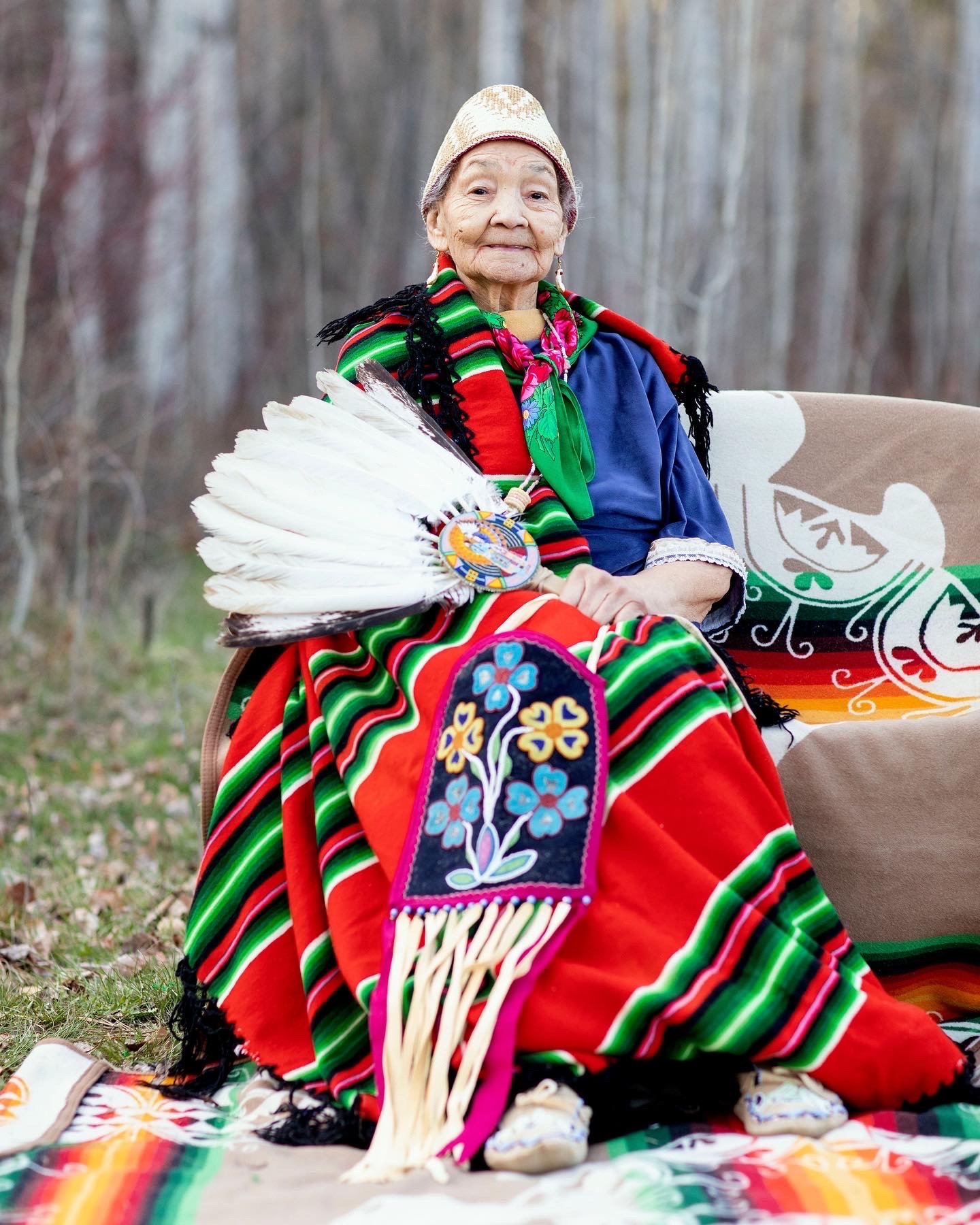
Pauline Stensgar, the most recent fully fluent speaker of Nxaʔamxcín (image credit: Spokesman-Review)
In it, I can easily find words borrowed from English (such as cíkən ‘chicken’), Chinuk Wawa (such as c̓íkc̓ik ‘wagon’), and even apparently Coast Salish (I have thoughts about sʔawtə̣ḷqṣwíl ‘stern of canoe or boat’).
My goal today is to skim through the Nxaʔamxcín dictionary for any words tracing back to Métis/Canadian French, likely from the fur-trade era of roughly the first half of the 1800s.
(Here’s a link to all previous installments in this mini-series.)
It does’t surprise me that I mostly find words beginning with an “L”. In this southerly region of the interior Pacific Northwest, that’s a common state of things. It’s almost as if an initial /l/ sound were taken as a “foreign noun marker” by the tribal-language speakers.
I always think whether a particular word more more likely came (earlier) straight from Métis/Canadian French, or else (later) via Chinook Jargon.
It will be helpful to the careful reader to know that:
- Plain Nxaʔamxcín /s/ can sound like “SH”, whereas /ṣ/ is more like English or Chinuk Wawa “S”.
- And plain /a/ can sound like Grand Ronde Chinook Jargon’s “A”, while under-dotted /ạ́/ is in the back of the mouth, something like English “aw”.
- Similarly, plain /u/ is like Jargon “U”, while under-dotted /ụ/ is more like “O”.
So here are the words I’m turning up in this short survey of Nxaʔamxcín.
- laklí ‘key’
- lapták ‘domestic potato’
- laputáy ‘bottle’
- ləkapú ‘coat’
- lipạ́ ‘raised bread’
- lipwá ‘peas’
- liṣák ‘cloth sack’
- ḷám ‘whiskey’
- ḷə̣kʷụṣụ́ ‘pig’
- ḷə̣mụtụ́ ‘sheep’
- susukrí ‘Jesus’
As I have stated in previous installments of this mini-series, these are words that certainly came in with Nxaʔamxcín speakers’ first sustained contact with folks from outside this region, which as far as anyone can prove means the fur-trade era when an enormous majority of the workers were speakers of Métis/Canadian French.
The listed terms are words for:
- new “trade” items that you could buy at an NWC and/or Hudson Bay Company post;
- new species of animals that you’d see there;
- and a new religion.
The phonetic details in the Nxaʔamxcín words look as if they preserve elements of pronunciation that are specifically characteristic of Métis/Canadian French.
- For example, lapták for ‘domestic potato’ is a distinctly north-of-Louisiana North American French word. Albert Valdman’s “Dictionary of Louisiana French” has only patate, as does McDermott’s “Glossary of Mississippi Valley French“.
- And the beginning sequence of an unstressed /li/ in 3 of the words corresponds with Métis/Canadian French [lι] for masculine singular le ‘the’, distinct from Louisiana [lə].
- And the plain /a/ in the word for ‘peas’, being a more “front” vowel than the underdotted letter, evokes the Métis/Canadian French [lιpwε], which contrasts with Louisiana [pwa].
Well now,
