Nebraska, 1876: A “Chinook song” is foreign
Whenever you research something, collect the negative evidence too!
Thus says the “Chinook Man” who teaches his students about “silent IT” and such…😊
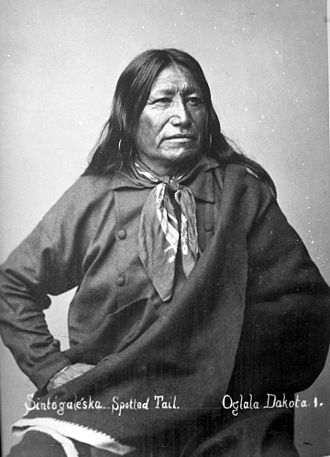
Image credit: Wikipedia
The following personal anecdote tells of being among the people of Sinte Gleška (“Chief Spotted Tail”, 1823-1881), an important leader of the Sicángu Oyáte (literally ‘burnt-thighs nation’, a.k.a. “Brûlé”) Lakhota people. It’s datelined northwestern “Nebraska”, as it’s before the time when the Rosebud Indian Reservation of South Dakota was established for this tribe, just across the border.
It’s likely that “Chinook song” in the following clipping is Settler slang for any generically Native song. The writer tells earlier in the article of having picked up some of the local language at the Fort Peck reservation in Montana, where in fact Nakota, Lakota, and Dakota people lived, so his song was probably in one of those languages. But for our purposes, it’s still interesting to see how people spoke of “Chinook” in the late frontier era…

Thursday and Friday evenings of each week there is a singing school in the church, conducted by the chaplain and teachers. Every one that likes can attend. On Thursday they sing in English, and the class is generally composed of half-breed women, soldiers from Camp Sheridan, and quartermaster’s employees. On Friday they warble in Indian. I went once, and although not musically inclined, I tried a little Chinook song of my own own; but was promptly informed by one of the elderly maidens that nothing but sacred music was allowed. Vainly I attempted to persuade her that it was a translation of Old Hundred I was trying to get through me. She admitted that it might be so, but thought that it sounded too much like the air in which the Indians were accustomed to sing their heathen songs. I left in disgust, but was consoled by the reflection that I had frequently heard better, and infinitely more sacred, music from a band of cayotes [SIC] on the Marias river in Montana. — Neither could I see anything wrong with the song, which I had learned at a Fort Peck grass dance. There are also dances at this Agency…
— from “Spotted Tail Agency: Camp Sheridan, Neb[raska].” in the Benton (MT) Record of February 19, 1876, page 2, column 5
