1890, Fort Spokane: “Erin go bragh”
To say that today’s newspaper clipping fails to meet any standards of objectivity is like calling Saint Patrick “Irish”. It’s true, but there’s plenty more to be said.

Fort Spokane (image credit: National Park Service)
So brace yourself for some white-privileged, elder-disrespecting, racializing, sexualizing, anti-government, anti-military (!) ranting in the following piece from the closing year of the frontier era.
On the positive side, I’ve finally found a Chinuk Wawa quotation for St. Paddy’s Day!
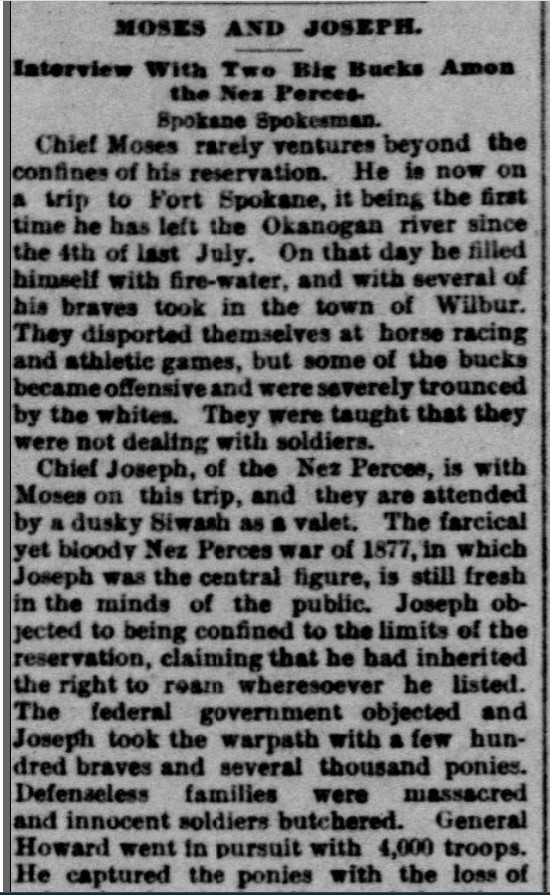


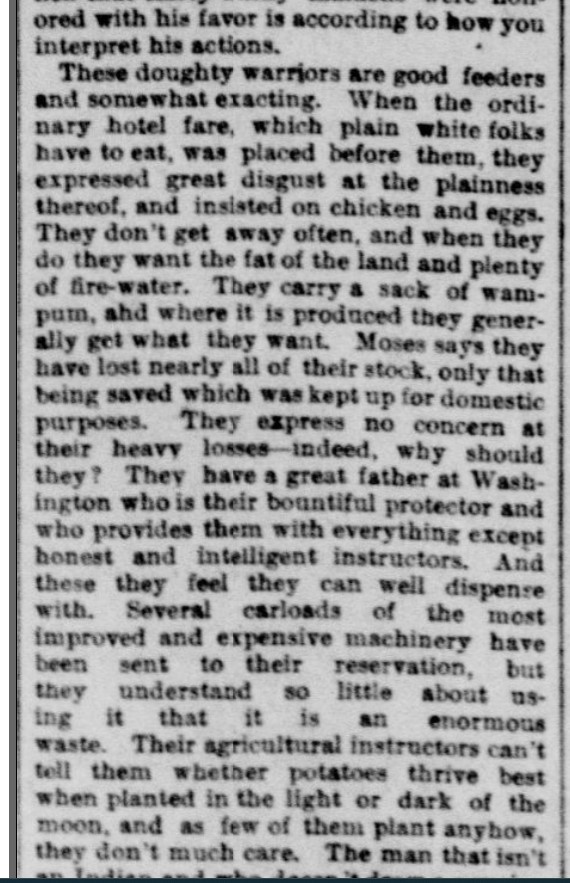

MOSES AND JOSEPH
Interview With Two Big Bucks Amon[g]
the Nez Perces.Spokane Spokesman.
Chief Moses rarely ventures beyond the
confines of his reservation. He is now on
a trip to Fort Spokane, it being the first
time he has left the Okanogan river since
the 4th of last July. On that day he filled
himself with fire-water, and with several of
his braves took in the town of Wilbur.
They disported themselves at horse racing
and athletic games, but some of the bucks
became offensive and were severely trounced
by the whites. They were taught that they
were not dealing with soldiers.Chief Joseph, of the Nez Perces, is with
Moses on this trip, and they are attended
by a dusky Siwash as a valet. The farcical
yet bloody Nez Perces war of 1877, in which
Joseph was the central figure, is still fresh
in the minds of the public. Joseph ob-
jected to being confined to the limits of the
reservation, claiming that he had inherited
the right to roam wheresoever he listed.
The federal government objected and
Joseph took the warpath with a few hun-
dred braves and several thousand ponies.
Defenseless families were massacred
and innocent soldiers butchered. General
Howard went in pursuit with 4,000 troops.
He captured the ponies with the loss of
only a few hundred soldiers, and shot them
them that they might not be retaken by
the Indians. General Miles advanced from
the east with 2,000 men and Joseph found
himself between two fires. Having no
ponies and being averse to pedestrianism
he decided to accept the generosity of
Uncle Sam and spend the remainder of his
days in peace and plenty.Together with his combative braves and
their families Joseph was banished to the
Indian Territory. That climate was more
potent than the sword, and the Nez
Perces were decimated at a rapid rate.
Fearing to entirely lose the noble sons of
the forest, the government brought them
back to Washington and placed Joseph in
the keeping of Moses, without whom he is
not permitted to leave the reservation.I had an hour of delightful social con-
verse with these two murderous villains
last night, and also slept beneath the same
roof that sheltered them. It is a serious
coincidence that near relatives of their
slaughtered victims acted as their hosts.
Moses is a ponderous buck of some twenty-
stone weight. His countenance is not un-
like that of Ben Butler‘s. Massive head,
deep-set eyes that twinkle with cunning
and deceit, full, round face, mouth full of
craft and cruelty. He wore a pair of loud-
striped trousers, over which dangled the
flaps of a flaming red shirt. To this was
added an army overcoat trimmed with
brass buttons when in street costume.Joseph closely resembled him in personal
appearance, save that be looked younger,
his face rounder and features more regular.
To look at him one would judge him to be
full of kindliness and good humor. Yet he
is one of the most famous old butchers now
living and he seems to enjoy and grow fat
on his hideous notoriety. His attire is
more modest than Moses’ and in keeping
with his fallen greatness. They are both
exceedingly amiable and exerted them-
selves to be agreeable and social. I brushed
up my chinook and we held a spirited con-
versation together. Repartee was rapid
and the choicest bon-mots were exchanged.Said Joseph to me: “Hi-lo cultus, tenas
culchum.”I caught on at once and promply replied,
“Erin go bragh, je ne weiss mas sie vies-
tcha,”Joseph appreciated my little jest and
laughed hugely at the ignorance of the by-
standers.I asked Moses how many squaws he had,
but he straightened up pompously and re-
plied, “Alle same heap big priest.”A moment later the gay old Lothario
nudged me confidentially, held up three
finge[r]s, told them one after the other, and
said “ten” after each. Whether that signi-
fied that thirty dusky maidens were hon-
ored with his favor is according to how you
interpret his actions.These doughty warriors are good feeders
and somewhat exacting. When the ordi-
nary hotel fare, which plain white folks
have to eat, was placed before them, they
expressed great disgust at the plainness
thereof, and insisted on chicken and eggs.
They don’t get away often, and when they
do they want the fat of the land and plenty
of fire-water, They carry a sack of wam-
pum, and where it is produced they gener-
ally get what they want. Moses says they
have lost nearly all of their stock, only that
bring saved which was kept up for domestic
purposes. They express no concern at
their heavy losses — indeed, why should
they? They have a great father at Wash-
ington who is their bountiful protector and
who provides them with everything except
honest and intelligent instructors. And
these they feel they can well dispense
with. Several carloads of the most
improved and expensive machinery have
been sent to their reservation, but
they understand so little about us-
ing it that it is an enormous
waste. Their agricultural instructors can’t
tell them whether potatoes thrive best
when planted in the light or dark of the
moon, and as few of them plant anyhow,
they don’t much care. The man that isn’t
an Indian and who doesn’t draw a pension
has a hard row to hoe in this world. The
only consoling feature is that they are as
scarce as fiddlers in the glory land.
— from the Seattle (WA) Post-Intelligencer of April 2, 1890, page 12, column
What’s factual in today’s clipping is that both Moses & Joseph are known to have been fluent speakers of Chinuk Wawa. But I don’t quite know what to make of the Jargon quotation written as “Hi-lo cultus, tenas culchum.”
